
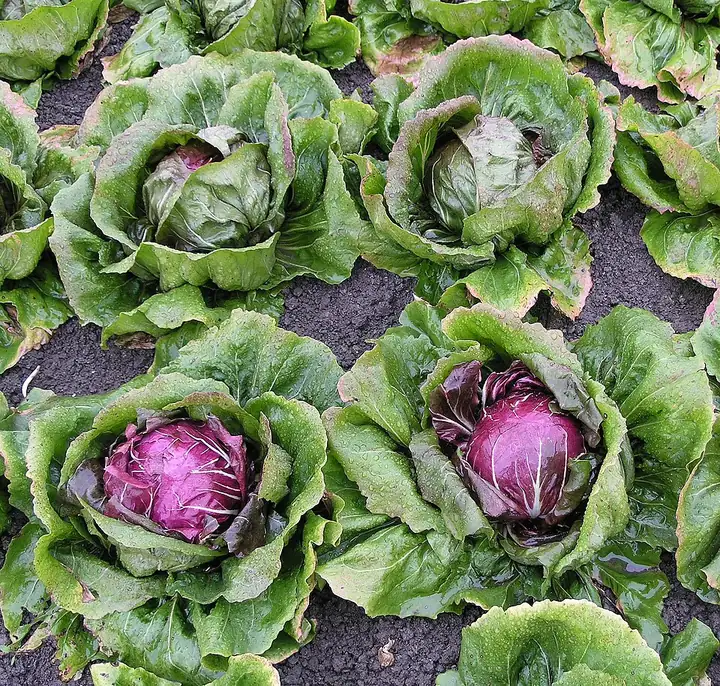
Radicchio
Cichorium intybus (leaf chicory) · Aster family (Asteraceae)
| Hardiness zones | 3 to 8 |
|---|---|
| Sun | full sun |
| Water | moderate |
| Life cycle | biennial |
| Frost | Hardy: takes frost |
| Soil pH | 6.5–8.0 |
| Spacing | 8 to 12 inches |
| Days to harvest | 60 to 90 days |
About Radicchio
Radicchio is a red-leaved heading chicory from Italy, with round Chioggia types and long Treviso types. Its spicy, mildly bitter leaves color up best in cool weather, so it is mainly a spring and fall crop. It is the same species as roadside chicory, which is a listed weed in some states: Colorado (List C noxious weed), New Mexico (Class B noxious weed) and the Kentucky Exotic Pest Plant Council's advisory list.
Chicory is hardy in zones 3-8; radicchio is grown for its heads as a cool-season crop and is usually pulled before it flowers. Young plants handle about 20F.
When to plant
Timing is counted from your average last spring frost (and first fall frost). Sow & Tell works out the actual dates for your ZIP code.
- Start seeds indoors: 5 to 6 weeks before the last frost
- Set out plants: around the last frost
- Sow seeds outdoors: 3 to 4 weeks before the last frost
- Fall planting: 7 to 9 weeks before the first fall frost
Days count from planting. Sow 3 to 4 weeks before the last frost or set out 5- to 6-week-old transplants near the frost date. For fall, plant 75 to 85 days before you want heads, timed to mature 3 to 4 weeks after the first frost (about 7 to 9 weeks before the first frost, worked out from Utah State's guidance).
Soil
Loose, fertile loam rich in organic matter that drains well but holds water; keep it evenly moist.
Follow a soil test and work fertilizer into the top 6 inches; add no more than 1 inch of well-made compost per 100 square feet.
Feeding
- 4 weeks after transplanting or thinning: nitrogen fertilizer such as 21-0-0. Scatter 1/4 cup per 10 feet of row beside the plants and water it in; add no more nitrogen once heads start to form.
Drought stress slows growth and makes the leaves bitter; keep soil evenly moist.
Harvest
Cut the head just below the leaves once it is full size and firm. Waiting too long makes it tough and very bitter. Some types only head up after cold weather; peel off frost-damaged outer leaves.
Cut each head once when it is full size and firm; waiting makes it tough and bitter. Some growers cut plants back in late summer and get small new heads 4 to 6 weeks later.
Varieties (20)
| Variety | Type | Days | Notes |
|---|---|---|---|
| Grumolo | Green chicory | Cold-hardy green type for late fall or overwintering. | |
| Zuckerhut | Green heading (sugarloaf) | Dense, romaine-like green heads. | |
| Early Treviso | Long red heading (Treviso type) | An earlier Treviso type on Wisconsin's list. | |
| Rossa di Treviso | Long red heading (Treviso type) | 92 days | Upright, elongated red heads; an Italian heirloom best grown as a fall crop. |
| Cleopatra | Red heading | Did well in Oregon trials, with good color. | |
| Firebird | Red heading | Red heading type listed in Oregon, Utah and Wisconsin. | |
| Milan | Red heading | Early and vigorous. | |
| Perseo | Red heading | 55 days | A cool-season specialty green on Central Texas lists. |
| Red Surprise | Red heading | Listed for Wisconsin gardens. | |
| Rubello | Red heading | Hybrid that did well in Oregon trials for late harvest. | |
| Virtus | Red heading | Listed for Wisconsin home gardens. | |
| Adria | Round red heading | Makes large heads. | |
| Augusto | Round red heading | Red heading type for late-summer harvest. | |
| Giulio | Round red heading | Does not bolt easily and colors red even in hot weather, so it suits a summer harvest. | |
| Palla Rossa | Round red heading | Red heading type grown in Oregon and Wisconsin. | |
| Ronette | Round red heading | Makes large heads. | |
| Chioggia | Round red heading (Chioggia type) | The classic round, red radicchio; also the name of the whole round-headed type. | |
| Indigo | Round red heading (Chioggia type) | 65 days | Firm, medium-large burgundy heads; tolerant of tipburn and bottom rot; grows in hot or cool weather. |
| Rossa di Verona | Round red heading (Verona type) | Red heading radicchio; Oregon's list calls it Verona Red. | |
| Castelfranco | Variegated heading | One of the Italian regional types grown as a fall and winter radicchio west of the Cascades. |
Pests to watch for
Aphids, Cabbage looper, Slugs, Brown garden snail, Cutworms, Voles, Pocket gophers
Diseases and problems
Root and crown rot, Virus diseases
In the kitchen
Raw in salads and slaws, or grilled, roasted or sauteed, which softens the bitterness.
Keeping it: Keep heads unwashed in a sealed plastic bag in the coldest part of the refrigerator. They hold up to about 2 weeks but taste best within a few days; keep them away from apples and pears, which make them bitter.
Safety: People allergic to plants in the aster (ragweed) family should be cautious with chicory products (European Medicines Agency).
Pets: Not listed by the ASPCA
Sources
- horticulture.oregonstate.edu
- extension.usu.edu
- hort.extension.wisc.edu
- plants.ces.ncsu.edu
- mastergardener.extension.wisc.edu
- extension.oregonstate.edu
- uaex.uada.edu
- ag.colorado.gov
- nmdeptag.nmsu.edu
- gardenclubky.org
- ema.europa.eu
- aspca.org
- aspca.org
- extensionpubs.unl.edu
Photo: Photo: Goldlocki / Wikimedia Commons, CC BY-SA 3.0 (CC BY-SA 3.0). Photo resized for the web.

Planting dates and advice are general guidance; check with your local Cooperative Extension office for your area.