
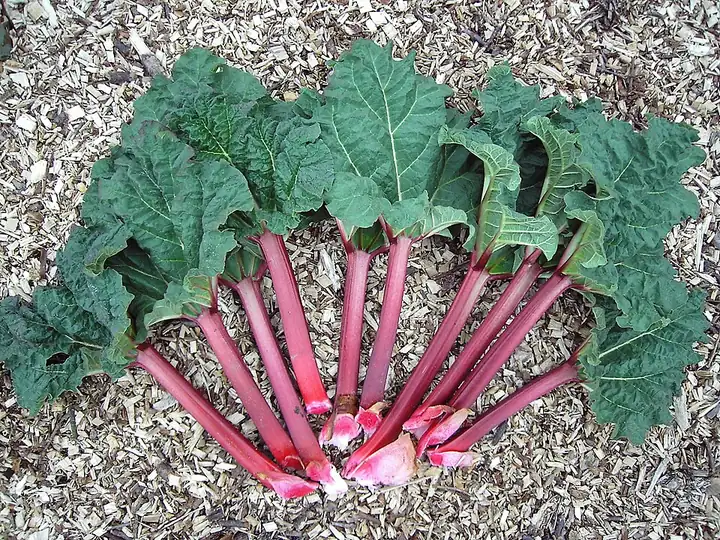
Rhubarb
Rheum rhabarbarum · Buckwheat family (Polygonaceae)
| Hardiness zones | 3 to 8 |
|---|---|
| Sun | full sun |
| Water | moderate |
| Life cycle | perennial |
| Frost | Hardy: takes frost |
| Soil pH | 5.5–6.5 |
| Spacing | 36 to 48 inches |
About Rhubarb
Rhubarb is a long-lived perennial grown for its tart red or green leaf stalks, a spring favorite for pies and sauces. Once planted it can keep producing for many years with little care.
Hardy in zone 4 and worth trying in zone 3 (UMN). It grows most easily in the Midwest and Northeast and needs winter cold to rest, so it is a reliable perennial only to about zone 8; in hot, dry climates like Arizona it may need shade cloth in summer, and in the Deep South it is grown as a cool-season annual.
When to plant
Timing is counted from your average last spring frost (and first fall frost). Sow & Tell works out the actual dates for your ZIP code.
Plant or divide dormant crowns in early spring, with the crown level with the soil. Harvest is counted in years: none the first year, 1 to 2 weeks the second, and a full 8 to 10 weeks from the third year on.
Soil
Well-drained loam; good drainage is essential, and raised beds help keep crowns from rotting.
Work plenty of compost or well-rotted manure into the bed before planting; soil pH matters little for rhubarb.
Feeding
- each early spring, before growth starts: complete garden fertilizer or rich compost. Spread it around the plants and water it in; use a low- or no-phosphorus product if your soil tests high in phosphorus.
- in spring when new stalks are about 2 to 10 inches tall: nitrogen fertilizer such as 21-0-0. Use about 3/4 lb per 100 ft of row beside the plants and water it in.
- late June, after harvest ends: high-nitrogen fertilizer such as 21-0-0. Side-dress beside the plants and water it in.
- late fall or early winter: compost or well-rotted manure. Spread a layer around the crowns.
Do not harvest the first year; years of 10-10-10 or heavy manure can build up too much phosphorus in the soil.
Harvest
Pull and twist stalks off at the base (don't cut them) and trim away the leaf blades, taking no more than about a third of the stalks at once. Cut off any flower stalks as soon as they appear.
Start picking in the second season (third from seed) and pick stalks until the end of June each year, then let the plant keep its leaves to store energy for next year. Plants can live 15 years or more.
Varieties (11)
Extension sources document about a dozen rhubarb varieties. Stalk color can vary from year to year, and flavor is fairly similar across varieties; red stalks are not necessarily less tart (Maine, Penn State).
| Variety | Type | Days | Notes |
|---|---|---|---|
| Riverside Giant | Green stalks | A green-stalked rhubarb grown in Oregon. | |
| Victoria | Green stalks with pink speckles | Good flavor; Utah State notes a sweet taste. Light green stalks with pink to red speckles, mostly near the base. Penn State calls it a robust, very reliable performer. It tends to send up seed stalks often. | |
| Strawberry | Light red stalks | Light red stalks, moderate vigor, and few flower stalks. | |
| Canada Red | Red stalks | Tender and very sweet. Red stalks that are shorter and more slender than most, with few seed stalks. Utah State calls it high-yielding and says it keeps its color when cooked or processed. Also sold as Chipman's Canada Red. | |
| Cherry Red | Red stalks | Sweet. Long, thick stalks that are red inside and out. Vigorous, juicy and tender. Also sold as Cherry or Early Cherry. | |
| Cherry Wine | Red stalks | Bright red stalks, moderate vigor, and few flower stalks. | |
| Crimson Red | Red stalks | Balanced sweet-tart and not stringy. Tall, plump, bright red stalks on a vigorous plant. Utah State notes it tends to flower. Also sold as Crimson, Crimson Cherry or Crimson Wine. | |
| Early Sunshine | Red stalks | Intensely red stalks on a moderately productive plant. Utah State notes it is good for pie filling. | |
| MacDonald | Red stalks | A common, productive rhubarb with tender-skinned, bright pink to red stalks. Oregon State notes it tends to send up seed stalks more often. Also spelled McDonald. | |
| Valentine | Red stalks | Much less acidic than many others; Utah State praises its classic rhubarb flavor. Broad, deep red stalks that stay rosy when cooked. It makes few seed stalks, and usually not until the plant is older. | |
| German Wine | Listed among culinary rhubarbs by Maine Extension. |
Pests to watch for
European corn borer
Diseases and problems
Root and crown rot, Bolting (going to seed), Black walnut toxicity, Frost and freeze injury
In the kitchen
The tart stalks are cooked with sugar into pies, crisps, sauces and jams.
Keeping it: Trim off the leaves right away and refrigerate the stalks wrapped; use them within about a week, or freeze. Choose firm stalks, not limp or curled ones.
Safety: Only the leaf stalks are eaten. The leaf blades (and roots) are poisonous because of their high oxalic acid content; eating them can cause mouth burning, nausea, vomiting and weakness, and large amounts can be fatal. Stalks from plants hit by a hard freeze have poor texture and flavor and may pick up oxalic acid from the leaves (UMN, NC State, Illinois).
Pets: Toxic to dogs, cats and horses (ASPCA): soluble calcium oxalates can cause kidney failure, tremors and drooling.
Sources
- extension.umn.edu
- extension.illinois.edu
- plants.ces.ncsu.edu
- cales.arizona.edu
- extension.umd.edu
- aspca.org
- riley.k-state.edu
Photo: Photo: Dieter Weber (Uellue), CC BY-SA 3.0, via Wikimedia Commons (CC BY-SA 3.0). Photo resized for the web.

Planting dates and advice are general guidance; check with your local Cooperative Extension office for your area.