
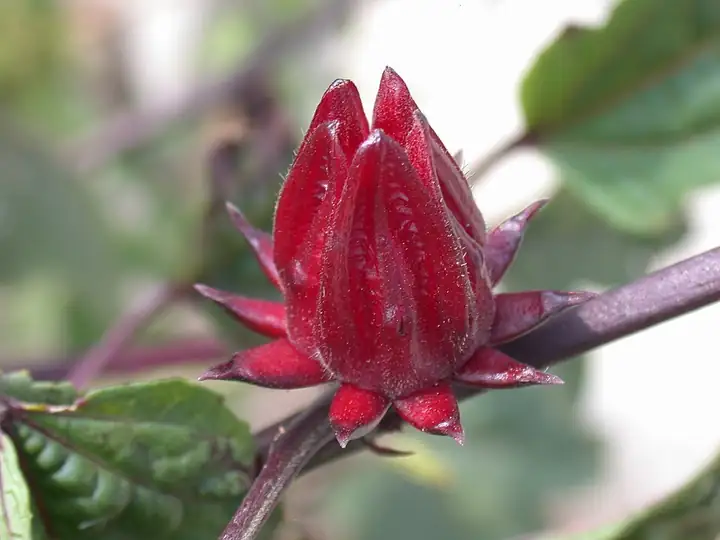
Roselle (Florida cranberry)
Hibiscus sabdariffa · Mallow family (Malvaceae)
| Hardiness zones | 8 to 11 |
|---|---|
| Sun | full sun |
| Water | moderate |
| Life cycle | annual |
| Frost | Tender: killed by frost |
| Soil pH | 5.5–6.8 |
| Spacing | 18 to 36 inches |
| Days to harvest | 120 to 150 days |
About Roselle (Florida cranberry)
Roselle is a tall tropical hibiscus, often 5-7 feet, grown for its fleshy red calyces, the cup of sepals around each seed pod. They make a tart, cranberry-like tea, jelly and sauce, and the young leaves are eaten as greens. It blooms only as days get shorter in fall, so it needs a long, warm season.
Grown as a warm-season annual; UF/IFAS says it survives winter only in zones 9-10 and is damaged by frost. Red types flower in late September or October, so in short-season areas (Rutgers found this in New Jersey) frost can come before the calyces ripen.
When to plant
Timing is counted from your average last spring frost (and first fall frost). Sow & Tell works out the actual dates for your ZIP code.
Days to harvest count from planting: plants bloom as days shorten, about 3-5 months after planting, and each calyx is ready about 2 weeks after its flower opens (UF/IFAS). Start seed indoors 4-6 weeks before setting plants out; seed sprouts in 5-10 days. Florida gardeners plant in April or May, and Rutgers plants in New Jersey from early May to mid-June.
Soil
Well-drained soil; Rutgers suggests sandy loam to loamy sand with some organic matter and a soil test before planting.
Follow a soil test; Rutgers suggests sandy loam to loamy sand with more than 1% organic matter and a pH of 5.5 to 6.8.
Feeding
- 2-4 weeks after planting: fertilizer at the rate your soil test recommends. Rutgers advises feeding 2-4 weeks after planting, based on your soil test results; water it in.
Don't plant roselle in the same spot year after year: root-knot nematodes are its main pest, and rotation helps (UF/IFAS).
Harvest
Pick calyces while they are plump, crisp and tender, before they turn woody, about 2 weeks after the flower. Pick often to keep plants making more; fresh calyces keep about a week, and finish before nights drop below 40°F.
Plants bloom as days shorten in fall, with calyces ready in October or November; picking them encourages more flower buds. Pick while plump and tender.
Varieties (7)
Few named roselle cultivars are documented for US gardeners. These 7 come from UF/IFAS, Rutgers and the University of the Virgin Islands. Most roselle is short-day: it flowers only as days shorten in fall, so northern gardeners may not get calyces before frost unless they grow a day-neutral type.
| Variety | Type | Days | Notes |
|---|---|---|---|
| Festival | Day-neutral | Day-neutral, so it can bear for about 10 months of the year in the tropics. Known for its long fruit. | |
| Midnite | Day-neutral | Day-neutral sorrel with an open leaf canopy that leaves the calyces easy to see and pick. | |
| African Green | Green calyx | Green-calyx type that is very sensitive to day length and flowers late. | |
| African Red (Zobo) | Red calyx | Red-calyx West African type used for zobo drink. Very sensitive to day length and flowers late. | |
| Indian Red | Red calyx | Red-calyx type that is very sensitive to day length and flowers late, in late September to early October. | |
| Black | Trinidad Black sorrel | A Trinidad sorrel used as a parent of 'Festival' and 'Midnite'. | |
| Victor | Tart calyces with a cranberry-like taste, used for tea, jelly and sauce. UF/IFAS calls it a proven, reliable choice for South Florida gardens. |
Pests to watch for
Root-knot nematodes, Rabbits
In the kitchen
The red calyces make tea, jelly, jam, juice, syrup and a cranberry-like sauce, and young leaves are cooked as greens or added to salads (UF/IFAS).
Keeping it: Fresh calyces keep about a week in the fridge. Separate them from the seed pod before using, freezing or drying.
Safety: Roselle may lower blood pressure and affect blood sugar, so talk to a doctor if you take blood pressure or diabetes medicine; it may also weaken the malaria drug chloroquine and the cholesterol drug simvastatin. Its safety in pregnancy and breastfeeding has not been established, so medicinal use then is not recommended (Egyptian Drug Authority herbal monograph).
Pets: Not listed by the ASPCA; its 'Hibiscus' entry covers rose of Sharon (Hibiscus syriacus), which it lists as non-toxic to dogs, cats and horses
Sources
- plants.ces.ncsu.edu
- edis.ifas.ufl.edu
- ask.ifas.ufl.edu
- gardeningsolutions.ifas.ufl.edu
- sfyl.ifas.ufl.edu
- blogs.ifas.ufl.edu
- njaes.rutgers.edu
- edaegypt.gov.eg
- aspca.org
Photo: Photo: Earl Benton / Wikimedia Commons, CC BY-SA 4.0 (CC BY-SA 4.0). Photo resized for the web.

Planting dates and advice are general guidance; check with your local Cooperative Extension office for your area.