
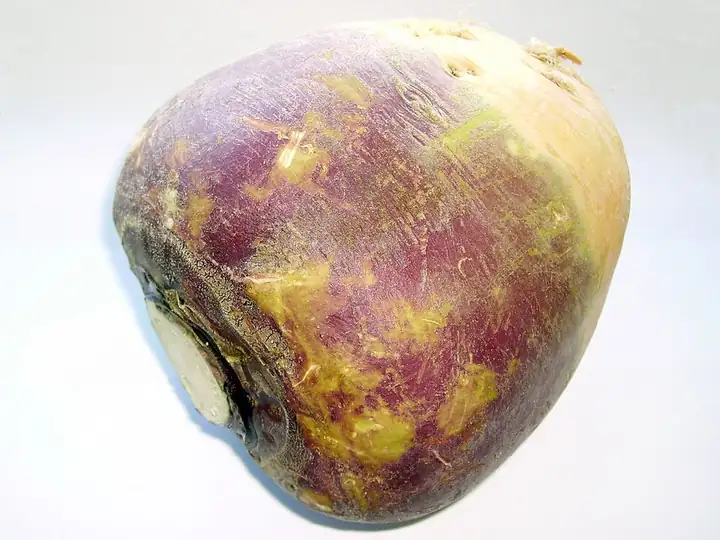
Rutabaga
Brassica napus Napobrassica Group · Cabbage family (Brassicaceae)
| Hardiness zones | 2 to 11 |
|---|---|
| Sun | full sun |
| Water | moderate |
| Life cycle | biennial |
| Frost | Hardy: takes frost |
| Soil pH | 6.0–7.0 |
| Spacing | 4 to 8 inches |
| Days to harvest | 90 to 120 days |
About Rutabaga
Rutabaga (swede) is a large, dense root, usually yellow inside, thought to come from a cross between turnip and cabbage. It is firmer and sweeter than a turnip but needs a longer season, so it is mostly grown as a fall crop. Frost sweetens the roots, and they keep for months in cold storage.
Grown as a cool-season annual in every zone; it grows best at 50 to 65F and is mostly planted for a fall harvest.
When to plant
Timing is counted from your average last spring frost (and first fall frost). Sow & Tell works out the actual dates for your ZIP code.
- Sow seeds outdoors: 4 to 6 weeks before the last frost
- Fall planting: 10 to 13 weeks before the first fall frost
Days count from seeding (90 to 120 by variety). Spring sowings go in 4 to 6 weeks before the last frost, but fall crops are more reliable: in the North sow in late May or early June (UMN); farther south sow about 2 1/2 to 3 months before a heavy frost (UGA). Thin to 4 to 8 inches once true leaves appear.
Soil
Deep, fertile, well-drained soil where cabbage-family crops haven't grown for 3 to 4 years; about an inch of water a week, since drought makes roots woody and bitter.
Follow a soil test and keep pH 6.0 to 7.0; work in compost or well-rotted manure (not fresh) in spring or fall. Without a test, Georgia suggests 2 to 5 lb of 10-10-10 per 100 sq ft, the higher rate on sandy soil, with half worked in at planting.
Feeding
- about a month after planting: nitrogen fertilizer such as 46-0-0 or 27-3-3, or the second half of the 10-10-10. Per 100 ft of row use about 1/2 cup of 46-0-0 or 1 cup of 27-3-3, beside the row, and water it in.
Too much nitrogen can cut root size; fresh manure makes roots branch, and weed-and-feed products should not be used.
Harvest
Dig roots at about 3 to 5 inches across with a spading fork; bigger roots can turn tough. Many gardeners wait for a hard frost to sweeten them, but harvest before the ground freezes.
Dig the roots once in fall, ideally after a hard frost and before the ground freezes. You can pick some young greens earlier; a root whose top is left undamaged keeps putting out new leaves.
Varieties (4)
Extension sources document 4 rutabaga varieties.
| Variety | Type | Days | Notes |
|---|---|---|---|
| American Purple Top | Purple top, yellow flesh | 90 to 100 days | Deep purple crown over yellow; round root 5 to 6 inches across with yellow flesh and blue-green leaves. The most popular variety. |
| Laurentian | Purple top, yellow flesh | 90 to 120 days | Sweet. Heirloom with a purple crown over light yellow; round root 5 to 5 1/2 inches across with yellow flesh. |
| Altasweet | 90 to 100 days | Milder than most rutabagas. | |
| Pike | 100 to 120 days | Similar to Laurentian but somewhat hardier. |
Pests to watch for
Cabbage maggot, Flea beetles, Aphids, Wireworms, Cutworms, Imported cabbageworm, Diamondback moth, Cabbage looper, Slugs, Root-knot nematodes
Diseases and problems
Clubroot, Black rot of cabbage-family crops, Alternaria leaf spot (cabbage family), White rust, Anthracnose
In the kitchen
Eaten cooked: boiled, mashed, steamed or roasted, or added to soups, stews and casseroles. The leaves can be cooked as greens.
Keeping it: Cut off the tops and the long taproot and keep roots at 32-40F with high humidity; in a root cellar they keep up to five months, but in a refrigerator they may dry out or sprout after a few weeks.
Safety: Store-bought roots are often coated with wax, so peel them before cooking. If you take the blood thinner warfarin, keep the amount of leafy greens you eat about the same from day to day, because they are rich in vitamin K (NIH Office of Dietary Supplements).
Pets: Not listed by the ASPCA
Sources
- extension.umn.edu
- fieldreport.caes.uga.edu
- plants.ces.ncsu.edu
- hgic.clemson.edu
- sare.org
- snaped.fna.usda.gov
- ods.od.nih.gov
- aspca.org
- aspca.org
- extensionpubs.unl.edu
Photo: Photo: Garitzko / Wikimedia Commons, Public domain. Photo resized for the web.

Planting dates and advice are general guidance; check with your local Cooperative Extension office for your area.