
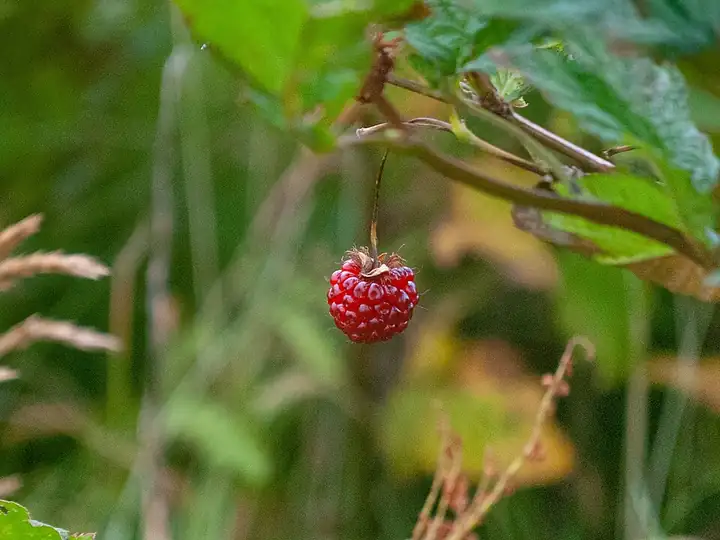
Salmonberry
Rubus spectabilis · Rose family (Rosaceae)
| Hardiness zones | 5 to 9 |
|---|---|
| Sun | full sun to part shade |
| Water | high |
| Life cycle | perennial |
| Frost | Hardy: takes frost |
| Spacing | 98 inches |
About Salmonberry
Salmonberry is a native Pacific Coast bramble with bright pink spring flowers and soft, raspberry-like berries that ripen yellow, orange or deep red. It is one of the first wild berries of the season, and hummingbirds and bees love the blooms. It spreads by underground stems into thickets, so give it a moist, out-of-the-way corner.
Oregon State rates it hardy to zone 5. It grows wild only in mild, moist coastal climates from Alaska to northwestern California (NRCS; Forest Service), which run to about zone 9, so it is a poor bet where summers are hot and dry.
When to plant
Timing is counted from your average last spring frost (and first fall frost). Sow & Tell works out the actual dates for your ZIP code.
Plant nursery plants, or dig small offshoots under 4 feet tall, which move easily (NRCS). Restoration growers set plants about 8 feet (2.5 m) apart (University of Washington). New shoots can come up 3 to 20 feet from the parent, so plan for spread (Forest Service). Stems bear fruit in their second year (Oregon State).
Soil
Moist to wet, rich soil, like the stream banks and damp woods where it grows wild; water it during summer dry spells.
Choose a spot with moist, rich soil; salmonberry grows best in nutrient-rich stream-bottom soils (Forest Service).
Feeding
Don't plant it in a small bed or near a lawn edge: its underground stems can spread many feet and form dense thickets (Forest Service).
Harvest
Berries ripen early, from about May to August depending on where you live (Forest Service; NRCS), and can be yellow, orange or red when ripe. Ripe fruit is tender and sweet but very soft, so pick gently and use or freeze it the same day.
Salmonberry fruits once a year, ripening June-July in the southern part of its range and July-August farther north or higher up.
Pests to watch for
Spotted wing drosophila, Raspberry cane borer, Deer, Rabbits, Sawflies (garden sawflies)
In the kitchen
Eaten fresh, frozen, canned or made into jam and jelly; the berries are too soft to dry (NRCS). Young spring shoots are peeled and eaten raw or cooked like asparagus (Forest Service).
Keeping it: Salmonberries are very soft: eat them the day you pick them, or keep them 2 to 3 days in shallow containers in the fridge. Frozen, they keep up to 2 years.
Safety: No toxic parts were noted in the sources we checked. Young stems can be very prickly, so wear gloves when pruning (Oregon State).
Pets: Not listed by the ASPCA
Sources
- nrcs.usda.gov
- plants.sc.egov.usda.gov
- fs.usda.gov
- fs.usda.gov
- landscapeplants.oregonstate.edu
- courses.washington.edu
- plants.ces.ncsu.edu
- green2.kingcounty.gov
- extension.oregonstate.edu
- plantsservices.sc.egov.usda.gov
- aspca.org
Photo: Photo: Gordon Leggett / Wikimedia Commons, CC BY-SA 4.0 (CC BY-SA 4.0). Photo resized for the web.

Planting dates and advice are general guidance; check with your local Cooperative Extension office for your area.