
Sassafras
Sassafras albidum · Laurel family (Lauraceae)
| Hardiness zones | 4 to 9 |
|---|---|
| Sun | full sun to part shade |
| Water | moderate |
| Life cycle | perennial |
| Frost | Hardy: takes frost |
About Sassafras
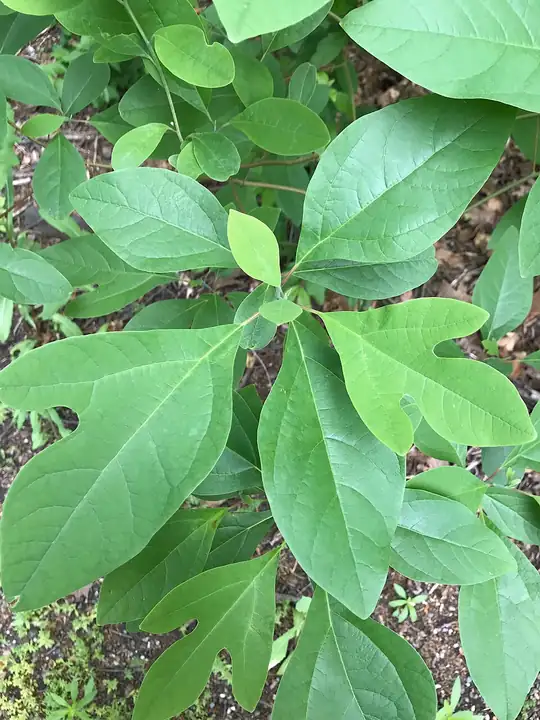
Sassafras is a fast-growing native tree with spicy-scented twigs and leaves shaped like mittens, three-lobed or plain ovals, often all on the same tree, and fall color in yellow, orange and red. It is native across the eastern U.S. from southern Maine and Michigan to Iowa, Kansas, eastern Texas and Florida (NC State, wildflower.org). It suckers into thickets, which is good for a natural grove or screen but means extra work in a tidy yard, and it feeds the caterpillars of the spicebush swallowtail. The FDA bans sassafras oil and safrole, its main oil, as food additives.
Hardy in zones 4-9 (NC State, Morton Arboretum). NC State notes it is susceptible to laurel wilt.
When to plant
Timing is counted from your average last spring frost (and first fall frost). Sow & Tell works out the actual dates for your ZIP code.
Plant a small container-grown tree; the deep taproot makes larger trees hard to move (USDA NRCS, NC State). Morton suggests spring planting. Pull or mow suckers to keep one trunk, or let them colonize for a screen or naturalized grove (NC State, USDA NRCS).
Soil
Best in well-drained, sandy, acidic soil; it tolerates clay, loam, rocky soil and drought once established, but wet clay leads to root rot and alkaline soil can yellow the leaves (NC State, USDA NRCS).
Test the soil first; sassafras likes well-drained, sandy, acidic soil. Loosen a wide area and mix 10-20 percent compost into the native soil; avoid wet clay, which leads to root rot (Clemson, NC State, USDA NRCS).
Feeding
- Spring, after the tree is established, and only if a soil test or pale leaves and weak twig growth show a need: slow-release nitrogen fertilizer with a ratio near 3-1-1 or 3-1-2 (3-0-1 or 3-0-2 if the soil test shows enough phosphorus). Spread it from just outside the trunk to the dripline and water it in. Clemson cites 2-4 lb of slow-release nitrogen per 1,000 sq ft per year, split into smaller feedings between budbreak and late summer; follow your soil test and skip it in a summer drought.
Water daily for the first 1-2 weeks, every 2-3 days until week 12, then weekly, giving about 1-1.5 gallons per inch of trunk width, until established (roughly 1.5 years per inch of trunk); only skip after more than an inch of rain (UMN). Yellow leaves with green veins usually mean the soil is too alkaline, which fertilizer won't fix (NC State, Clemson).
Harvest
Small, fragrant greenish-yellow flowers open from March to May before the leaves. Only female trees make the dark blue fruit on bright red stalks, ripe in late summer (NC State). Prune out dead wood in winter (USDA NRCS).
Pests to watch for
Japanese beetle
Diseases and problems
Laurel wilt, Root rot, Leaf spot, Powdery mildew, Canker
In the kitchen
Root bark once flavored root beer and teas, and dried, ground leaves are filé, used to thicken gumbo (NC State, USDA NRCS). Today the FDA bans sassafras oil, safrole and sassafras bark made into tea as food; only a safrole-free sassafras extract is allowed as a flavoring (FDA 21 CFR 189.180 and 172.580). The National Toxicology Program notes that gumbo filé also contains safrole.
Safety: The FDA bans safrole, oil of sassafras and sassafras bark tea in food (21 CFR 189.180). Safrole caused liver cancer in lab animals and is listed as reasonably anticipated to be a human carcinogen (NTP); no human studies support sassafras for any health use (MSKCC). NC State lists the bark as the poisonous part; the tree doesn't cause skin rashes.
Pets: Not listed by the ASPCA.
Sources
- plants.ces.ncsu.edu
- wildflower.org
- plants.sc.egov.usda.gov
- mortonarb.org
- ecfr.gov
- ecfr.gov
- ntp.Niehs.Nih.Gov
- mskcc.org
- aspca.org
- aspca.org
- hgic.clemson.edu
- hgic.clemson.edu
- extension.umn.edu
Photo: Photo: Katherine Wagner-Reiss / Wikimedia Commons, CC BY-SA 4.0 (CC BY-SA 4.0). Photo resized for the web.

Planting dates and advice are general guidance; check with your local Cooperative Extension office for your area.