
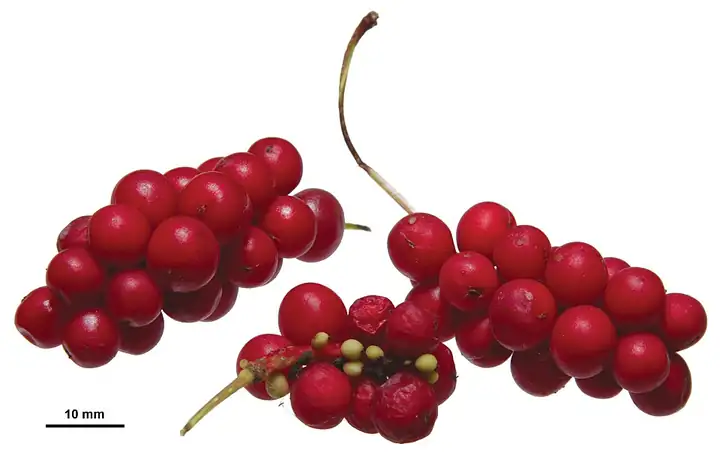
Schisandra (magnolia vine)
Schisandra chinensis · Schisandra family (Schisandraceae)
| Hardiness zones | 4 to 8 |
|---|---|
| Sun | full sun to part shade |
| Water | moderate |
| Life cycle | perennial |
| Frost | Hardy: takes frost |
About Schisandra (magnolia vine)
Schisandra is a hardy woody vine from northern China and the Russian Far East that climbs 15 to 30 feet. It bears hanging clusters of small red berries known as five-flavor fruit, because they taste sweet, sour, salty, bitter and spicy at once. Most plants are either male or female, so you need both for fruit.
The University of Wisconsin lists zones 4-8, with winter hardiness to about -30 F.
When to plant
Timing is counted from your average last spring frost (and first fall frost). Sow & Tell works out the actual dates for your ZIP code.
Plant at least one male vine with the females; a few Russian selections are self-fertile, but their seedlings usually are not (University of Wisconsin). Give it a tall arbor, fence or trellis, as for grapes (UMass; MOFGA). UMass protected young vines from deer with grow tubes. Sources differ on light: Wisconsin says full sun, while Maine growers favor some shade (MOFGA).
Soil
Moist, fertile, humus-rich soil that still drains well; keep it evenly moist through the growing season (University of Wisconsin).
Work plenty of compost into deeply dug, well-drained soil before planting (MOFGA).
Feeding
- Each spring: compost. Spread compost around the vines; Maine growers also add a trace-mineral rock dust (MOFGA).
Don't expect fruit from a single vine: plant both male and female plants unless you buy a self-fertile selection (University of Wisconsin).
Harvest
Berries ripen in late summer to early fall; pick whole clusters when every berry is fully scarlet (MOFGA). Use them fresh or dry them.
Schisandra gives one crop a year, ripening in late summer or early fall; pick when berries are fully scarlet and use them fresh or dry them. Vines start bearing in 3 to 4 years.
Varieties (1)
Only one named schisandra, Eastern Prince, is documented by neutral sources (University of Wisconsin; Maine Organic Farmers and Gardeners Association). Most plants are sold as unnamed seedlings, which need both male and female vines to fruit. No source rates the cultivar for hardiness.
| Variety | Type | Days | Notes |
|---|---|---|---|
| Eastern Prince | Self-fertile selection | In University of Wisconsin trials the vine survived but grew weakly and set only a few fruit. |
Pests to watch for
Deer
In the kitchen
Made into juice, preserves, wine, tea and sweets, or eaten fresh or dried (University of Wisconsin; MOFGA).
Keeping it: Use fresh berry clusters soon after picking, or dry them for long keeping in an airtight jar in a cool, dark place.
Safety: Schisandra is not well studied in people. It may change how the body handles some medicines, including drugs processed by the liver enzymes CYP3A4 and CYP1A2 and the transplant drug tacrolimus, and it can lower liver-enzyme test results (MSKCC). Ask a health care provider before using it if you are pregnant, nursing or take medicines (MOFGA).
Pets: Not listed by the ASPCA
Sources
- uncommonfruit.cias.wisc.edu
- umass.edu
- mofga.org
- mofga.org
- mskcc.org
- ncbi.nlm.nih.gov
- depts.washington.edu
- aspca.org
Photo: Photo: Vladimir Kosolapov / Wikimedia Commons, CC BY 3.0 (CC BY 3.0). Photo resized for the web.

Planting dates and advice are general guidance; check with your local Cooperative Extension office for your area.