
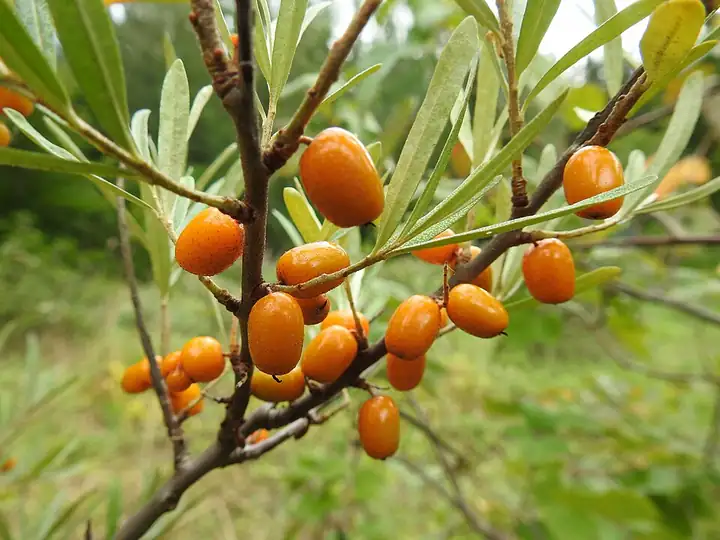
Sea buckthorn (seaberry)
Hippophae rhamnoides · Oleaster family (Elaeagnaceae)
| Hardiness zones | 3 to 8 |
|---|---|
| Sun | full sun |
| Water | low |
| Life cycle | perennial |
| Frost | Hardy: takes frost |
| Soil pH | 5.5–7.5 |
About Sea buckthorn (seaberry)
Sea buckthorn, often sold as seaberry, is a thorny shrub with silvery leaves and heavy clusters of bright orange berries that taste tart and a little like pineapple. It fixes its own nitrogen and shrugs off drought, salt and poor soil. Male and female flowers grow on separate plants, so you need a male nearby to get fruit. Heads-up: Maine lists sea buckthorn on its invasive plant do-not-sell list, and the New Jersey Invasive Species Strike Team lists it as invasive, so check your state's rules before you plant.
UW-Madison's Uncommon Fruit project rates it for zones 3-8 and the University of Saskatchewan calls it hardy to zone 2; Maine bans its sale as an invasive plant and New Jersey's strike team lists it, and Cornell suggests male or sterile plants where spread is a worry.
When to plant
Timing is counted from your average last spring frost (and first fall frost). Sow & Tell works out the actual dates for your ZIP code.
Plant about one male for every 6 to 8 females (UW-Madison CIAS; University of Nevada, Reno), and water right after planting. Expect the first berries 2 to 3 years after planting (UW-Madison CIAS). Tested Russian and German cultivars sent up almost no root suckers, but the Canadian 'Harvest Moon' does, and the University of Saskatchewan says plants can sucker into dense thickets.
Soil
Almost any well-drained soil, including sandy, poor or salty ground; it will not stand soggy soil (UW-Madison CIAS; NDSU). Established plants are very drought-tolerant, but crops suffer if the soil is too dry while fruit is forming (University of Nevada, Reno).
Little prep is needed: sea buckthorn fixes its own nitrogen and grows in almost any well-drained soil with a pH of about 5.5-7.5; test the soil, since it may respond to phosphorus where phosphorus is low (UW-Madison CIAS).
Feeding
- Only if a soil test shows low phosphorus, in spring: phosphorus fertilizer. Follow the soil test for the amount; skip nitrogen.
Don't feed nitrogen: it can reduce the root nodules that fix nitrogen for the plant (UW-Madison CIAS; University of Nevada, Reno). Don't plant in shade; plants with less than half a day of sun died within two years in Wisconsin trials.
Harvest
Berries ripen from July to November depending on the cultivar and hang on through winter (UW-Madison CIAS; University of Nevada, Reno). They cling tightly, and the branches carry needle-like thorns up to 3/4 inch long, so picking is slow; wear gloves.
Sea buckthorn gives one crop a year, ripening anywhere from July to November depending on cultivar. Some growers cut off fruit-laden branches and freeze them to strip the berries, but a cut branch takes about two years to regrow fruiting wood.
Varieties (14)
14 named sea buckthorns are documented by sources we could open: University of Wisconsin trials describe 8, a University of Nevada trial reports survival for a few more, and Cornell names 3. No source we opened names a male pollinizer cultivar; Wisconsin says one male for every 6-8 females is enough, and Cornell suggests about 1 male per 6 females. No source rates single cultivars for hardiness. Maine bans sale of sea buckthorn as invasive and New Jersey's invasive species strike team lists it; the owner chose to include it.
| Variety | Type | Days | Notes |
|---|---|---|---|
| Amber Dawn | Female fruiting cultivar | Small to medium yellow-orange berries, juicy and soft but lacking flavor. Did not adapt well in University of Wisconsin trials; only one small plant survived. | |
| Botanica | Female fruiting cultivar | ||
| Chuyskaya | Female fruiting cultivar | ||
| Frugana | Female fruiting cultivar | ||
| Garden's Gift | Female fruiting cultivar | Plentiful medium to large, dark orange, aromatic berries. Vigorous; one of the larger plants in University of Wisconsin trials, similar to Titan. | |
| Golden Sweet | Female fruiting cultivar | Medium, yellow to light orange berries with a slightly flattened round shape. The largest plants in University of Wisconsin trials, though it was sold as a medium shrub with large, very sweet fruit; Wisconsin suspects the plants were mislabeled. | |
| Harvest Moon | Female fruiting cultivar | Fruit much like Hergo. Sold as more compact with fewer thorns, but grew almost the same as Hergo in Wisconsin trials, and it was the only cultivar that suckered from the roots there. | |
| Hergo | Female fruiting cultivar | Small, light orange berries that are tart, flavorful and juicy. Branches pack densely with fruit that is hard to pull off by hand. | |
| Karima | Female fruiting cultivar | ||
| Leikora | Female fruiting cultivar | Medium, teardrop-shaped, bright orange berries with an intense, tart flavor. Showy in fruit, but not very productive in University of Wisconsin trials. | |
| Orange Delight | Female fruiting cultivar | ||
| Star of Altai | Female fruiting cultivar | Medium to large orange berries that are sweeter than most. Smaller plant than other cultivars of the same age. | |
| Titan | Female fruiting cultivar | Large berries for a seaberry (about blueberry size), bright orange and less tart than most. Upright plant over 12 ft tall if not pruned; bears reliably and is easier to pick by hand than most. | |
| Sprite | Sterile ornamental | A non-fruiting plant for ornamental use. |
Pests to watch for
Japanese beetle
In the kitchen
Tart berries go into juice, sauces, jams, jellies, pies, wine, tea, candy, ice cream and sorbet (UW-Madison CIAS; University of Saskatchewan). They are high in vitamins and omega fatty acids (UW-Madison CIAS).
Keeping it: The berries hang on the shrub well into winter. The easiest harvest is to cut fruiting branches, freeze them, then knock the frozen berries off and keep them in the freezer.
Safety: The sources we checked list no toxic parts, and we found no research-based guidance on use in pregnancy, drug interactions or allergies. The main hazard is the sharp thorns (University of Nevada, Reno).
Pets: Not listed as toxic by the ASPCA
Sources
- uncommonfruit.cias.wisc.edu
- ndsu.edu
- gardening.usask.ca
- extension.unr.edu
- woodyplants.cals.cornell.edu
- maine.gov
- eddmaps.org
- plantsservices.sc.egov.usda.gov
- aspca.org
- aspca.org
Photo: Photo: Jaana Siitonen / Wikimedia Commons, CC BY 4.0 (CC BY 4.0). Photo resized for the web.

Planting dates and advice are general guidance; check with your local Cooperative Extension office for your area.