
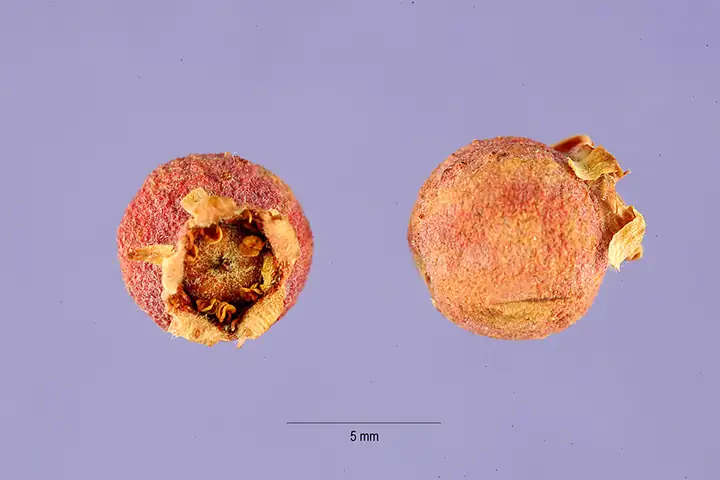
Serviceberry (juneberry, saskatoon)
Amelanchier alnifolia (saskatoon) and other Amelanchier species · Rose family (Rosaceae)
| Hardiness zones | 2 to 9 |
|---|---|
| Sun | full sun |
| Water | moderate |
| Life cycle | perennial |
| Frost | Hardy: takes frost |
| Soil pH | 5.5–7.0 |
About Serviceberry (juneberry, saskatoon)
Serviceberries are native shrubs and small trees with white flowers in spring and sweet, blueberry-like fruit in early summer. The saskatoon (A. alnifolia), a shrub up to about 10 feet, has the best fruit (University of Minnesota). Birds are the main competition for the crop.
University of Minnesota lists zones 2-8 depending on cultivar, NC State lists downy serviceberry (A. arborea) for zones 4-9, and saskatoon types are rated for zones 2-7 (UW-Madison CIAS).
When to plant
Timing is counted from your average last spring frost (and first fall frost). Sow & Tell works out the actual dates for your ZIP code.
Plant in spring or fall and keep new plants moist, watering about twice a week the first season (Utah State). Expect first fruit in 3 to 5 years and full production around year 8 (Utah State); UW-Madison CIAS says 2 to 4 years. Saskatoons spread slowly by underground runners: 'Northline' suckers heavily, while 'Honeywood' and 'Regent' sucker little (Utah State).
Soil
Well-drained loam or sandy loam; avoid wet, poorly drained spots and heavy clay, which invite root rot (University of Minnesota; Utah State).
Pick a well-drained loam or sandy loam, test the soil, and aim for a pH of about 5.5-7.0 (University of Minnesota; Utah State).
Feeding
- Each spring: balanced fertilizer such as 16-16-16, or a nitrogen-only fertilizer if a soil test shows enough phosphorus and potassium. About 4 ounces per plant, spread around the plant and watered in (Utah State).
Avoid heavy clay and wet spots, which lead to root rot (Utah State).
Harvest
Fruit ripens from late June through July and turns dark purple (Utah State; University of Minnesota). Pick when about two-thirds of the berries are ripe; they keep ripening after picking. Birds are the main pest (Utah State).
Serviceberry gives one crop a year, ripening late June through July; wait until about two-thirds of the fruit is ripe, then pick in the cool morning. Net branches, because birds are the worst threat.
Varieties (20)
| Variety | Type | Days | Notes |
|---|---|---|---|
| Autumn Brilliance | Apple serviceberry (A. × grandiflora hybrid) | Bluish-purple, flavorful berries. Small tree, about 20-25 ft tall, with brilliant red to red-orange fall color. Better resistance to leaf spot and fire blight. | |
| Ballerina | Apple serviceberry (A. × grandiflora hybrid) | Upright small tree, 15-20 ft, with spreading branches, bronze new leaves, masses of large flowers and bronze-purple fall color. Very good leaf spot resistance. | |
| Princess Diana | Apple serviceberry (A. × grandiflora hybrid) | Edible blue-black berries about 3/8 inch across. Tree about 25 ft tall and 15 ft wide, single- or multi-trunked, with red fall color. Excellent leaf spot resistance. | |
| Robin Hill | Apple serviceberry (A. × grandiflora hybrid) | Ornamental tree with pale pink flowers. | |
| Altaglow | Saskatoon (Amelanchier alnifolia) | Extremely cold hardy; Wisconsin Extension rates it to Zone 1. | |
| Honeywood | Saskatoon (Amelanchier alnifolia) | Classic saskatoon flavor, full and a bit tangy, with a juicy body. Upright, spreading bush with few suckers. Large berries per USask (NDSU found them smaller than Thiessen). Heavy, steady yields. | |
| JB30 | Saskatoon (Amelanchier alnifolia) | Large, juicy berries with a sweeter, milder taste than the old types; a favorite with NDSU visitors. Montana State panels rated its flavor lower. Heavy producer of very large berries with few suckers. Suits hand or machine picking. | |
| Lee 8 | Saskatoon (Amelanchier alnifolia) | Rated fairly well for looks and flavor in Montana State taste tests. High yields in Montana trials, with smallish berries. | |
| Martin | Saskatoon (Amelanchier alnifolia) | Very large, juicy berries that are sweeter than Honeywood. Rounded bush with moderate suckering. Moderate yields; lowest total yield in NDSU's six-year trial. | |
| Nelson | Saskatoon (Amelanchier alnifolia) | Tangy, somewhat acidic, fleshy berries. Even, uniform growth; some resistance to juniper (cedar) rust. | |
| Northline | Saskatoon (Amelanchier alnifolia) | Large, sweet, full-flavored berries. Very heavy crops that start on young plants. Suckers freely and spreads wide. | |
| Parkhill | Saskatoon (Amelanchier alnifolia) | Sweet, mild, medium-size berries. Smaller bush with medium to low yields; resistant to Entomosporium leaf spot. | |
| Pembina | Saskatoon (Amelanchier alnifolia) | Full-flavored, tangy and fairly sweet; berries slightly oval. Upright bush with very few suckers; high yields. | |
| Regent | Saskatoon (Amelanchier alnifolia) | Small, very sweet, mild berries. Compact bush, often only 4-6 ft tall, with very little suckering; medium yields. | |
| Smoky | Saskatoon (Amelanchier alnifolia) | Small, mild, sweet and fleshy berries; USask notes an almond flavor, but NDSU testers found it bland. Very high yielding bush that suckers freely. | |
| Standing Ovation | Saskatoon (Amelanchier alnifolia) | Deep purple, edible berries that run smaller than the fruiting types. Narrow, columnar shrub up to about 12 ft tall, with white flowers and yellow fall color. | |
| Thiessen | Saskatoon (Amelanchier alnifolia) | Large, juicy berries; NDSU found it the sweetest juneberry in its trials. Big, rounded, productive bush with few suckers. Among the largest berries (about 17 mm). Flowers early, so late frosts can hurt the crop. | |
| Rainbow Pillar | Shadblow serviceberry (Amelanchier canadensis) | Sweet, juicy black berries (species description). Upright, tightly multi-stemmed, suckering shrub, 6-10 ft tall, with yellow, gold, orange and red fall color. | |
| Spring Glory | Shadblow serviceberry (Amelanchier canadensis) | Sweet, juicy black berries (species description). Upright, tightly multi-stemmed, suckering shrub, 6-10 ft tall, with yellow to orange-red fall color. | |
| Cumulus | Smooth serviceberry (Amelanchier laevis) | Sweet, juicy purple-black berries (species description). Ornamental tree with orange to brick-red fall color. |
Pests to watch for
Birds, Aphids, Twospotted spider mite, Scale insects, Leafminers, Peachtree borer, Roundheaded appletree borer, Pear sawfly (pearslug, cherry slug)
Diseases and problems
Entomosporium leaf and berry spot, Saskatoon-juniper rust, Cedar-apple rust, Powdery mildew, Fire blight, Cedar-quince rust
In the kitchen
Eaten fresh or made into juice, jam, jelly and pies (Utah State; University of Minnesota). The flavor is sweet, like sweet cherry with a hint of almond (UW-Madison CIAS).
Keeping it: Refrigerate fresh berries and use them within a few days, or freeze them in airtight, labeled containers for up to a year.
Safety: The sources we checked list no toxic parts, and we found no research-based guidance on use in pregnancy, drug interactions or allergies.
Pets: Not listed as toxic by the ASPCA
Sources
- extension.usu.edu
- extension.umn.edu
- ndsu.edu
- plants.ces.ncsu.edu
- uncommonfruit.cias.wisc.edu
- aspca.org
- aspca.org
Photo: Photo: Tracey Slotta, USDA-NRCS PLANTS Database / Wikimedia Commons, Public domain. Photo resized for the web.

Planting dates and advice are general guidance; check with your local Cooperative Extension office for your area.