
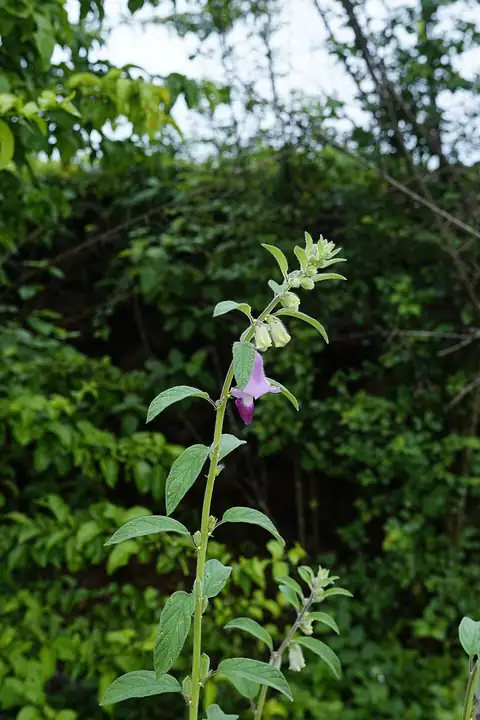
Sesame
Sesamum indicum · Sesame family (Pedaliaceae)
| Hardiness zones | 3 to 11 |
|---|---|
| Sun | full sun |
| Water | low |
| Life cycle | annual |
| Frost | Tender: killed by frost |
| Soil pH | 5.5–7.0 |
| Spacing | 2 to 6 inches |
| Days to harvest | 100 to 135 days |
| Soil temperature to plant | at least 68°F |
About Sesame
Sesame is an ancient oilseed crop, grown in Jefferson's day as 'benne', with bell-shaped white, pink or pale purple flowers that bumble bees love. Each grooved pod holds dozens of tiny seeds for baking, tahini and oil, and benne leaves can be cooked as greens. It thrives in hot, dry summers and sulks in wet soil. Sesame is a major food allergen: see safety.
Grown as a warm-season annual, but it needs a long, warm season (about 100 to 135 days) and soil near 70F to sprout, so it is easiest in the South and Southwest; plantings made after mid-June in Missouri may not mature before frost.
When to plant
Timing is counted from your average last spring frost (and first fall frost). Sow & Tell works out the actual dates for your ZIP code.
- Sow seeds outdoors: 2 to 6 weeks after the last frost
Days count from seeding (NC State: about 100 days plus 1-2 weeks of dry-down; Missouri: 125-135 days). Sow 1/2 inch deep into moist soil once it is about 68-70F, usually mid-May in North Carolina, and no later than early July there; avoid sowing right before heavy rain, which crusts the soil. Seedlings grow slowly for the first few weeks, so keep weeds down.
Soil
Well-drained loam or sandy loam; it tolerates clay and sand but dies quickly in waterlogged soil, and heavy clay crusts over the tiny seedlings.
Lime acid soil toward pH 6 to 7 and add phosphorus and potassium as a soil test recommends; NC State saw poor pod set where potassium was low.
Feeding
- When flowering starts, about 30 days after sowing: nitrogen fertilizer such as 21-0-0, in a small amount. NC State found that holding nitrogen until flowering may slightly raise yield; keep the season's total low (no more than about 50 lb N per acre, roughly 1 lb per 1,000 sq ft) and water it in.
Too much nitrogen makes tall, leafy plants that fall over and get more leaf disease; never plant where water stands.
Harvest
Harvest when the top of the stalk dries out and the plants turn from green to yellow; NC State cracks open a lower pod and looks for a dark layer as the sign of ripe seed. Older varieties split open and scatter their seed when ripe, so cut and handle the stalks gently over a sheet or bag.
Plants flower and set pods from the bottom up for weeks, but the seed is harvested once, when stalks dry and turn yellow; lower pods ripen first, so don't wait so long that they split and drop seed.
Varieties (1)
Modern U.S. field varieties are licensed only to contract farmers, and garden packets are usually unnamed, so Extension sources describe just one named heirloom.
| Variety | Type | Days | Notes |
|---|---|---|---|
| Benne | Heirloom | Stronger and slightly more bitter than common white sesame. Brown-seeded heirloom sesame; its leaves are also cooked as greens. |
Pests to watch for
Aphids, Stink bugs, Corn earworm (tomato fruitworm), Whiteflies
Diseases and problems
Alternaria leaf spot, Cercospora leaf spot, Damping-off
In the kitchen
Toast the seeds for baked goods, candies such as honey-sesame bars, and salads; grind them into tahini for hummus; or press for oil. Young benne leaves can be cooked as greens, and pounded leaves thicken stews much like okra.
Keeping it: Dry the seed thoroughly and keep it in an airtight container in a cool, dry place; Iowa State notes damp sesame seed heats and turns rancid.
Safety: Sesame is one of the nine major food allergens in the U.S.; since 2023 packaged foods must label it (FDA). Keep seeds, oil and leaves away from anyone with a sesame allergy.
Pets: Not listed by the ASPCA
Sources
Photo: Photo: Vengolis, CC BY-SA 4.0, via Wikimedia Commons (CC BY-SA 4.0). Photo resized for the web.

Planting dates and advice are general guidance; check with your local Cooperative Extension office for your area.