
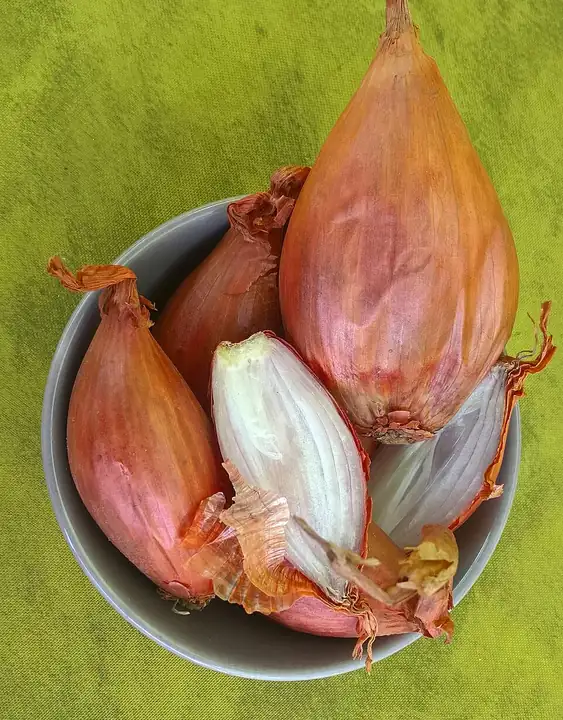
Shallot
Allium cepa var. aggregatum · Amaryllis family (Amaryllidaceae)
| Hardiness zones | 2 to 11 |
|---|---|
| Sun | full sun |
| Water | moderate |
| Life cycle | biennial |
| Frost | Hardy: takes frost |
| Soil pH | 5.5–7.5 |
| Spacing | 3 to 6 inches |
About Shallot
Shallots are a clustering kind of onion: each bulb you plant splits into a clump of several. Their mild, sweet flavor is prized in cooking, and the dry bulbs store well.
Grown as an annual in every zone. Spring planting works everywhere; fall-planted bulbs in zones 4 to 5 need mulch or frost cloth, while in the mild South they are planted in fall for winter and spring harvest.
When to plant
Timing is counted from your average last spring frost (and first fall frost). Sow & Tell works out the actual dates for your ZIP code.
Plant bulbs (sets) 1 to 2 inches deep in early spring as soon as the ground can be worked, or in fall where winters are mild. Green shallots can be cut about 60 days after planting; dry bulbs are ready when the tops fall over.
Soil
Fertile, well-drained loam kept evenly moist but not soggy.
Follow a soil test and keep pH about 6.2 to 6.5; work in no more than about 1 inch of compost per 100 sq ft.
Feeding
- about 30 days after planting: nitrogen fertilizer such as 21-0-0. Spread about 1/2 lb per 100 sq ft beside the plants and water it in.
- about 60 days after planting: nitrogen fertilizer such as 21-0-0. Repeat the same amount and water it in; do not feed after midsummer.
Late-season nitrogen makes extra leaves instead of bulbs, gives smaller bulbs that store poorly and can lead to bulb rot.
Harvest
For dry bulbs, harvest after the tops fall over, then let them cure outdoors for 1 to 2 weeks before storing in a cool, dry place. Green shoots can be cut when 6 to 8 inches tall.
Dry bulbs are lifted once, after the tops fall over, then cured 1 to 2 weeks; some green tops can be cut earlier when 6 to 8 inches tall. Save stored bulbs to replant.
Varieties (8)
Extension sources name few shallot varieties. The Louisiana types below were bred by LSU for the Gulf Coast; Delta Giant and Evergreen are crosses with Japanese Nebuka onions.
| Variety | Type | Days | Notes |
|---|---|---|---|
| Gray Griselle | Gray shallot | Utah State says it has the best flavor. Listed by Utah State. | |
| Baylou Pearl | Louisiana shallot | An LSU shallot that yields well when planted from sets in fall in southern and central Louisiana. | |
| Louisiana Pearl | Louisiana shallot | An LSU selection with vigorous plants that yield well even in soil heavy with pink root disease. Also called Angola. | |
| Wintergreen | Louisiana shallot | A selection of Louisiana Pearl that yields well from transplants set out in spring in southern and central Louisiana. | |
| Delta Giant | Louisiana shallot (Nebuka x shallot hybrid) | Vigorous, dark green plants with a large root system and a long season. Resists leaf spot and dieback. | |
| Evergreen | Louisiana shallot (shallot x Nebuka cross) | Stays green all season, with smaller leaves than Nebuka. It resists pink root and suits the Gulf Coast. | |
| Dutch Yellow | Stronger and more like an onion. Listed by Utah State. | ||
| French Red | Utah State says it is the most common shallot sold. |
Pests to watch for
Aphids, Onion maggot, Thrips, Allium leafminer
Diseases and problems
Gray mold (Botrytis), Downy mildew, Purple blotch, Neck rot
In the kitchen
Minced raw into dressings, or sauteed and roasted anywhere you want a gentle onion flavor.
Keeping it: Cure bulbs for 2 to 3 weeks, then keep them in mesh bags somewhere cool, dry and airy; they can last 5 to 8 months. Use thick-necked bulbs first.
Pets: Shallots are a form of onion (Allium cepa), which the ASPCA lists as toxic to dogs, cats and horses: N-propyl disulfide damages red blood cells and can cause vomiting, anemia and a fast heart rate.
Sources
Photo: Photo: Beitrag50330, CC BY-SA 4.0, via Wikimedia Commons (CC BY-SA 4.0). Photo resized for the web.

Planting dates and advice are general guidance; check with your local Cooperative Extension office for your area.