
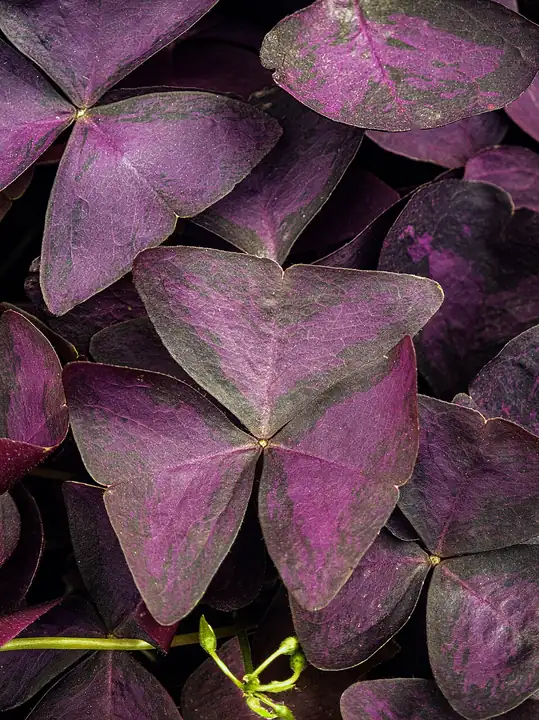
Shamrock plant (oxalis)
Oxalis triangularis (O. regnellii is now treated as the same species) · Wood sorrel family (Oxalidaceae)
| Hardiness zones | 8 to 11 |
|---|---|
| Sun | full sun to part shade |
| Water | moderate |
| Life cycle | perennial |
| Frost | Tender: killed by frost |
About Shamrock plant (oxalis)
The shamrock plant is a South American wood sorrel that grows from small rhizomes, with three-part leaves in deep purple, green or silver-marked forms and dainty white to pale pink flowers (NC State). Its leaves and flowers fold up at night or when the plant is jostled, which makes it a favorite with children. It rests now and then, dying back in fall or after a hot, dry spell, then sprouts again from the rhizomes.
Hardy outdoors in zones 8-11, where it dies back in winter and returns in spring (NC State); in colder areas it is grown indoors and can summer outdoors in a pot in part shade, coming in before frost.
When to plant
Timing is counted from your average last spring frost (and first fall frost). Sow & Tell works out the actual dates for your ZIP code.
Usually bought as a potted plant, often around St. Patrick's Day, or started by dividing the rhizomes (NC State).
Growing it indoors
- Light: A sunny window or one with a few hours of direct sun suits it; NC State lists full sun to part shade.
- Water: Let the surface of the mix dry between waterings, water until it drains, and empty the saucer (NC State, MU Extension). When it goes dormant, cut back the water until new shoots appear.
- Temperature: The sources we opened give no indoor temperature range; heat and dryness can send it into dormancy (NC State).
- Feeding: Feed a complete houseplant fertilizer about once a month while it is growing and skip feeding while it is dormant (MU Extension).
- Repotting: Repot when the rhizomes crowd the pot, ideally while it is resting, dividing the clump as you go (MU Extension, NC State).
Soil
A loamy, well-drained potting mix (NC State).
Pot in a loamy, well-drained potting mix (NC State).
Feeding
- While it is in leaf and growing: complete houseplant fertilizer. About once a month at the label strength, on moist mix (MU Extension).
- Dormancy, when the leaves die back: none. Stop feeding and cut back watering until new shoots appear (NC State, MU Extension).
Don't keep watering and feeding a plant that has gone dormant; wait for new growth (NC State).
Varieties (6)
NC State Extension names 6 cultivars.
| Variety | Type | Days | Notes |
|---|---|---|---|
| Fanny | Green and silver leaf | Olive-green leaves with a silver center pattern and soft pink flowers. | |
| Atropurpurea | Purple leaf | Deep purple leaves with a wide black border and light pink summer flowers. | |
| Charmed Wine | Purple leaf | Deep purple shamrock leaves and white flowers. | |
| Ebony | Purple leaf | Purple-black leaves; white flowers that turn pink as they age. | |
| Francis | Purple leaf | Bright purple leaves with light lavender flowers in fall. | |
| Mijke | Purple leaf | Deep purple leaves with mauve flowers in spring and summer. |
In the kitchen
NC State notes the leaves and flowers are edible in moderation, but they hold soluble oxalates, and large amounts can harm the kidneys, so treat it as a garnish at most and never let pets graze it.
Safety: Low-severity poison (NC State): all parts contain soluble calcium oxalates; small tastes rarely matter, but eating a large amount can cause kidney failure. It does not cause skin rashes.
Pets: Toxic to dogs, cats and horses (ASPCA, listed as shamrock plant, Oxalis spp.): soluble calcium oxalates can cause drooling, tremors and, rarely in dogs and cats, kidney failure; NC State adds that it can cause colic in horses.
Sources
Photo: Photo: Didier Descouens, CC BY-SA 4.0, via Wikimedia Commons (CC BY-SA 4.0). Photo resized for the web.

Planting dates and advice are general guidance; check with your local Cooperative Extension office for your area.