
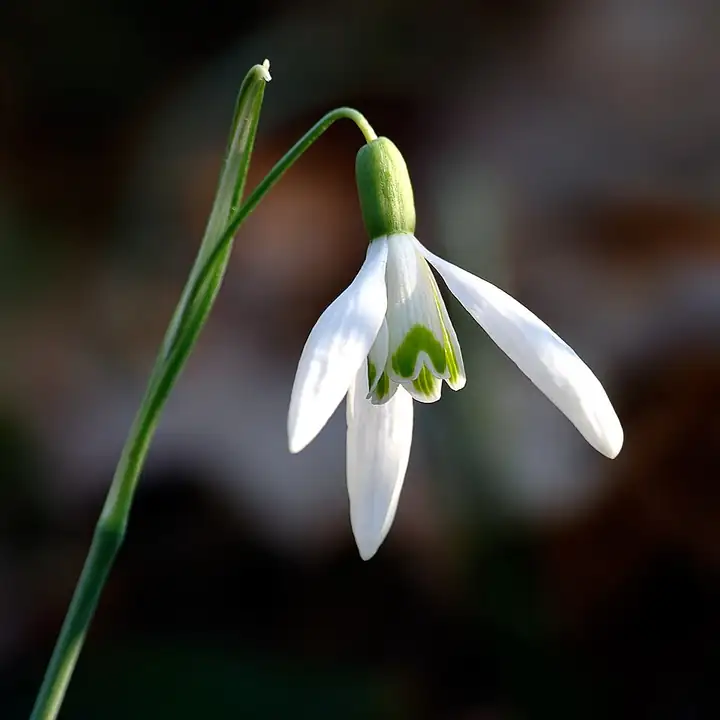
Snowdrop
Galanthus nivalis (common snowdrop); also G. elwesii (giant snowdrop) and other Galanthus species · Amaryllis family (Amaryllidaceae)
| Hardiness zones | 3 to 9 |
|---|---|
| Sun | full sun to part shade |
| Water | moderate |
| Life cycle | perennial |
| Frost | Hardy: takes frost |
| Spacing | 3 inches |
About Snowdrop
Snowdrops are tiny bulbs whose nodding white flowers, marked with green, open in late winter, often right through the snow. They spread slowly into big colonies under deciduous trees and in lawns and woodland gardens (Wisconsin, NC State). Deer, rabbits and rodents usually leave them alone.
NC State lists zones 3-9, but snowdrops need a cold winter and do poorly in hot southern gardens (Clemson, Penn State); giant snowdrop and G. byzantinus handle heat better (Wisconsin).
When to plant
Timing is counted from your average last spring frost (and first fall frost). Sow & Tell works out the actual dates for your ZIP code.
Plant dry bulbs in early fall, once nights cool to about 40-50 F, 2-3 inches deep and about 3 inches apart, in groups (Wisconsin, Penn State). To move or divide clumps, dig right after flowering while the leaves are still green and replant at once (Wisconsin).
Soil
Well-drained soil rich in organic matter; they like sun while the leaves are up in spring and a drier soil in summer, which makes the ground under deciduous trees ideal (Wisconsin, NC State).
Plant in well-drained soil with good organic matter; add compost rather than fertilizer at planting unless a soil test shows a need (Wisconsin, UMN).
Feeding
- Early spring as shoots appear, or right after bloom: fertilizer labeled for bulbs, applied lightly. Give one light feeding a year (Wisconsin, UMN); follow a soil test.
Don't cut or mow the leaves until they die back, about six weeks after bloom (Wisconsin). Avoid high-nitrogen fertilizer and fresh manure, which can lead to bulb rot (UMN).
Harvest
Snowdrops bloom from January to March, depending on the winter; in much of Pennsylvania it's late February or March (Penn State). There is nothing to deadhead; let the leaves die back on their own, and in a lawn wait about six weeks after bloom before mowing (Wisconsin).
Varieties (10)
Extension sources we could open document 10 snowdrop species and cultivars; many more exist, mostly sold in Europe (Wisconsin).
| Variety | Type | Days | Notes |
|---|---|---|---|
| Atkinsii | Common snowdrop (G. nivalis) | Robust plant; flowers are often oddly formed or have extra petals. | |
| Flore Pleno | Common snowdrop (G. nivalis) | Double white flowers up to 1 inch long; good for naturalizing in woodland. | |
| Sam Arnott | Common snowdrop (G. nivalis) | Large, fragrant flowers. | |
| Viridi-apice | Common snowdrop (G. nivalis) | Green marks on the outer petals as well as the inner ones; more vigorous than the species. | |
| White Dream | Common snowdrop (G. nivalis) | Leaves have a white stripe. | |
| Giant snowdrop | Galanthus elwesii | Vigorous, with wider leaves and bigger flowers (1 1/4-2 inches) with a bolder green blotch; handles heat better than common snowdrop. | |
| Crimean snowdrop | Galanthus plicatus | Broad leaves folded back along the edges. | |
| Galanthus byzantinus | Species | Longer leaves and smaller flowers; a better choice for southern gardens. | |
| Galanthus reginae-olgae | Species | Blooms in fall instead of late winter. | |
| Galanthus woronowii | Species | Leaves curve backward; often sold as G. ikariae latifolius. |
Good neighbors
Wisconsin suggests pairing snowdrops with other early bulbs such as small daffodils, winter aconite and Siberian squill for looks; no pest benefit has been tested.
Pests to watch for
Narcissus bulb fly
In the kitchen
Safety: Poisonous if eaten, the bulbs especially; it can cause nausea, vomiting and diarrhea (NC State: low severity). Some gardeners get itchy skin from handling them, so gloves help (Penn State).
Pets: We could not find snowdrop in the ASPCA plant list. NC State lists the plant as poisonous (low severity, bulbs most toxic), so keep dogs from digging up and eating the bulbs.
Sources
Photo: Photo: André Karwath / Wikimedia Commons, CC BY-SA 2.5 (CC BY-SA 2.5). Photo resized for the web.

Planting dates and advice are general guidance; check with your local Cooperative Extension office for your area.