
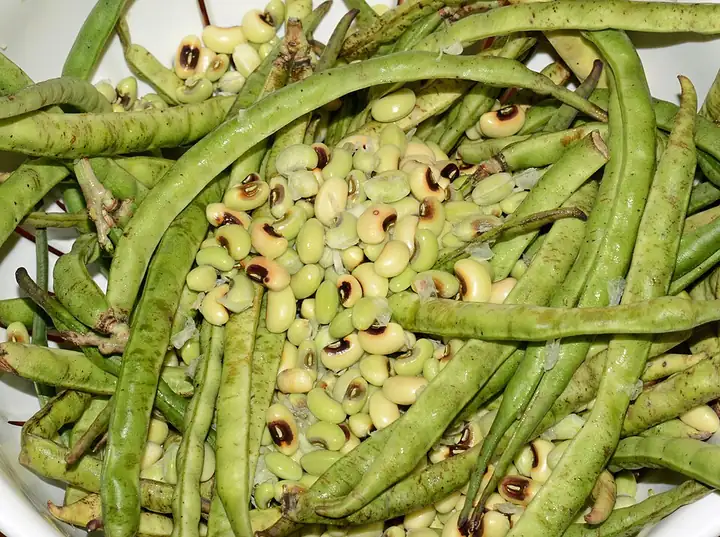
Southern peas
Vigna unguiculata subsp. unguiculata · Pea family (Fabaceae)
| Hardiness zones | 3 to 11 |
|---|---|
| Sun | full sun |
| Water | low |
| Life cycle | annual |
| Frost | Tender: killed by frost |
| Soil pH | 5.8–6.3 |
| Spacing | 4 to 6 inches |
| Days to harvest | 65 to 125 days |
| Soil temperature to plant | at least 60°F |
About Southern peas
Southern peas, also called cowpeas, include black-eyed, crowder and cream peas. They love heat, tolerate poor soil and dry spells, and are a classic summer crop across the South.
Grown as a warm-season annual in every zone; it is killed by frost, so plant it after the danger of frost has passed. They need warm soil and long, hot summers, so they are easiest in the South.
When to plant
Timing is counted from your average last spring frost (and first fall frost). Sow & Tell works out the actual dates for your ZIP code.
- Sow seeds outdoors: 2 to 10 weeks after the last frost
- Fall planting: 10 to 12 weeks before the first fall frost
Days count from seeding and vary widely by variety. Wait for warm soil (at least 60F) and sow seeds 3/4 to 1 1/2 inches deep.
Soil
Most well-drained soils; fertile soil helps, but avoid heavy, wet ground. Irrigation is usually not needed.
Follow a soil test and keep pH 5.8 to 6.3; feed lightly with about 2 to 3 lb of 5-10-10 per 100 ft of row, 7 to 10 days before planting or banded 2 to 3 inches beside and 3 to 4 inches deep from the seed.
Feeding
Rich soil or leftover nitrogen from earlier crops gives lots of vine and few peas, so no side-dressing is needed.
Harvest
For fresh shelling peas, pick as soon as the pods shell easily and the seeds have started to swell. For dry peas, let pods dry on the vine.
Pick pods as soon as they shell easily; NC State advises picking this species daily to keep the vines productive (advice given for its long-pod type).
Varieties (24)
| Variety | Type | Days | Notes |
|---|---|---|---|
| California Blackeye No. 5 | Blackeye | 60 to 65 days | A blackeye pea on Texas, Florida, Georgia and Louisiana lists. |
| Charleston Blackeye | Blackeye | A USDA release (2005) for home and market gardeners. It resists root-knot nematodes and matures early. | |
| Magnolia Blackeye | Blackeye | 65 to 75 days | A medium, bushy plant with light green-yellow pods about 7 inches long. Resists fusarium wilt and root-knot nematodes. |
| Green Dixie Blackeye | Blackeye (green pea) | 71 days | A USDA release whose peas keep their fresh green color even when dried. About 14 peas per pod; about 71 days to dry pods. |
| Mississippi Shipper | Brown crowder | Pods are dark green when young and partly dark purple at the shelling stage. High yielding for fresh use and canning. | |
| Carolina Cream | Cream | A medium, bushy plant with a concentrated pod set. Pods are green with purple shading at the shelling stage. | |
| Mississippi Cream | Cream | 70 days | A high-yielding cream pea. |
| Texas Cream 8 | Cream | 75 days | A cream pea on Texas, Florida, Georgia and Louisiana lists. |
| Zipper Cream | Cream crowder | 65 to 75 days | Large, pale peas that are easy to shell by hand, with high yields. |
| Colossus | Crowder | Large pods and peas that are easy to pick and shell. | |
| Dixielee | Crowder | A vining type. | |
| Knuckle Purple Hull | Crowder | 70 days | On Texas and Louisiana lists. |
| Mississippi Purple | Crowder | 60 to 68 days | A semi-vining plant with disease resistance. |
| Mississippi Silver | Crowder | 62 to 65 days | Less vine, pods set in bunches, and easy shelling. Resists fusarium wilt and root-knot nematodes and tolerates viruses. |
| Top Pick | Crowder | 55 days | Easy to harvest because the pods are held on top of the plant. |
| Iron and Clay | Field pea | A robust, vining field type with small peas that make a dark cooking liquid. | |
| Coronet | Pinkeye | 62 days | An upright, compact plant with purple pods at the green-shell stage. About 62 days to green-shell peas. |
| Mississippi Pinkeye | Pinkeye | 54 to 60 days | A semi-upright plant with a concentrated pod set and slightly curved pods about 9 inches long. |
| Pinkeye Purple Hull | Pinkeye | 65 to 75 days | Purple pods with cream-colored peas that have a maroon eye. Mississippi State calls it the typical pinkeye type. |
| Pinkeye Purple Hull-BVR | Pinkeye | Looks just like Pinkeye Purple Hull in plant, pod and pea, but resists blackeye cowpea mosaic virus. | |
| Charleston Greenpack | Pinkeye (green pea) | A USDA release (1997) whose peas stay green even when picked near dry. Strong field resistance to blackeye cowpea mosaic virus. | |
| Calhoun Purplehull | Pinkeye purple hull | 63 days | A semi-vining plant with reddish-purple pods and wilt resistance. Released by LSU in 1966. |
| Quickpick | Pinkeye purple hull | 60 to 72 days | A very compact plant with pods held high above the leaves, so it is easy to pick. Purple pods hold light green peas with pink eyes. Resists cowpea mosaic virus. |
| Early Acre | A very compact bush plant that matures 8 to 10 days earlier than White Acre. |
Good neighbors
UMN Extension notes that flowering cowpeas grown with or under sweet corn can boost beneficial insects that attack corn earworm; results depend on the planting.
Pests to watch for
Aphids, Stink bugs, Leaffooted bugs, Corn earworm (tomato fruitworm), Cabbage looper, Thrips, Twospotted spider mite, Root-knot nematodes, Mexican bean beetle, Cowpea curculio, Beet armyworm, European corn borer, Bean leaf beetle
Diseases and problems
Fusarium wilt, Southern blight, Powdery mildew, Mosaic viruses, Tomato and tobacco ringspot, Alfalfa mosaic
In the kitchen
Simmered fresh or dried with seasonings, or added to salads and soups.
Keeping it: Shell fresh peas and cook or freeze them soon after picking. Before storing dried peas, freeze them for at least 48 hours to kill any weevils, then keep them airtight in a cool, dry place.
Pets: Not listed as toxic by the ASPCA
Sources
- hgic.clemson.edu
- plants.ces.ncsu.edu
- agrilifeextension.tamu.edu
- hgic.clemson.edu
- hgic.clemson.edu
- extension.umn.edu
- aspca.org
- aspca.org
- extension.umd.edu
- franklin.ces.ncsu.edu
Photo: Photo: Jud McCranie, CC BY-SA 4.0, via Wikimedia Commons (CC BY-SA 4.0). Photo resized for the web.

Planting dates and advice are general guidance; check with your local Cooperative Extension office for your area.