
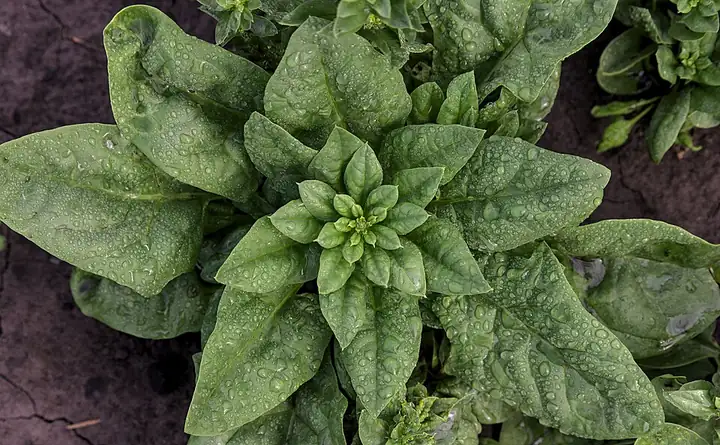
Spinach
Spinacia oleracea · Amaranth family (Amaranthaceae)
| Hardiness zones | 2 to 11 |
|---|---|
| Sun | full sun to part shade |
| Water | moderate |
| Life cycle | annual |
| Frost | Hardy: takes frost |
| Soil pH | 6.5–8.0 |
| Spacing | 2 to 4 inches |
| Days to harvest | 40 to 60 days |
| Soil temperature to plant | at least 40°F |
About Spinach
Spinach is a fast, cold-tolerant leafy green for early spring and fall. Long days and warm weather make it bolt, so it is best sown early and again in late summer.
Grown as a cool-season annual in every zone; time it for the cool weather of spring or fall. Mulched plants with 4 to 5 true leaves can overwinter.
When to plant
Timing is counted from your average last spring frost (and first fall frost). Sow & Tell works out the actual dates for your ZIP code.
- Sow seeds outdoors: 2 to 6 weeks before the last frost
- Fall planting: 4 to 8 weeks before the first fall frost
Days count from seeding. Sow every 1 to 2 weeks in spring until it turns hot; several days above 75F, long days or drought will make plants bolt.
Soil
Fertile, well-drained soil rich in organic matter; spinach tolerates neutral to slightly alkaline soil.
Follow a soil test and keep pH 6.0 to 7.0 (spinach dislikes acid soil); work in no more than about 1 inch of compost and till any pre-plant fertilizer about 6 inches deep.
Feeding
- 3 to 4 weeks after planting, around thinning time: nitrogen fertilizer such as calcium nitrate (15.5-0-0) or 21-0-0. Use about 1 lb of calcium nitrate per 100 sq ft (30 ft of row), or 1/4 cup of 21-0-0 per 10 ft of row, 4 to 6 inches from the plants, and water it in; split it in two on sandy soil.
Keep fertilizer off the leaves and away from the stems to avoid burn; do not use weed-and-feed products.
Harvest
Pick outer leaves once they reach usable size, or cut the whole plant about 2 inches above the soil, any time before the flower stalk forms.
Pick single leaves while they are small and the plant grows new ones for several harvests. Once one plant starts to bolt the rest soon follow, so harvest them all then.
Varieties (28)
| Variety | Type | Days | Notes |
|---|---|---|---|
| Whale | Hybrid | Round, dark, uniform leaves. Slow to bolt, with resistance to many downy mildew races. | |
| Ozarka II | Savoy | Open-pollinated, medium-curled savoy spinach for fall planting where white rust is a problem. | |
| Regiment | Savoy | 37 days | Fast savoy spinach recommended for Central Texas. |
| America | Savoy (Bloomsdale type) | Deep dark green Bloomsdale type that matures later than others. Extremely slow to bolt and suited to spring sowing under long days. | |
| Bloomsdale Long Standing | Savoy (crinkled leaf) | 48 days | Wisconsin Extension calls it one of the best-tasting spinach varieties. Crinkled, dark green leaves. Slow to bolt, so it suits late-spring and early-summer sowings. Has no disease resistance. |
| Ambassador | Savoy, hybrid | Vigorous hybrid with dark green, heavy, fully savoyed leaves on semi-upright plants. | |
| Regal | Semi-savoy | 30 days | Quick semi-savoy suited to dense sowings for baby leaves. Resists downy mildew races 1 to 7. |
| Avon | Semi-savoy, hybrid | 44 days | Dark green hybrid for early spring sowings. Tolerates blight and mildew. |
| Chesapeake | Semi-savoy, hybrid | 45 days | Vigorous, winter-hardy hybrid that can overwinter. Fairly slow to bolt. |
| Coho | Semi-savoy, hybrid | Upright, fast-growing hybrid with dark green leaves. Slow to bolt. | |
| Emperor | Semi-savoy, hybrid | Dark green, upright hybrid with round to oval leaves. Good for baby leaf. | |
| Grandstand | Semi-savoy, hybrid | Hybrid that is slow to bolt, suited to spring planting. | |
| Melody | Semi-savoy, hybrid | 42 to 43 days | Dark green, lightly crinkled leaves. Resists downy mildew races 1 and 2 and cucumber mosaic virus. |
| Skookum | Semi-savoy, hybrid | 41 days | Fast-growing, long-standing hybrid with dark green, upright leaves. |
| Tyee | Semi-savoy, hybrid | 39 to 42 days | Thick, dark green leaves on a fast-growing hybrid. Very slow to bolt and tolerates downy mildew races 1 and 3. |
| Correnta | Smooth leaf | Long-standing, smooth, oval, dark green leaves. Resists downy mildew races 1 to 3. | |
| Corvair | Smooth leaf | 40 days | Smooth-leaved spinach with resistance to downy mildew races 1 to 11. |
| Giant Nobel | Smooth leaf | Large-leaved spinach. | |
| Lizard | Smooth leaf | Smooth-leaf spinach recommended in Georgia and North Dakota. | |
| Seaside | Smooth leaf | Smooth-leaf spinach recommended for Georgia that performed well in North Dakota trials. | |
| Viroflay | Smooth leaf | An older smooth-leaved spinach. | |
| Olympia | Smooth leaf, hybrid | 46 days | Fast-growing, dark green, smooth leaves. Very slow to bolt and tolerates downy mildew races 1 to 3. |
| Red Kitten | Smooth leaf, hybrid | Medium green, round, smooth leaves with bright red stems and veins. | |
| Space | Smooth leaf, hybrid | 29 to 39 days | Smooth-leaved hybrid that resists bolting and downy mildew. |
| Acadia | 45 days | Dark green spinach that resists bolting. | |
| Dixie Market | Fast-growing, compact, upright plants with dark green leaves, released by Texas and the USDA in 1957. Resists blue mold and spinach blight. | ||
| Teton | Utah State lists it among the spinach varieties that suit local conditions. | ||
| Winter Bloomsdale | A Bloomsdale type that UGA recommends for Georgia gardens. |
Good neighbors
Tomato, Pepper (sweet and chili)
UMN Extension suggests sowing spinach early among later tomatoes and peppers to save space; there is no pest-control claim.
Pests to watch for
Leafminers, Flea beetles, Slugs, Aphids, Cutworms, Garden symphylan, Beet armyworm, European corn borer, Seedcorn maggot, Deer, Voles
Diseases and problems
Downy mildew, White rust, Leaf spots, Bolting (going to seed), Nitrogen deficiency, Herbicide injury, Mosaic viruses, Damping-off, Cercospora leaf spot, Sooty mold, Cucumber mosaic, Curly top, Lettuce mosaic, Turnip mosaic
In the kitchen
Eaten raw in salads or cooked in soups, pastas, egg dishes and sautes.
Keeping it: Keep spinach cold and moist in a bag in the fridge and use it within about 10 days. Wash it well just before using.
Safety: If you take the blood thinner warfarin, keep the amount of greens like spinach about the same from day to day, because they are rich in vitamin K (NIH Office of Dietary Supplements).
Pets: Not listed as toxic by the ASPCA
Sources
- extension.umn.edu
- extension.usu.edu
- extension.unh.edu
- monroe.cce.cornell.edu
- extension.colostate.edu
- yardandgarden.extension.iastate.edu
- warren.cce.cornell.edu
- extension.umn.edu
- extension.umd.edu
- ods.od.nih.gov
- plantdiseasehandbook.tamu.edu
- hgic.clemson.edu
- extension.umn.edu
Photo: Photo: Алексей Тараканов, CC BY-SA 2.0, via Wikimedia Commons (CC BY-SA 2.0). Photo resized for the web.

Planting dates and advice are general guidance; check with your local Cooperative Extension office for your area.