
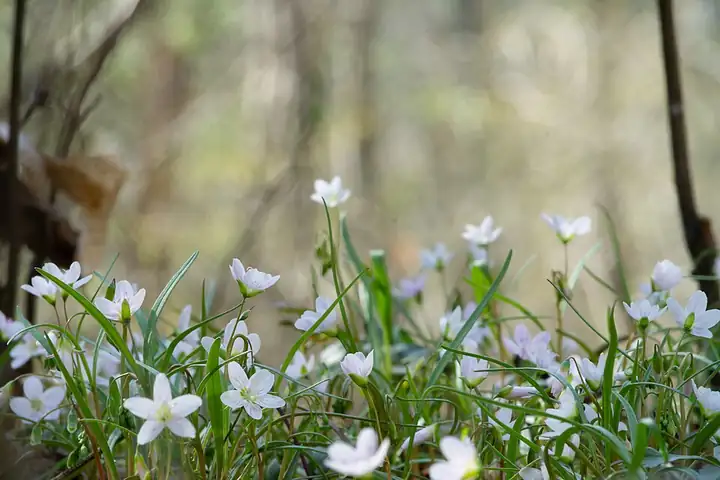
Spring beauty
Claytonia virginica · Miner's lettuce family (Montiaceae; formerly the purslane family, Portulacaceae)
| Hardiness zones | 3 to 8 |
|---|---|
| Sun | full sun to part shade |
| Water | moderate |
| Life cycle | perennial |
| Frost | Hardy: takes frost |
| Spacing | 3 inches |
About Spring beauty
Spring beauty is a small native wildflower: loose sprays of white to pale pink flowers striped with darker pink rise over narrow, grass-like leaves in early spring, and the whole plant goes dormant by late spring (NC State, wildflower.org). It grows from a small corm and spreads by offsets and seed into carpets in woods, meadows and even lawns. It is native from Nova Scotia and Minnesota south to Georgia and east Texas, west to eastern Nebraska and Kansas (wildflower.org). One native mining bee, Andrena erigeniae, gathers pollen only from spring beauty (NC State).
Hardy in zones 3-8 (NC State). Native and not invasive, though NC State notes it can naturalize and spread.
When to plant
Timing is counted from your average last spring frost (and first fall frost). Sow & Tell works out the actual dates for your ZIP code.
Plant corms 3 inches deep and 3 inches apart in fall (NC State). Sow seed as soon as it ripens in early summer (wildflower.org). Buy nursery corms instead of digging wild plants; Missouri Extension notes that removing wildflowers from public land is against the law.
Soil
Rich, moist, humus-filled soil that drains well, on the acid side, though it tolerates many soils (NC State, wildflower.org).
Mix in organic matter for rich, moist, well-drained, slightly acid soil (NC State, wildflower.org).
Feeding
- Fall, while dormant: a light mulch of shredded leaves or leaf compost. Missouri Extension recommends leaf mulch for woodland wildflowers; no fertilizer schedule is given.
Don't remove the leaves before the plant dies back on its own after the seed ripens (wildflower.org).
Harvest
Blooms in early spring, from as early as January in the South to May in the North; flowers open on sunny days and close at night and on cloudy days (NC State, wildflower.org). Don't deadhead: let it set seed, and the plant dies back soon after its pods ripen.
In the kitchen
The small corms, called fairy spuds, were eaten by Native peoples and early settlers and taste a bit like chestnuts or potatoes (NC State, wildflower.org, University of Kansas American Indian Health). If you try them, dig only from a patch you planted, take just the larger corms and leave the small ones to bloom again.
Safety: No toxicity is listed in the sources we used. Be certain of identification before eating any wild plant, and never dig it from the wild or public land.
Pets: Not listed by the ASPCA.
Sources
Photo: Photo: Jasper Shide, CC0, via Wikimedia Commons (CC0). Photo resized for the web.

Planting dates and advice are general guidance; check with your local Cooperative Extension office for your area.