
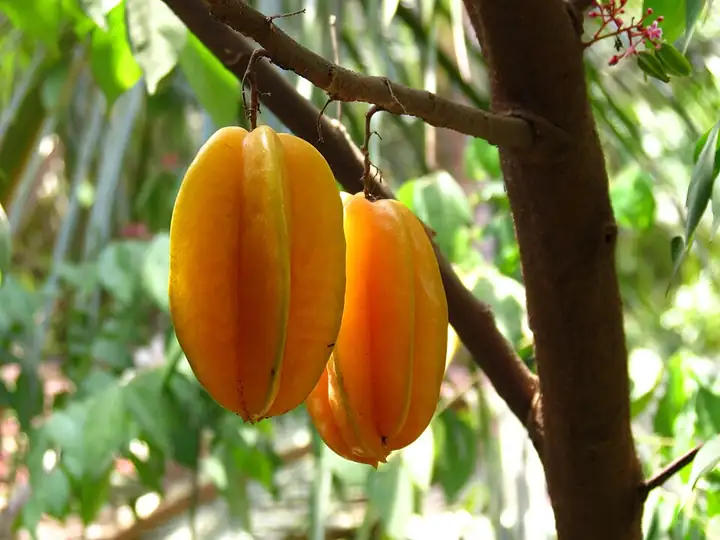
Starfruit (carambola)
Averrhoa carambola · Wood sorrel family (Oxalidaceae)
| Hardiness zones | 10 to 11 |
|---|---|
| Sun | full sun |
| Water | moderate |
| Life cycle | perennial |
| Frost | Tender: killed by frost |
| Soil pH | 4.5–7.0 |
| Spacing | 240 to 360 inches |
About Starfruit (carambola)
Starfruit is an evergreen tropical tree, usually kept 6-12 ft tall by pruning, whose waxy, yellow, ribbed fruit makes a star shape when sliced. Sweet types are best for eating fresh, while tart types suit cooking. Important: starfruit contains oxalic acid, and people with kidney disease should not eat it unless their doctor says it is safe, because it can cause a rapid drop in kidney function (UF/IFAS).
No source we found gives USDA zones; the 10-11 range is our reading of UF/IFAS cold data (young trees die at 27-29 F, mature trees at 20-24 F) and its advice that starfruit grows well only in warm south Florida coastal counties, with protection farther north. The UF/IFAS Assessment rates it 'not a problem species' in Florida.
When to plant
Timing is counted from your average last spring frost (and first fall frost). Sow & Tell works out the actual dates for your ZIP code.
Plant a grafted tree in full sun, 20-30 ft from buildings and other trees, in a warm spot out of constant wind (UF/IFAS). Trees in wind-protected spots start fruiting 10-14 months after planting; young leaves are hurt at 30-32 F, young trees can die at 27-29 F and mature trees at 20-24 F (UF/IFAS).
Soil
Grows in many well-drained soils, from sand to rocky limestone, at about pH 4.5-7; it can't take salty soil or water, and on alkaline soil it often runs short of iron, manganese and zinc (UF/IFAS).
Don't add fertilizer, topsoil or compost to the planting hole; if you amend, mix no more than half compost with the dug soil, and plant on a 3-4 ft mound where the water table is high (UF/IFAS).
Feeding
- First year, every 1-2 months: mixed fertilizer with nitrogen, phosphate, potash and magnesium (about 6-8% N, 2-4% P2O5, 6-8% K2O, 3-4% Mg). UF/IFAS uses 1/4 to 1/2 lb per application, 5-6 times in the first year, spread under the canopy.
- Each later year, raising the amount as the tree grows: the same mixed fertilizer. UF/IFAS raises it to 1-1.5 lb per feeding by year 3 and 1-5 lb per feeding, 4-6 times a year, on mature trees (about March, May, July, September and November).
- Warm months, 3-6 times a year: micronutrient (manganese, zinc, iron) spray; chelated iron drench on high-pH soil. Follow the label; on alkaline soil UF/IFAS uses a chelated iron soil drench 4-6 times a year.
Don't overwater with timed sprinklers (root rot) and keep heavy lawn fertilizer away from the tree, which can cut fruiting (UF/IFAS).
Harvest
Pick when the grooves between the ribs turn from green to yellow while the rib edges are still green; fruit does not get sweeter after picking, so tree-ripened fruit is sweetest (UF/IFAS). In south Florida fruit ripens from June to February, peaking in August-September and December-February.
In south Florida the tree blooms mainly in April-May and September-October, and fruit ripens from June to February with peaks in August-September and December-February. UF/IFAS says pruning long shoots can push an extra, off-season crop about 3 months later.
Varieties (16)
| Variety | Type | Days | Notes |
|---|---|---|---|
| Arkin | Sweet | Sweet, with good quality and flavor. Medium to large fruit, yellow to dark yellow-orange; Florida selection. Sets heavy crops planted alone or in a block. | |
| B-10 | Sweet | Sweet, with good quality and flavor. Medium to large, yellow to dark yellow-orange fruit from Malaysia. | |
| B-16 | Sweet | Sweet, fair quality and flavor. Medium to large yellow fruit; from Malaysia. | |
| B-17 | Sweet | Sweet, with good quality and flavor. Medium to large, yellow to dark yellow-orange fruit from Malaysia. | |
| B-2 | Sweet | Sweet, fair quality and flavor. Medium to large, white to light yellow fruit; from Malaysia. | |
| Demak | Sweet | Sweet but with a bitter aftertaste; poor quality. Medium to large yellow fruit; from Indonesia. | |
| Fwang Tung | Sweet | Sweet, with very good flavor. Medium to large, white to light yellow fruit from Thailand; sets heavy crops planted alone or in a block. | |
| Hew-1 | Sweet | Sweet, with good flavor. Medium to large yellow fruit with whitish spots on the skin; from Malaysia. | |
| Kajang | Sweet | Sweet, with good quality and flavor. Medium to large, yellow to dark yellow-orange fruit; from Hawaii. | |
| Kary | Sweet | Sweet, with very good quality and flavor. Medium to large, yellow to dark yellow-orange fruit; from Hawaii. | |
| Lara | Sweet | Sweet, with good quality and flavor. Medium to large, yellow to dark yellow-orange fruit; Florida selection. | |
| Sri Kembangan | Sweet | Sweet, with good quality and flavor. Large, yellow to dark yellow-orange fruit; from Malaysia. | |
| Golden Star | Tart | Tart unless left to ripen fully on the tree, when it turns sweet. Medium to large, yellow to dark yellow-orange fruit; Florida selection. Its seedlings handle high-pH soil better than Arkin's; sets heavy crops planted alone or in a block. | |
| Newcomb | Tart | Tart. Medium to large, yellow to dark yellow fruit; Florida selection, good for cooking. | |
| Star King | Tart | Tart. Medium to large, yellow to dark yellow fruit; Florida selection. | |
| Thayer | Tart | Tart; UF/IFAS rates its quality and flavor poor. Medium to large, yellow to dark yellow fruit; Florida selection. |
Pests to watch for
Scale insects, Stink bugs, Leaffooted bugs, Thrips, Birds, Opossum, Raccoon
Diseases and problems
Leaf spot, Algal leaf spot (red alga), Anthracnose, Sooty blotch, Root and crown rot
In the kitchen
Slice it into stars for eating fresh, fruit salads or a garnish; it is also made into pickles, sauces, jelly, preserves and dried fruit (UF/IFAS).
Keeping it: Wash the fruit under running water before eating. Refrigerated in a plastic bag it keeps up to about 3 weeks (UF/IFAS), or slice and freeze it to keep it longer (UF/IFAS Miami-Dade).
Safety: Kidney warning: people with kidney disease should not eat starfruit or drink its juice unless their doctor says it is safe. It is high in oxalic acid and can cause a sudden drop in kidney function (UF/IFAS), and it holds a nerve toxin that healthy kidneys clear but failing kidneys can't, which can lead to hiccups, confusion, seizures and, in serious cases, death (National Kidney Foundation).
Pets: Not listed by the ASPCA. Its high oxalate content is still a reason to keep pets from eating it.
Sources
- ask.ifas.ufl.edu
- aspca.org
- blogs.ifas.ufl.edu
- blogs.ifas.ufl.edu
- assessment.ifas.ufl.edu
- kidney.org
- aspca.org
Photo: Photo: Mailamal / Wikimedia Commons, CC BY-SA 3.0 (CC BY-SA 3.0). Photo resized for the web.

Planting dates and advice are general guidance; check with your local Cooperative Extension office for your area.