
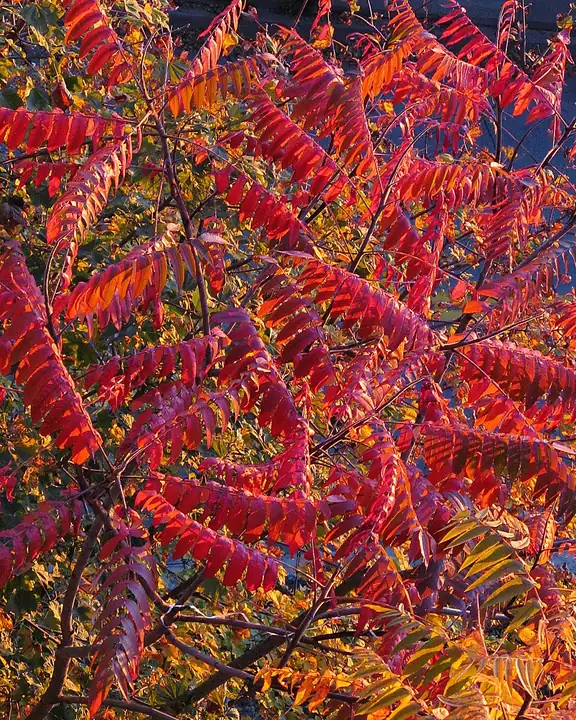
Sumac
Rhus glabra (smooth sumac), R. typhina (staghorn sumac; syn. R. hirta) and R. aromatica (fragrant sumac) as groups; NOT poison sumac (Toxicodendron vernix) · Cashew family (Anacardiaceae)
| Hardiness zones | 3 to 9 |
|---|---|
| Sun | full sun to part shade |
| Water | low |
| Life cycle | perennial |
| Frost | Hardy: takes frost |
About Sumac
Sumacs are tough native shrubs grown for blazing orange and red fall color and upright clusters of fuzzy red berries that feed birds through winter. Smooth sumac is the only shrub native to all 48 lower states, staghorn sumac grows wild from Quebec and Minnesota south to Georgia and Alabama, and the low fragrant sumac ranges from Quebec to Georgia and Texas and west to California (wildflower.org, NC State). Smooth and staghorn sumac spread hard by root suckers into colonies, so they suit slopes and wild edges more than small beds; fragrant sumac is smaller and less aggressive (NC State). Garden sumacs are not poison sumac: poison sumac grows in swamps and bogs, has 7-13 smooth-edged leaflets on a red stalk and drooping clusters of whitish berries, while these sumacs have toothed leaflets and upright clusters of red berries (NC State, Alabama Extension).
All three are hardy in zones 3-9 (NC State). Smooth and staghorn sumac sucker into thickets, and NRCS says smooth sumac can turn weedy if it isn't managed.
When to plant
Timing is counted from your average last spring frost (and first fall frost). Sow & Tell works out the actual dates for your ZIP code.
Plant container shrubs in spring or fall and water deeply until established, at least two growing seasons (UMN). Smooth and staghorn sumac need room to spread; plant fragrant sumac (or 'Gro-Low') for a small space or a slope (NC State). Only female plants make berries, and you need a male nearby (NC State).
Soil
Any well-drained soil, including dry, rocky, sandy or clay ground; not for soggy sites. Very drought tolerant once settled (NC State, NRCS).
No special prep: sumacs grow in poor, dry, rocky soil as long as it drains (NC State, NRCS).
Feeding
Water is what new shrubs need most: daily for the first 2 weeks, every 2-3 days through week 12, then weekly until the roots spread, at least two growing seasons, using about a quarter to a third of the nursery pot's volume each time (UMN). After that, sumac is very drought tolerant (NRCS), and Clemson notes established drought-tolerant shrubs often need little or no fertilizer.
Harvest
Flower clusters open in late spring to summer on smooth and staghorn sumac (May-July) and in early spring, before the leaves, on fragrant sumac (March-April); the red berry clusters ripen from late summer and hang on into winter (NC State, NRCS). Cut leggy smooth or staghorn sumac to the ground every few years to renew it (NC State); avoid nicking staghorn's thin bark with mowers and trimmers, which sets off suckers (wildflower.org).
Varieties (5)
NC State documents these; NRCS knows of no smooth sumac cultivars.
| Variety | Type | Days | Notes |
|---|---|---|---|
| Gro-Low | Fragrant sumac | Low groundcover under 3 ft tall, spreading about 8 ft; good for slopes and erosion control. | |
| Konza | Fragrant sumac | Disease resistant with a good growth form; provides wildlife cover. | |
| Dissecta | Staghorn sumac | Deeply cut leaves; spreads aggressively. | |
| Laciniata | Staghorn sumac | Fern-like, cut leaves; 10-20 ft. | |
| Tiger Eyes | Staghorn sumac | Golden, finely cut leaves; suckers much less than the species. |
Pests to watch for
Aphids, Scale insects, Twospotted spider mite
Diseases and problems
Leaf spot, Rust, Vascular wilt
In the kitchen
NC State lists smooth sumac's fruit as edible and says staghorn sumac's fruit, soaked in water, makes a tart, lemony drink. Only use the red, fuzzy, upright berry clusters of a sumac you've identified for sure.
Safety: Smooth, staghorn and fragrant sumacs are not poisonous to touch; NC State calls staghorn sumac not poisonous. Poison sumac (Toxicodendron vernix) is a different plant that causes a severe, blistering rash: it grows in wet, acid swamps and bogs, has 7-13 smooth-edged leaflets on a reddish stalk and drooping clusters of whitish berries, while these sumacs have toothed leaflets (11-31 on smooth sumac) and upright red berries. Fragrant sumac has three leaflets like poison oak and poison ivy, but its three leaflets meet at one point, while their end leaflet sits on a short stalk (NC State, Alabama Extension).
Pets: Not listed by the ASPCA.
Sources
- plants.ces.ncsu.edu
- plants.ces.ncsu.edu
- plants.ces.ncsu.edu
- wildflower.org
- wildflower.org
- wildflower.org
- plants.sc.egov.usda.gov
- plants.ces.ncsu.edu
- aces.edu
- extension.umn.edu
- aspca.org
- hgic.clemson.edu
Photo: Photo: Cbaile19, CC0, via Wikimedia Commons (CC0). Photo resized for the web.

Planting dates and advice are general guidance; check with your local Cooperative Extension office for your area.