
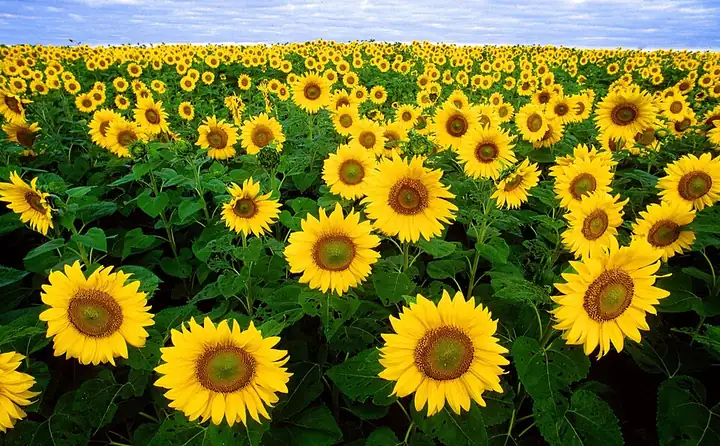
Sunflower
Helianthus annuus · Daisy family (Asteraceae)
| Hardiness zones | 2 to 11 |
|---|---|
| Sun | full sun |
| Water | moderate |
| Life cycle | annual |
| Frost | Tender: killed by frost |
| Soil pH | 6.0–6.8 |
| Spacing | 6 to 24 inches |
| Days to harvest | 50 to 95 days |
| Soil temperature to plant | at least 60°F |
About Sunflower
The common sunflower is a North American annual that ranges from 2-foot dwarfs to 10-foot giants. Its big heads feed bees and other pollinators in summer and finches and other seed-eating birds in fall.
Grown as a summer annual in every zone; frost kills it.
When to plant
Timing is counted from your average last spring frost (and first fall frost). Sow & Tell works out the actual dates for your ZIP code.
- Sow seeds outdoors: up to 3 weeks after the last frost
Days count from sowing to bloom, depending on variety. Sow seed 1 inch deep after all danger of frost, once soil is at least 60 F; seedlings appear in 7-10 days. Space 6 inches for short types, 1 foot for tall ones and 2 feet for giants.
Soil
Moist, well-drained soil; established plants tolerate drought.
Follow a soil test; without one, work in about 2.5 lb of a balanced fertilizer such as 13-13-13 per 100 sq ft (25 lb per 1,000 sq ft). Sunflowers like well-drained soil with a pH of 6.0 to 6.8.
Feeding
- when seedlings have several true leaves: nitrogen fertilizer such as 34-0-0, or an all-purpose slow-release fertilizer. Side-dress about 5 lb of 34-0-0 per 100 ft of row beside the plants and water right away to move it to the roots.
Harvest
For seed, cut the head when the back turns from green to yellow-brown and the head nods down, then dry it for several weeks in a warm, airy place. Or leave heads standing for birds.
Varieties (24)
| Variety | Type | Days | Notes |
|---|---|---|---|
| Autumn Beauty | Branching | 4-6 ft branching plants with many flowers in autumn shades of orange and red. | |
| Pastiche | Branching | Multi-stemmed 4-5 ft plants with flowers in deep yellow, orange-red and mahogany blends. | |
| Ring of Fire | Branching | 5 in flowers with a chocolate center, a red ring and golden petal tips on long stems. | |
| Sonja | Branching | 2-6 ft branching plants with yellow-orange flowers; used for cutting. | |
| Soraya | Branching | 80 to 90 days | 4-6 ft branching plants with 4-6 in orange flowers with chocolate centers on long stems. |
| Suncredible Yellow | Branching | Bush-type ornamental sunflower with yellow flowers. | |
| Sunfinity Double Yellow | Branching | 32-40 in plants with double yellow flowers that keep reblooming. | |
| The Joker | Branching | About 6 ft tall with 4 in double flowers in red and yellow. | |
| Valentine | Branching | About 4 ft tall with pale lemon flowers and dark centers; produces lots of blooms. | |
| Velvet Queen | Branching | About 5-6 ft tall with velvety dark red petals and a chocolate center. | |
| Big Smile | Dwarf | Dwarf, 1-2 ft, with 3-6 in flowers of golden rays around a black center. | |
| Suntastic Yellow with Black Center | Dwarf | ||
| Teddy Bear | Dwarf | 2-3 ft branching plants with fluffy, golden, pompom-like double flowers. | |
| American Giant | Giant | Giant sunflower 8 ft or taller. | |
| Cyclops | Giant | Giant sunflower 8 ft or taller. | |
| Lemon Queen | Giant | Tall sunflower, 8 ft or more, with yellow flowers. | |
| Mammoth Russian | Giant | Giant type; UMN says giant sunflowers grow 8 feet or taller. | |
| Mongolian Giant | Giant | Very tall, 12-14 ft, with golden heads 16-18 in across. | |
| Russian Giant | Giant | Up to about 10 ft tall with yellow rays and a dark center. | |
| ProCut series | Pollenless cut flower | Single-stem, pollenless cut-flower series, 2-8 ft tall, in many colors and forms. | |
| Sunrich series | Pollenless cut flower | Pollenless cut-flower sunflowers; 'Sunrich Orange' reached about 5 ft with 6 in golden-orange flowers, 'Sunrich Lemon' about 4 ft with light green centers. | |
| Italian White | Semi-dwarf / mid-height | Mid-height sunflower, 3-8 ft tall. | |
| Moonwalker | Semi-dwarf / mid-height | 4-5 ft plants with yellow rays around a dark chocolate center. | |
| Moulin Rouge | Semi-dwarf / mid-height | 4-7 ft plants with dark red flowers and black centers. |
Pests to watch for
Aphids, Stink bugs, Tarnished plant bug, Lace bugs (azalea and chrysanthemum lace bugs), Four-lined plant bug, Leaffooted bugs
Diseases and problems
Powdery mildew, Downy mildew, Rust, Verticillium wilt, Bacterial wilt
In the kitchen
Seeds are eaten as snacks and pressed for oil; petals are edible and young buds can be steamed like artichokes.
Keeping it: Cut in the morning and get stems straight into water; change it every few days. Pollenless kinds keep pollen off the table and last longer.
Pets: Not toxic to dogs, cats or horses (ASPCA 'Sunflower' entry, which names the related Helianthus angustifolius)
Sources
Photo: Photo: Bruce Fritz, U.S. Department of Agriculture, Public domain (USDA), via Wikimedia Commons. Photo resized for the web.

Planting dates and advice are general guidance; check with your local Cooperative Extension office for your area.