
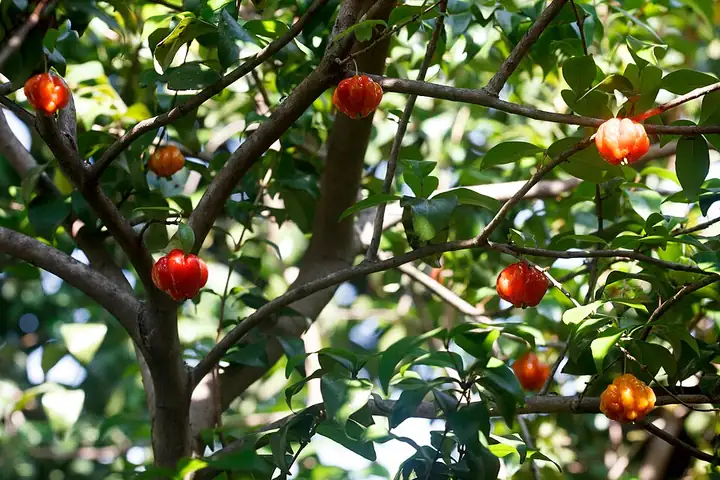
Surinam cherry
Eugenia uniflora · Myrtle family (Myrtaceae)
| Hardiness zones | 9 to 11 |
|---|---|
| Sun | full sun to part shade |
| Water | moderate |
| Life cycle | perennial |
| Frost | Half-hardy: takes a light frost |
| Spacing | 24 to 60 inches |
About Surinam cherry
Surinam cherry (pitanga) is an evergreen shrub or small tree with red new leaves and small, ribbed fruit that looks like a glossy mini pumpkin, turning red or, in some plants, dark maroon to nearly black when ripe. Ripe fruit is juicy, with a resin-like note that is strongest when underripe; the dark types are sweeter and less resinous. Heads-up: it is a Florida Category I invasive plant, because birds spread its seeds into natural areas, and UF/IFAS asks south Florida gardeners not to plant it.
UF/IFAS lists zones 9b-11; young plants are hurt below about 28 F, while established plants had only light damage at 22 F (Morton, Purdue NewCROP). The Florida Invasive Species Council lists it as Category I invasive, and the UF/IFAS Assessment calls it invasive in south Florida and 'caution' in central and north Florida; it is not on Florida's legal noxious weed list.
When to plant
Timing is counted from your average last spring frost (and first fall frost). Sow & Tell works out the actual dates for your ZIP code.
Space plants 2-5 ft apart for a hedge (UF/IFAS); a single plant can reach 8-20 ft tall. Seedlings grow slowly: some fruit at 2 years, others take 5-6 years or more (Morton, Purdue NewCROP).
Soil
Grows in almost any well-drained soil, from sand to clay and soft limestone; it handles brief flooding but not salt (Morton, Purdue NewCROP; UF/IFAS).
Almost any well-drained soil works; skip salty sites (Morton, Purdue NewCROP).
Feeding
- Every 3 months (quarterly): complete (balanced) fertilizer. Morton notes quarterly feeding encourages fruiting; follow the label, and water well, since a good soaking makes fruit bigger and sweeter.
Don't let fruit or seedlings escape into natural areas in Florida; it is invasive there (UF/IFAS).
Harvest
Fruit ripens about 3 weeks after the flowers open (Morton). Pick only fully ripe fruit that drops into your hand at the slightest touch; underripe fruit tastes strongly of resin, so check plants daily (Morton). Florida plants give a spring crop (March-June) and often a second crop in September-November.
In Florida there is a spring crop (March-June) and often a second, fall crop (September-November); fruit ripens just 3 weeks after bloom, so pick daily. A dry spell followed by water and fertilizer can set off an extra flush of bloom.
Varieties (1)
Extension and university sources describe two fruit types, the common red and a rarer dark (maroon to nearly black) type, and name only one cultivar, 'Zill Dark'.
| Variety | Type | Days | Notes |
|---|---|---|---|
| Zill Dark | Dark-fruited | Dark fruit types are sweeter and less resinous than the common red ones (Morton). A grafted Florida selection whose fruit ripens through red to dark maroon or nearly black; isolated plants set fruit on their own the year after planting. |
Pests to watch for
Scale insects, White grubs
Diseases and problems
Leaf spot, Anthracnose, Thread blight, Root and crown rot, Armillaria root rot
In the kitchen
Eat fully ripe fruit fresh; for the table, cut out the seeds and chill the fruit a couple of hours (a sprinkle of sugar helps) to soften the resin taste. It also goes into fruit cups, ice cream, pies, sauces, jam, jelly and relish (Morton, Purdue NewCROP).
Safety: Don't eat the seeds: they are very resinous (Morton, Purdue NewCROP). The strong, spicy smell given off when pruning can irritate the airways of sensitive people.
Pets: Not listed by the ASPCA. Morton notes dogs fed whole fruits got diarrhea, so keep pets from eating them.
Sources
- ask.ifas.ufl.edu
- fnai.org
- plant-directory.ifas.ufl.edu
- gardeningsolutions.ifas.ufl.edu
- hort.purdue.edu
- journals.flvc.org
- aspca.org
- assessment.ifas.ufl.edu
- floridainvasives.org
- extension.umd.edu
- yardandgarden.extension.iastate.edu
- aspca.org
Photo: Photo: Tijden / Wikimedia Commons, CC BY-SA 4.0 (CC BY-SA 4.0). Photo resized for the web.

Planting dates and advice are general guidance; check with your local Cooperative Extension office for your area.