
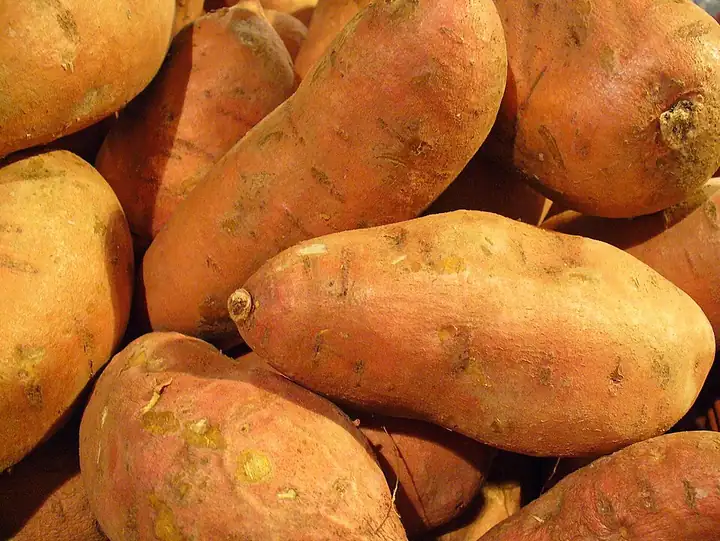
Sweet potato
Ipomoea batatas · Morning glory family (Convolvulaceae)
| Hardiness zones | 3 to 11 |
|---|---|
| Sun | full sun |
| Water | moderate |
| Life cycle | tender perennial (grown as an annual) |
| Frost | Tender: killed by frost |
| Soil pH | 5.5–6.2 |
| Spacing | 12 to 18 inches |
| Days to harvest | 90 to 120 days |
| Soil temperature to plant | at least 65°F |
About Sweet potato
Sweet potatoes are sprawling vines grown from rooted sprouts called slips, and their sweet orange or pale roots store for months. They love heat and need a long, warm frost-free season, which makes them a Southern favorite.
Grown as a summer annual, but it needs a long, hot frost-free season (Texas A&M: about 150 days before soil cools to 55F), so it is easiest in the South and a challenge in short-season northern gardens; it is perennial only in about zones 9-11.
When to plant
Timing is counted from your average last spring frost (and first fall frost). Sow & Tell works out the actual dates for your ZIP code.
- Set out plants: 1 to 2 weeks after the last frost
Days to harvest count from setting out slips; some varieties such as Jewel take 120 to 135 days. Most gardeners buy slips; roots sprouted at home take about 6 weeks to produce them.
Soil
Loose, well-drained sandy loam, ideally on a raised ridge; heavy clay gives small, misshapen roots.
Follow a soil test; without one, till in about 30 lb of 5-10-10 per 1,000 sq ft (about 3 lb per 100 sq ft) or work in compost before setting slips.
Feeding
- before the vines cover the row: low-nitrogen fertilizer such as 5-10-10. Spread about 4 lb per 100 ft of row beside the plants and water it in.
Too much nitrogen lowers yield and quality.
Harvest
Dig around the time of the first fall frost, or when about 30 percent of the roots are over 3 1/2 inches across. Cure at about 85F and high humidity for 1 to 2 weeks, then store above 50F.
Dig all at once near season's end, when about 30% of roots are over 3 1/2 inches across, and before frost, since cold soil hurts quality and storage.
Varieties (19)
| Variety | Type | Days | Notes |
|---|---|---|---|
| NC Japanese | Asian type, purple skin, white flesh | Purple skin and white flesh. | |
| Centennial | Orange-flesh | 100 to 110 days | Moist texture. Smooth skin with deep orange flesh. Resistant to root-knot nematode and wireworms. |
| Evangeline | Orange-flesh | Light to dark rose skin and intense deep orange flesh. Highly resistant to root-knot nematode and resistant to Fusarium wilt. | |
| Regal | Orange-flesh | Purplish-red skin and dark orange flesh. Resists internal cork, Fusarium wilt, soil rot, root-knot nematode and many soil insects. | |
| Porto Rico | Orange-flesh (heirloom) | Copper to light orange skin with salmon-orange flesh. Susceptible to Fusarium wilt and soil rot. | |
| Vardaman | Orange-flesh, bush type | 100 days | Compact bush-type vines. Smooth, oval roots with rich orange flesh; some Fusarium wilt resistance. |
| Averre | Orange-flesh, early | 90 to 100 days | Light rose skin, orange flesh and very high yields in a short season. Resistant to Fusarium wilt. |
| Beauregard | Orange-flesh, early | 90 to 100 days | Light rose skin and moderately deep orange flesh. Resistant to Fusarium wilt and Rhizopus soft rot; very susceptible to root-knot nematode. |
| Georgia Jet | Orange-flesh, early | Rose skin; high yielding. | |
| Orleans | Orange-flesh, early | Light rose skin like Beauregard with orange flesh; smooth skin that cures and stores well. Resistant to Fusarium wilt; susceptible to root-knot nematode. | |
| Jewel | Orange-flesh, late | 120 to 135 days | Copper skin and deep orange flesh. Resistant to Fusarium wilt, southern root-knot nematode and internal cork. |
| Covington | Orange-flesh, midseason | 95 to 115 days | Baked roots rate very good in taste panels, similar to Beauregard. Smooth rose skin and uniform orange flesh with very uniform root shape. Resistant to Fusarium wilt and southern root-knot nematode. |
| Bayou Belle | Orange-flesh, red skin | Red to purple skin and deep orange flesh; very high yield. Resistant to Fusarium wilt and highly resistant to Rhizopus soft rot. | |
| Burgundy | Orange-flesh, red skin | Red skin with deep orange flesh. Highly resistant to root-knot nematode and resistant to Fusarium wilt. | |
| Carolina Ruby | Orange-flesh, red skin | Deep red skin and orange flesh; high-yielding, blocky roots on thin, trailing vines. Resistant to Fusarium wilt. | |
| Murasaki-29 | Purple-skin, white-flesh (Japanese type) | 100 to 120 days | Drier, flakier texture with a nutty flavor; less creamy than orange types. Dark purple skin with white flesh on very vigorous vines. Highly resistant to root-knot nematode and resistant to Fusarium wilt. |
| Sumor | White to yellow flesh | 110 to 120 days | Not very sweet; cook it like a white potato. Light tan skin with white to yellow flesh. Resistant to Fusarium wilt, root-knot nematode and many insect pests. |
| Bonita | White-flesh | Light tan skin with a pink cast and white flesh with a hint of yellow. Highly resistant to root-knot nematode. | |
| O'Henry | White-flesh | Cream skin with white flesh; a white-fleshed mutation of Beauregard. |
Good neighbors
UMD Extension shows sweet potato as a ground cover under okra in an intensive garden; this is a space-saving idea rather than proven pest control.
Pests to watch for
Wireworms, Root-knot nematodes, Cutworms, Whiteflies, Mole crickets, Roof rats and Norway rats, Red imported fire ant, Beet armyworm, Sweetpotato weevil, Voles
Diseases and problems
Black rot, Fusarium wilt, Scurf, Internal cork, Streptomyces soil rot, Frost and freeze injury, Southern blight, Sooty mold
In the kitchen
Baked, roasted, mashed or made into pies and fries; orange-fleshed types are especially sweet.
Keeping it: After curing, keep sweet potatoes at 55 to 60F with moderate humidity for 4 to 6 months. Don't refrigerate raw roots; cold below 55F causes off-flavors and dark spots.
Pets: Listed as non-toxic to dogs, cats and horses (ASPCA, 'Sweet Potato Vine').
Sources
- hgic.clemson.edu
- aggie-horticulture.tamu.edu
- extension.illinois.edu
- gardeningsolutions.ifas.ufl.edu
- plants.ces.ncsu.edu
- extension.unh.edu
- extension.umd.edu
- extension.umd.edu
- aspca.org
- riley.k-state.edu
Photo: Photo: Llez, CC BY-SA 3.0, via Wikimedia Commons (CC BY-SA 3.0). Photo resized for the web.

Planting dates and advice are general guidance; check with your local Cooperative Extension office for your area.