
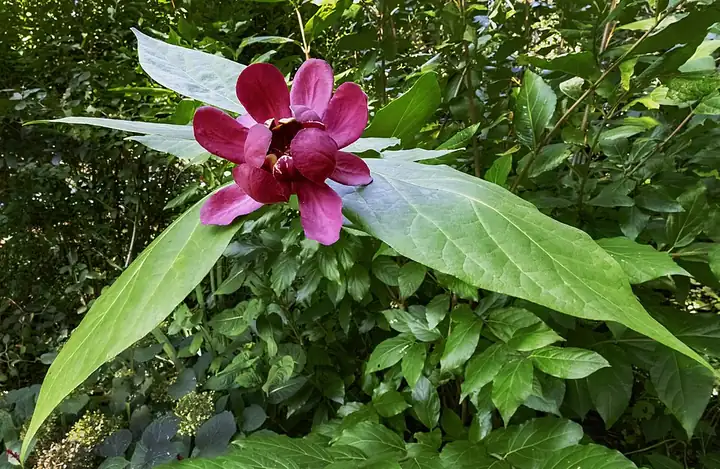
Sweetshrub (Carolina allspice)
Calycanthus floridus (common sweetshrub, Carolina allspice); hybrids such as C. x raulstonii 'Hartlage Wine' and 'Venus' are sold alongside it · Sweetshrub family (Calycanthaceae)
| Hardiness zones | 4 to 9 |
|---|---|
| Sun | full sun to part shade |
| Water | moderate |
| Life cycle | perennial |
| Frost | Hardy: takes frost |
About Sweetshrub (Carolina allspice)
Sweetshrub is an old-fashioned Southern shrub with maroon, many-petaled flowers in spring that smell like strawberries, pineapple and banana, plus leaves, stems and bark that are fragrant when bruised. It's native from Pennsylvania and New York south through the Southeast to Florida and Louisiana, in shady woods and along streams (NC State). Scent varies a lot from plant to plant, so buy one in bloom. The seeds are poisonous.
Hardy in zones 4-9 (NC State, Morton Arboretum). Plants spread by suckers into thickets unless you remove them.
When to plant
Timing is counted from your average last spring frost (and first fall frost). Sow & Tell works out the actual dates for your ZIP code.
Plant container shrubs in spring or fall, at least 6 ft from other shrubs (NC State), in a spot sheltered from strong wind (Morton Arboretum). It's shallow-rooted, so mulch to hold moisture and water deeply until established, at least two growing seasons (UMN).
Soil
Rich, moist, well-drained loam with plenty of organic matter, acid or alkaline; it handles brief flooding and occasional dryness but struggles in drought (NC State, Morton Arboretum).
Test the soil before planting; established shrubs in decent soil need little or no fertilizer (Clemson).
Feeding
- Spring to early summer after new growth starts, only if a soil test shows a need: slow-release complete fertilizer in a 3:1:2 ratio, or what the soil test calls for. Spread evenly from the trunk out to the drip line and water it in; a typical soil-test rate for shrubs is about 2 lb of 12-6-6 per 100 sq ft (Clemson). Follow a soil test.
Water is what new shrubs need most: daily for the first 2 weeks, every 2-3 days through week 12, then weekly until the roots spread (at least two growing seasons), using about a quarter to a third of the nursery pot's volume each time (UMN). It's shallow-rooted and struggles in drought, so keep it mulched and watered in dry spells (Morton Arboretum, NC State). Too much fertilizer burns roots and pushes leaves at the expense of flowers (Clemson).
Harvest
Blooms mid-April to mid-May, sometimes with a few flowers into July; the scent is strongest in warm weather (NC State). Prune right after flowering, and renew leggy plants by cutting out old stems (NC State, Morton Arboretum).
Varieties (6)
NC State and Morton Arboretum document these; 'Venus' and 'Hartlage Wine' are hybrids sold with sweetshrub.
| Variety | Type | Days | Notes |
|---|---|---|---|
| Aphrodite | Cultivar | Upright, 4-6 ft, with bright red flowers. | |
| Athens | Cultivar | Dense mound about 6 ft tall with very fragrant greenish-white to yellow flowers. | |
| Edith Wilder | Cultivar | Red, highly fragrant flowers. | |
| Michael Lindsey | Cultivar | Shiny leaves and very fragrant flowers. | |
| Venus | Hybrid | White flowers with purple centers, very fragrant; sets no fruit. | |
| Hartlage Wine | Hybrid (C. x raulstonii) | 6-8 ft tall and wide with deep maroon 2-inch flowers, only slightly fragrant; sun or shade; hardy to zone 6. |
In the kitchen
Safety: The seeds are poisonous: they hold calycanthine and related alkaloids, linked to convulsions and raised blood pressure (NC State rates the danger as low). Keep the urn-shaped seed pods away from children. It doesn't cause skin rashes (NC State).
Pets: Not listed by the ASPCA.
Sources
- plants.ces.ncsu.edu
- mortonarb.org
- extension.umn.edu
- aspca.org
- aspca.org
- aspca.org
- extension.rutgers.edu
- hgic.clemson.edu
Photo: Photo: Didier Descouens / Wikimedia Commons, CC BY-SA 4.0 (CC BY-SA 4.0). Photo resized for the web.

Planting dates and advice are general guidance; check with your local Cooperative Extension office for your area.