
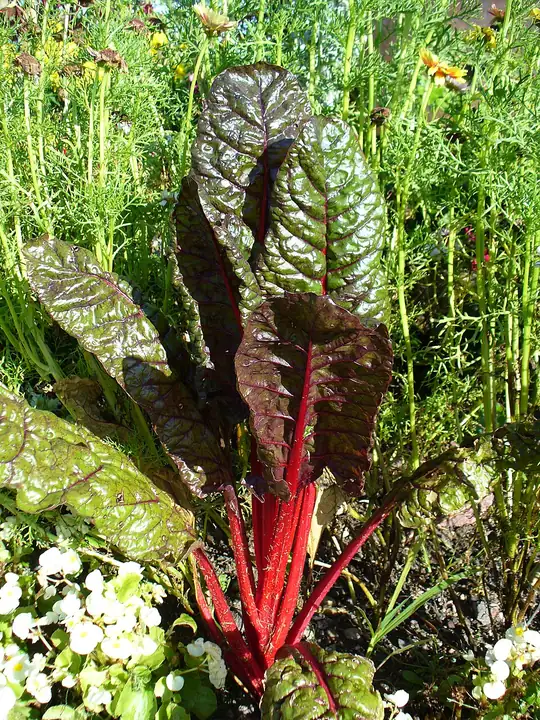
Swiss chard
Beta vulgaris (Cicla group) · Amaranth family (Amaranthaceae)
| Hardiness zones | 2 to 11 |
|---|---|
| Sun | full sun |
| Water | moderate |
| Life cycle | biennial |
| Frost | Half-hardy: takes a light frost |
| Soil pH | 6.0–6.5 |
| Spacing | 6 to 9 inches |
| Days to harvest | 45 to 60 days |
| Soil temperature to plant | at least 40°F |
About Swiss chard
Swiss chard is a beet grown for its big leaves and colorful stems instead of its root. It is one of the easiest greens: pick outer leaves and the plant keeps making more for months.
Grown as an annual in every zone; it tolerates light frost. As a biennial, it will not flower until it has lived through a winter.
When to plant
Timing is counted from your average last spring frost (and first fall frost). Sow & Tell works out the actual dates for your ZIP code.
- Start seeds indoors: 6 to 8 weeks before the last frost
- Set out plants: 2 weeks before the last frost
- Sow seeds outdoors: 2 to 4 weeks before the last frost
- Fall planting: 6 to 10 weeks before the first fall frost
Days count from seeding. In cold northern springs, waiting until after the last frost can help, because a long cold spell can make plants bolt; UMN suggests early to mid-May in Minnesota.
Soil
Well-drained soil improved with compost; chard tolerates slightly more acidic soil than spinach, down to about pH 6.
Follow a soil test and keep pH about 6.0 to 6.5; without a test, work in about 1 1/2 lb of balanced fertilizer such as 10-10-10 per 100 sq ft, or up to 1 inch of compost.
Feeding
- at thinning, or about 4 weeks after setting out transplants: nitrogen fertilizer such as 21-0-0. Spread about 1/4 cup per 10 ft of row beside the plants and water it in.
- after a big harvest of leaves: nitrogen fertilizer such as 21-0-0. Give a light side-dressing beside the row and water it in to help new leaves grow.
Do not use weed-and-feed products, and skip extra phosphorus unless a soil test calls for it.
Harvest
Pick outer leaves once they are big enough to use, leaving the center to keep growing (cut-and-come-again), or cut the whole plant at once.
Pick outer leaves and leave the center growing for repeated harvests all season; a light nitrogen side-dressing after picking helps new leaves come.
Varieties (15)
| Variety | Type | Days | Notes |
|---|---|---|---|
| Charbell | Colored stems | 35 days | A vigorous chard with bright stems that is slow to bolt. |
| Bright Lights | Multicolored stems | 55 to 60 days | Milder than ordinary chard. Stems in red, yellow, pink, orange and white with lightly crinkled green to bronze leaves. It won an All-America Selections award and is pretty enough for flower beds. |
| Rainbow | Multicolored stems | Stems in red, pink, white, orange, yellow and striped colors. | |
| Charlotte | Red stems | A red-stemmed chard on Wisconsin Extension's list. | |
| Ruby Red | Red stems | Deep green, crinkled leaves with red veins and bright red, slightly flat stems. | |
| Vulcan | Red stems | A red-stemmed chard on Wisconsin Extension's list. | |
| Rhubarb | Red stems, heirloom | 55 to 60 days | Reddish-green crinkled leaves on bright red, wide stems with an orange tint. Also sold as Rhubarb Red or Ruby chard. |
| Fordhook Giant | White stems | 50 to 60 days | Dark green, crinkled leaves with white veins on broad white stems. It stands up well to heat. |
| Large White Ribbed | White stems | Smooth, dark green leaves on broad, smooth, white stems that are a little flat. | |
| Lucullus | White stems | 50 days | A standard chard recommended by Utah State, Oklahoma State, Wisconsin and UF/IFAS. |
| Monstruoso | White stems | A white-stemmed chard on Wisconsin Extension's list. | |
| Paros | White stems | Mild and sweet. Tall, shiny, upright green leaves on thick white stalks. | |
| Silverado | White stems | Glossy, dark green leaves and white stems on a compact plant. | |
| Argentata | White stems, Italian heirloom | Mild and sweet. Silvery-white midribs and broad, crinkled, deep green leaves. | |
| Bright Yellow | Yellow stems | 28 days | Long, thick stems with yellow stems and veins. |
Pests to watch for
Leafminers, Flea beetles, Aphids, Cutworms, Slugs, Brown garden snail, Blister beetles, Deer
Diseases and problems
Cercospora leaf spot, Nitrogen deficiency
In the kitchen
Young leaves go raw into salads; older leaves and stems are sauteed, added to soups or cooked like spinach.
Keeping it: Like spinach, keep leaves cold and moist in a bag in the fridge and use them within about a week. The thick stems keep a little longer than the leaves.
Pets: Listed as non-toxic to dogs, cats and horses (ASPCA 'Beets' entry, which names Swiss chard); large mature leaves contain oxalic acid.
Sources
- extension.umn.edu
- hgic.clemson.edu
- extension.unh.edu
- extension.colostate.edu
- agrilifeextension.tamu.edu
- warren.cce.cornell.edu
- extension.purdue.edu
- aspca.org
- extension.usu.edu
- fieldreport.caes.uga.edu
Photo: Photo: Neelix, Public domain, via Wikimedia Commons. Photo resized for the web.

Planting dates and advice are general guidance; check with your local Cooperative Extension office for your area.