
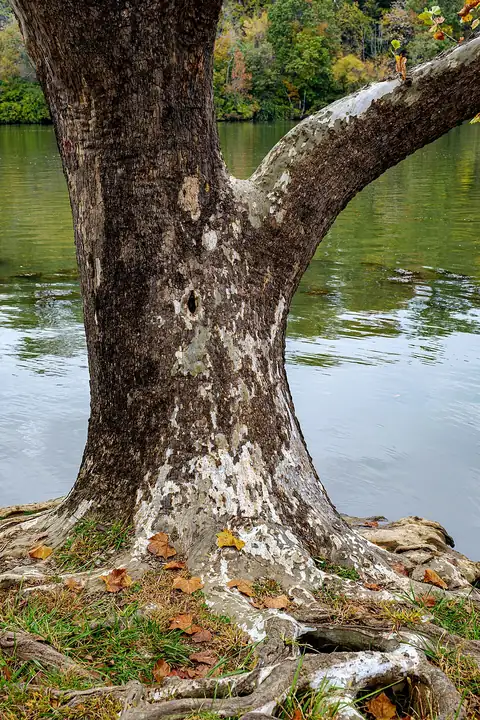
Sycamore
American sycamore (Platanus occidentalis) and London planetree (Platanus x acerifolia, a hybrid of American sycamore and Oriental planetree) · Plane-tree family (Platanaceae)
| Hardiness zones | 4 to 9 |
|---|---|
| Sun | full sun |
| Water | high |
| Life cycle | perennial |
| Frost | Hardy: takes frost |
About Sycamore
American sycamore is a huge, fast-growing native shade tree famous for its peeling bark that shows patches of white and cream, big maple-like leaves and round seed balls that hang into winter. It is native from southern Maine and southern Ontario west to Iowa, eastern Nebraska and Kansas and south to the Florida Panhandle and eastern Texas, along streams and bottomlands (wildflower.org). London planetree, a hybrid that arose in Europe in the 1600s, is the tough city street tree; both need lots of room and drop twigs, bark, leaves and seed balls, and sycamore anthracnose browns the leaves in cool, wet springs (NC State, Clemson).
Both are hardy in zones 4-9 (NC State).
When to plant
Timing is counted from your average last spring frost (and first fall frost). Sow & Tell works out the actual dates for your ZIP code.
Plant container or balled-and-burlapped trees; container trees can go in any time the ground can be worked, but fall is best in the South because roots keep growing through mild winters (Clemson). Dig no deeper than the root ball and at least twice as wide, set the top roots level with the soil, and mulch 2-4 inches deep without touching the trunk (Clemson). Sycamores need more than 60 ft of room; London planetree roots can lift sidewalks and get into sewer pipes, so keep it away from paving and lines (NC State).
Soil
Not fussy about soil texture or pH; best in deep, moist soil and it takes wet sites and occasional flooding, though it also handles some drought, clay and city conditions (NC State, wildflower.org).
Test the soil first. Loosen a wide planting area and mix 10-20 percent compost into the native soil you dig out; use only composted material, and don't dig deeper than the root ball (Clemson).
Feeding
- Spring to early summer, after the tree is established, and only if a soil test or weak growth shows a need: slow-release nitrogen fertilizer with a ratio near 3-1-1 or 3-1-2 (3-0-1 or 3-0-2 if the soil test shows enough phosphorus). Spread it evenly from just outside the trunk flare to the drip line and water it in. Clemson cites 2-4 lb of slow-release nitrogen per 1,000 sq ft per year, split between spring and late summer; follow your soil test.
- Late summer to early fall, the second half of the split feeding (only if a soil test calls for it): slow-release nitrogen fertilizer, same as spring. Water it in, and skip it if the tree is drought-stressed, since roots can't take up fertilizer from dry soil (Clemson).
First-year watering matters far more than fertilizer: water daily for the first 2 weeks, every 2-3 days through week 12, then weekly, using 1-1.5 gallons per inch of trunk diameter, until the tree is established (about 1.5 years for a 1-inch trunk). Skip a watering only after more than an inch of rain (UMN). Clemson advises keeping sycamores vigorous with watering and fertilizing as part of managing anthracnose, but feed by a soil test; heavy fertilizer pushes soft growth that pests and cold injure (Clemson).
Varieties (7)
NC State documents these London planetree cultivars, mostly chosen for disease resistance; we found no well-documented American sycamore cultivars.
| Variety | Type | Days | Notes |
|---|---|---|---|
| Bloodgood | London planetree | About 60 ft tall; bred for anthracnose resistance (Clemson rates it moderately resistant). | |
| Columbia | London planetree | About 50 ft tall; disease resistant, moderately resistant to anthracnose. | |
| Liberty | London planetree | About 50 ft tall; disease resistant, moderately resistant to anthracnose. | |
| Metzam | London planetree | About 70 ft tall; pyramidal and disease resistant. | |
| Morton Circle | London planetree | Pyramidal with a strong central trunk; vigorous and anthracnose resistant. | |
| Ovation | London planetree | Broader pyramidal to rounded shape. | |
| Yarwood | London planetree | Pyramidal and disease resistant. |
Pests to watch for
Lace bugs (azalea and chrysanthemum lace bugs), Japanese beetle, Scale insects, Twospotted spider mite
Diseases and problems
Sycamore anthracnose, Canker stain, Powdery mildew, Bacterial leaf scorch, Leaf spot
In the kitchen
The sweet sap can be tapped in spring and boiled into syrup, though it is low in sugar, so it takes more sap than maple (NC State, wildflower.org).
Safety: NC State gives no poison rating for sycamore or London planetree.
Pets: Not listed by the ASPCA. NC State tags American sycamore as non-toxic to cats, dogs and horses.
Sources
- plants.ces.ncsu.edu
- plants.ces.ncsu.edu
- wildflower.org
- hgic.clemson.edu
- aspca.org
- aspca.org
- hgic.clemson.edu
- hgic.clemson.edu
- extension.umn.edu
Photo: Photo: Lee Ann Ratledge / Wikimedia Commons, CC BY 4.0 (CC BY 4.0). Photo resized for the web.

Planting dates and advice are general guidance; check with your local Cooperative Extension office for your area.