
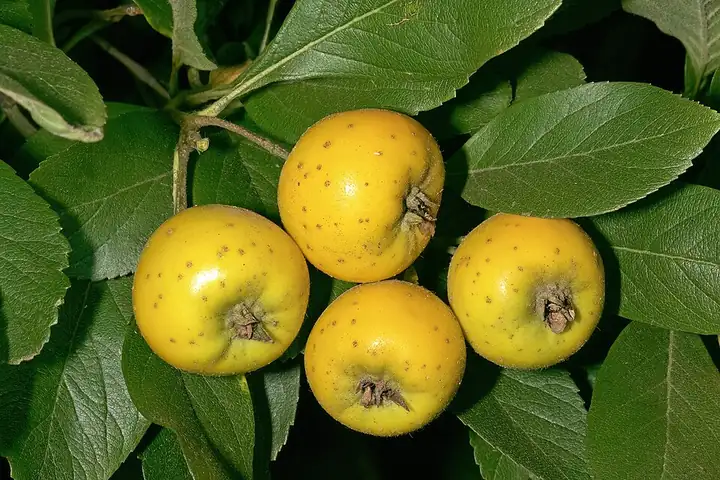
Tejocote (Mexican hawthorn)
Crataegus mexicana (syn. C. pubescens) · Rose family (Rosaceae)
| Hardiness zones | 8 to 9 |
|---|---|
| Sun | full sun |
| Water | moderate |
| Life cycle | perennial |
| Frost | Hardy: takes frost |
About Tejocote (Mexican hawthorn)
Tejocote is a small, mostly evergreen hawthorn tree from the mountains of Mexico and Guatemala. Its golden to orange fruits, like tiny crabapples, ripen in late fall and are a must for Mexican Christmas ponche, Day of the Dead altars and pinatas. It is grown in southern California, where there are commercial orchards; fresh tejocotes from Mexico were only allowed into the U.S. after USDA APHIS approved commercial, inspected shipments in 2015.
Rated for zones 8-9: it takes at least 0F but may drop leaves below about 18F, and it grows best in the West, such as the San Francisco Bay Area; give it a warm, sunny spot (Trees and Shrubs Online).
When to plant
Timing is counted from your average last spring frost (and first fall frost). Sow & Tell works out the actual dates for your ZIP code.
Fruiting trees are usually grafted onto tejocote seedlings (Perez-Ortega and others). Seed is very slow, with 2 to 3 years of dormancy, but layering and root cuttings root easily (CONAFOR). No source gives a planting season for U.S. gardens.
Soil
Adapted to shallow, poor and limy soils and winter drought (Perez-Ortega and others; CONAFOR), but it fruits better with summer watering in dry climates (Trees and Shrubs Online).
Choose a warm, sunny, well-drained spot; tejocote copes with poor, shallow, limy soil (CONAFOR; Perez-Ortega and others).
Feeding
In dry-summer climates don't let it go without water all summer; it survives drought but grows and fruits better with some irrigation (Trees and Shrubs Online).
Harvest
Fruit ripens November to December in Mexico (CONAFOR) and can hang on the tree into winter unless people or birds get it first (Trees and Shrubs Online). Pick when it turns golden yellow to orange.
One crop a year, ripening in November and December in Mexico; fruit can hang on the tree into winter if birds leave it alone.
Varieties (2)
No named cultivars are documented; Mexican researchers describe two provisional fruit types, and some local clones have been picked out for fruit quality.
| Variety | Type | Days | Notes |
|---|---|---|---|
| Cedar type | Fruit type | Usually spiny, with small red or yellow fruit (about 1/3 to 2/3 inch); grown mostly as an ornamental or hedge. | |
| Manzanita type | Fruit type | Thornless, commonly cultivated tree with relatively large yellow fruit; forms a regular framework that rarely needs corrective pruning. |
Pests to watch for
Apple maggot, Birds
In the kitchen
Eaten fresh, simmered in Christmas ponche and compotes, and made into jams, jellies and ate (fruit paste); the fruit is rich in pectin and vitamin C (CONAFOR; Nunez-Colin; Perez-Ortega and others).
Safety: Some forms have stout thorns 1.5 to 2 inches long; the 'manzanita' fruit type is thornless. The FDA warns that many supplements sold as 'tejocote root' (raiz de tejocote) for weight loss actually contained poisonous yellow oleander, which can cause severe or fatal heart problems; don't use them.
Pets: Listed as non-toxic to dogs, cats and horses by the ASPCA (hawthorn, Crataegus species)
Sources
- treesandshrubsonline.org
- redalyc.org
- agro.icm.edu.pl
- idefor.cnf.gob.mx
- publicaciones.inecol.mx
- ishs.org
- govinfo.gov
- govinfo.gov
- regulations.justia.com
- npgstest.ars-grin.gov
- fda.gov
- aspca.org
Photo: Photo: SAplants, CC BY-SA 4.0, via Wikimedia Commons (CC BY-SA 4.0). Photo resized for the web.

Planting dates and advice are general guidance; check with your local Cooperative Extension office for your area.