
Tepary bean
Phaseolus acutifolius · Pea family (Fabaceae)
| Hardiness zones | 3 to 11 |
|---|---|
| Sun | full sun |
| Water | low |
| Life cycle | annual |
| Frost | Tender: killed by frost |
| Spacing | 4 inches |
| Days to harvest | 60 to 120 days |
About Tepary bean
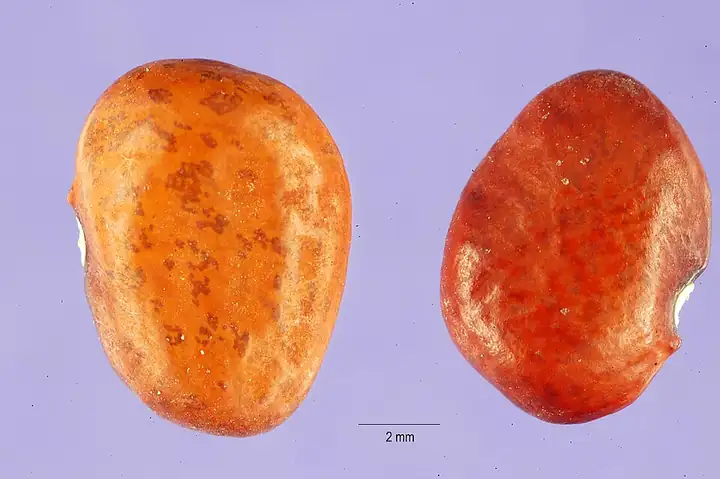
Tepary is a native desert bean of Arizona, New Mexico, Texas and Mexico, grown for small, nutty dry beans in white, brown, black and speckled colors. The Tohono O'odham of the Sonoran Desert kept it as a staple, planting it with the summer monsoon rains. It sets seed in heat above 105F and needs far less water than common beans, so it suits hot, dry gardens.
Grown as a warm-season annual; it does best in hot, dry summers like the desert Southwest. About a century ago farmers also grew it in California and the Midwest (USDA NRCS).
When to plant
Timing is counted from your average last spring frost (and first fall frost). Sow & Tell works out the actual dates for your ZIP code.
In the low deserts, sow 1 to 1.5 inches deep when the monsoon rains start (mid-June to mid-July), or earlier if you can water; space seeds about 4 inches apart in rows 12 to 16 inches apart (USDA NRCS). Days count from sowing to harvest of dry beans.
Soil
A firm, weed-free, well-drained seedbed; wild plants grow on sandy and silty wash soils, and teparies take more salt than common beans (USDA NRCS).
Prepare a firm, weed-free seedbed and test the soil before planting to see whether anything needs to be added (USDA NRCS).
Feeding
Too much nitrogen keeps the roots from fixing their own, and too much water gives leafy plants with fewer beans (USDA NRCS; UC ANR).
Harvest
Let the pods dry on the plant, then pull the plants, beat or stomp out the beans and winnow away the chaff (USDA NRCS). A crop can be ready in about two months in good conditions (UC ANR).
Grown for dry beans: let the pods dry, then pull the whole planting and thresh it. In the desert, monsoon-sown teparies were traditionally harvested by October.
Varieties (2)
USDA NRCS says teparies are grown mostly as local landraces (white, brown, black and speckled), with few improved varieties; only two USDA-ARS releases are documented.
| Variety | Type | Days | Notes |
|---|---|---|---|
| USDA Fortuna (TARS-Tep 23) | Improved dry bean | 66 to 67 days | Larger, fast-cooking seed without hard seeds; resists leafhoppers and common bacterial blight and tolerates bean golden yellow mosaic virus. |
| TARS-Tep 32 | USDA-ARS germplasm | 59 to 72 days | Yellow-seeded, heat and drought tolerant, resists common bacterial blight and seed weevils; low, sprawling plants. Susceptible to bean common mosaic virus and Colorado rust races. |
Diseases and problems
Bean common mosaic, Rust
In the kitchen
Cook the small dry beans in chili, bean dip or a plain pot of beans; they hold their shape and taste nutty, and they can also be ground into meal (UC ANR; USDA NRCS).
Keeping it: Dry the beans fully, then keep them in closed containers somewhere cool and dry; Tohono O'odham families stored them in baskets or clay pots.
Safety: USDA's plant guide notes no toxic parts; eat the beans fully cooked, as with all dry beans. Seed can carry bean common mosaic virus, which can spread to nearby beans (USDA NRCS).
Pets: Not listed by the ASPCA
Sources
Photo: Photo: Tracey Slotta / Wikimedia Commons, Public domain. Photo resized for the web.

Planting dates and advice are general guidance; check with your local Cooperative Extension office for your area.