
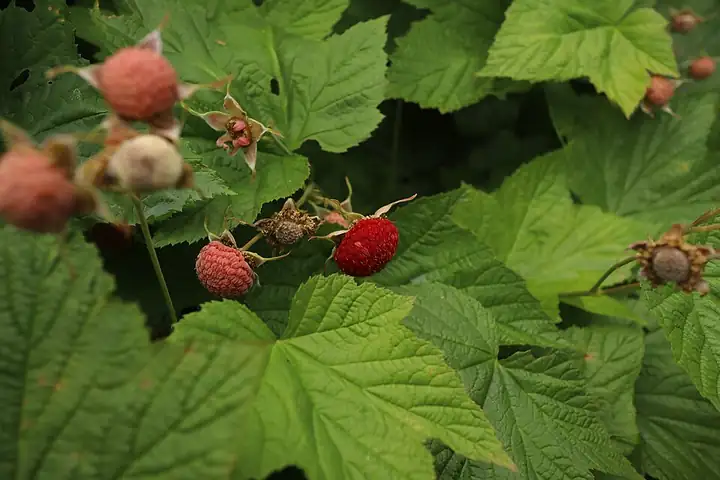
Thimbleberry
Rubus parviflorus · Rose family (Rosaceae)
| Hardiness zones | 3 to 8 |
|---|---|
| Sun | full sun to part shade |
| Water | moderate |
| Life cycle | perennial |
| Frost | Hardy: takes frost |
| Soil pH | 6.0–7.0 |
| Spacing | 36 to 72 inches |
About Thimbleberry
Thimbleberry is a thornless native raspberry relative of the West and Great Lakes, with big soft maple-like leaves, white flowers and soft, tart red berries. It spreads by underground stems into thickets and grows in sun or part shade.
WSU lists zones 3-8. It is native from Alaska to northern Mexico, with outlying populations in the Black Hills and the Great Lakes region (US Forest Service).
When to plant
Timing is counted from your average last spring frost (and first fall frost). Sow & Tell works out the actual dates for your ZIP code.
Restoration plantings use 1,200-4,800 plants per acre, roughly 3-6 feet apart (University of Washington). Canes live two years and flower and fruit in their second year, and plants spread by rhizomes into dense clumps (US Forest Service). The pH range is from wild sites in southeast Alaska (US Forest Service).
Soil
Moist, rich, well-drained loam or clay loam is best; it tolerates drier sites but grows smaller there (US Forest Service; University of Washington).
Plant in moist, well-drained, nutrient-rich loam or clay loam; thimbleberry prefers nitrogen-rich soil.
Feeding
- During the growing season, if growth is weak: compost or a nitrogen fertilizer such as 21-0-0. Thimbleberry is a nitrogen-demanding plant, but no rate is published; follow a soil test.
Don't let the soil dry out for long; plants on dry sites stay small.
Harvest
Berries ripen in August and September (US Forest Service) and turn red when ripe. They are soft and seedy and tend to fall apart when picked (WSU).
Thimbleberry fruits once a year, usually August-September, on second-year stems.
Pests to watch for
Deer, Birds, Tree squirrels, Sawflies (garden sawflies)
In the kitchen
The tart berries are eaten raw or cooked into jam, jelly and fruit leather (US Forest Service).
Keeping it: Thimbleberries are soft and fall apart easily, so eat or freeze them the day you pick them.
Safety: No toxic parts are noted in the US Forest Service or WSU plant pages.
Pets: Not listed as toxic by the ASPCA
Sources
- fs.usda.gov
- fs.usda.gov
- pnwplants.wsu.edu
- depts.washington.edu
- plantsservices.sc.egov.usda.gov
- aspca.org
- aspca.org
Photo: Photo: Fernsebner / Wikimedia Commons, CC0 (CC0). Photo resized for the web.

Planting dates and advice are general guidance; check with your local Cooperative Extension office for your area.