
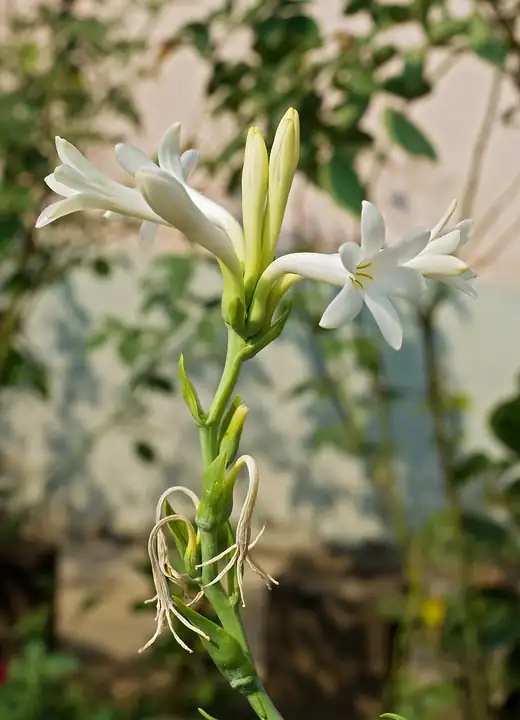
Tuberose
Polianthes tuberosa (now often classed as Agave amica) · Asparagus family (Asparagaceae; agave subfamily)
| Hardiness zones | 7 to 10 |
|---|---|
| Sun | full sun |
| Water | moderate |
| Life cycle | tender perennial (grown as an annual) |
| Frost | Tender: killed by frost |
| Soil pH | 6.0–8.0 |
| Spacing | 4 to 12 inches |
About Tuberose
Tuberose grows from a tuberous rhizome and sends up 2-3 ft spikes of waxy white, tube-shaped flowers in late summer, with one of the strongest scents in the garden (UF/IFAS, Texas A&M). It isn't native to the U.S.: it was domesticated in Mexico before Columbus and isn't known in the wild, and the Spanish carried it to Europe in the 1500s (Arkansas Extension, Texas A&M). It's a classic cut flower and a perfume plant, and its nectar draws hummingbirds and moths (NC State).
NC State lists zones 8-10; it can stay in the ground with 3-4 in of mulch in zone 7 (Arkansas Extension, UF/IFAS), but colder than that, dig the rhizomes each fall. Texas A&M advises digging it everywhere except zones 9-10.
When to plant
Timing is counted from your average last spring frost (and first fall frost). Sow & Tell works out the actual dates for your ZIP code.
- Sow seeds outdoors: up to 2 weeks after the last frost
Plant rhizomes 2 inches deep after the last frost, 4-12 inches apart (closer for a mass, wider for single plants) (UF/IFAS, Arkansas Extension, Texas A&M). It needs a long, warm season, so where summers are short, start it in pots indoors in early spring and set it out after frost (UF/IFAS, Maryland Extension). In north and central Florida, plant January-March (UF/IFAS). We found no sourced day count to first bloom, so days_to_harvest is empty.
Soil
Rich, well-drained loam or sandy soil, kept evenly moist while growing; soggy soil rots the rhizomes (UF/IFAS, NC State).
Work a 3-4 in layer of organic matter into the bed with a complete fertilizer such as 12-4-8 at about 1-1.5 lb per 100 sq ft (UF/IFAS bulb guide); follow a soil test where you can.
Feeding
- Once or twice during the growing season, while the leaves are green and growing: complete fertilizer such as 12-4-8, or a bulb fertilizer. About 1-1.5 lb of 12-4-8 per 100 sq ft of bed, scattered around the plants and watered in (UF/IFAS bulb guide).
Soggy soil rots the rhizomes; cut back on water once the leaves start to yellow in fall (NC State, UF/IFAS).
Harvest
Blooms in late summer to early fall, opening from the bottom of the spike up (Texas A&M, NC State). Cut spikes for the vase when most of the florets are open; the thick petals give a long vase life (Kansas State, Arkansas Extension). After bloom, let the leaves yellow on their own before digging (NC State).
Varieties (4)
Extension sources document 4 named tuberoses.
| Variety | Type | Days | Notes |
|---|---|---|---|
| The Pearl | Double-flowered | Fully double white flowers; double forms are the ones most often grown (Arkansas Extension). | |
| Mexican Single | Single-flowered | Single white flowers with six petals and strong scent. | |
| Marginata | Variegated | A miniature with variegated leaves. | |
| Sensation | Fragrant flowers that NC State lists as pink. |
Pests to watch for
Aphids, Twospotted spider mite, Scale insects, Thrips
Diseases and problems
Anthracnose, Root rot, Nematode damage
In the kitchen
Safety: None of the extension sources we checked list tuberose as poisonous, but it isn't a food plant. The scent is very strong, so a few stems go a long way indoors.
Pets: Not listed by the ASPCA (no tuberose entry on its toxic and non-toxic plant lists).
Sources
- plants.ces.ncsu.edu
- uaex.uada.edu
- aggie-hort.tamu.edu
- blogs.ifas.ufl.edu
- ufdcimages.uflib.ufl.edu
- extension.umn.edu
- ask2.extension.org
- bookstore.ksre.ksu.edu
- aspca.org
- aspca.org
- aspca.org
Photo: Photo: Joydeep, CC BY-SA 3.0, via Wikimedia Commons (CC BY-SA 3.0). Photo resized for the web.

Planting dates and advice are general guidance; check with your local Cooperative Extension office for your area.