
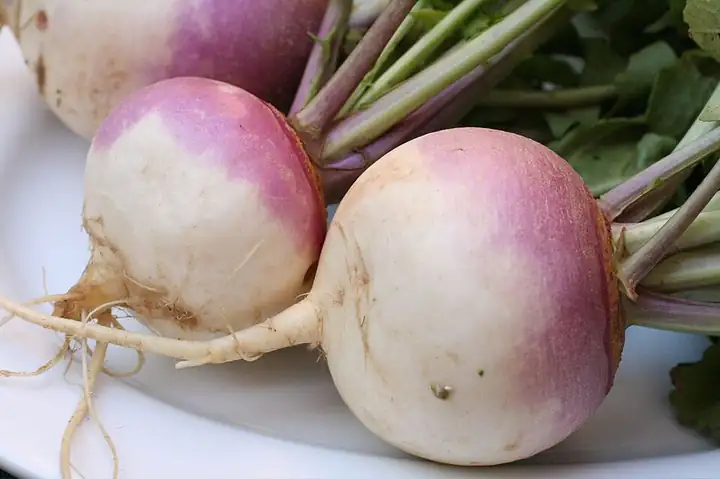
Turnip
Brassica rapa (Rapifera group) · Cabbage family (Brassicaceae)
| Hardiness zones | 2 to 11 |
|---|---|
| Sun | full sun |
| Water | moderate |
| Life cycle | biennial |
| Frost | Hardy: takes frost |
| Soil pH | 6.0–7.5 |
| Spacing | 3 to 6 inches |
| Days to harvest | 45 to 70 days |
| Soil temperature to plant | at least 40°F |
About Turnip
Turnips are fast, cold-hardy root crops, and their leafy tops are good cooked greens too. They are easy to sow in both spring and fall.
Grown as a cool-season annual in every zone; time it for the cool weather of spring or fall.
When to plant
Timing is counted from your average last spring frost (and first fall frost). Sow & Tell works out the actual dates for your ZIP code.
- Sow seeds outdoors: 2 to 4 weeks before the last frost
- Fall planting: 2 to 12 weeks before the first fall frost
Days count from seeding to roots; greens can be picked in about 30 days, so the latest fall sowings are mainly for greens.
Soil
Loose, well-drained soil from slightly acidic to slightly alkaline; give about an inch of water a week.
Follow a soil test and keep pH 6.0 to 7.0; work in compost or well-rotted manure the season before, and without a test add about 2 to 3 lb of complete fertilizer such as 10-20-10 per 100 sq ft.
Feeding
- 3 to 4 weeks after planting, when plants are about 4 to 5 inches tall: nitrogen fertilizer such as calcium nitrate (15.5-0-0). Use about 1 lb per 100 sq ft (30 ft of row) beside the plants and water it in; split it into two feedings 3 to 4 weeks apart on sandy soil.
Too much nitrogen or fresh manure can give forked roots and fewer good roots; phosphorus matters most for root size.
Harvest
Pull roots when they are 2 to 3 inches across, usually with their shoulders showing above the soil; larger roots get woody. Cut young tops for greens.
Pull roots once at 2 to 3 inches wide, before they turn woody; greens can be cut and cooked, including from thinnings.
Varieties (16)
| Variety | Type | Days | Notes |
|---|---|---|---|
| Alamo | Greens only | Grown only for greens; it does not form a swollen root. | |
| Seven Top | Greens only, heirloom | 45 days | Grown for its very dark green leaves; the root is not eaten. |
| Market Express | Hybrid | Mild and sweet. Small, pure white, globe-shaped roots that mature very early. Good for both roots and greens. | |
| Royal Crown | Hybrid | A vigorous, uniform hybrid with semi-flat roots that are white below and purple on top. | |
| Royal Globe | Hybrid | 45 days | A hybrid with uniform size, shape and color that grows faster than open-pollinated turnips. Royal Globe II has broader, darker, less cut leaves. |
| Tokyo Cross | Hybrid | 35 days | A very early hybrid with white, globe-shaped roots. |
| White Lady | Hybrid | 35 to 40 days | Medium, pure white roots with tender leaves on an upright plant. It tolerates heat and resists bolting. |
| All Top | Hybrid, greens | 35 days | A fast, high-yielding hybrid grown for greens. It can be cut more than once. |
| Topper | Hybrid, greens | A hybrid Seven Top type with smooth, dark leaves, good cold tolerance, and resistance to aphids and downy mildew. | |
| Just Right | Hybrid, roots and greens | 50 to 70 days | A large white globe that tolerates cold, so it is best for fall and winter crops. |
| Shogoin | Open-pollinated, greens and roots | 30 to 42 days | Tender, mild leaves. Grown mostly for its tender leaves. Roots are white and flat on top. Mississippi State calls it a quick-growing Japanese type. |
| Purple Top White Globe | Roots and greens, heirloom | 50 to 55 days | Mild and sweet. Round, smooth white roots with a bright purple top. Wisconsin calls it the standard American turnip. |
| Hakurei | Salad turnip | 38 days | Small, smooth, flat-round white roots that mature early. |
| Golden Ball | Yellow-fleshed | A yellow-fleshed turnip for summer. | |
| Purple Crown | 50 to 55 days | A purple-top turnip on Kentucky's list. | |
| White Egg | Sweet. Egg-shaped white roots with a green-white top and crisp flesh. |
Pests to watch for
Flea beetles, Cabbage maggot, Bagrada bug, Beet armyworm, Seedcorn maggot, Blister beetles, Voles
Diseases and problems
Black rot of cabbage-family crops, Clubroot, Boron deficiency, Alternaria leaf spot (cabbage family), Powdery mildew, White rust, Common scab, Turnip mosaic
In the kitchen
Roots are roasted, mashed, boiled or eaten raw when small; the tops are cooked as greens.
Keeping it: Cut off the tops, then refrigerate roots in a sealed bag or container. In a cold (32 to 35F), humid root cellar they can keep 4 to 5 months, though they dry out more easily than other roots.
Safety: If you take the blood thinner warfarin, keep the amount of turnip greens you eat about the same from day to day, because they are very rich in vitamin K (NIH Office of Dietary Supplements).
Pets: Not listed as toxic by the ASPCA
Sources
- extension.umn.edu
- extension.unh.edu
- extension.colostate.edu
- agrilifeextension.tamu.edu
- yardandgarden.extension.iastate.edu
- riley.k-state.edu
- ods.od.nih.gov
- aspca.org
- aspca.org
- hgic.clemson.edu
- aggie-horticulture.tamu.edu
Photo: Photo: thebittenword.com, CC BY 2.0, via Wikimedia Commons (CC BY 2.0). Photo resized for the web.

Planting dates and advice are general guidance; check with your local Cooperative Extension office for your area.