
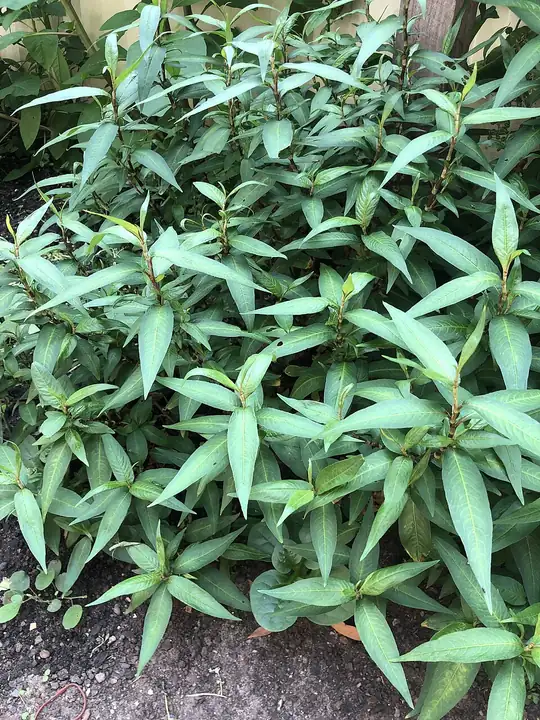
Vietnamese coriander
Persicaria odorata (syn. Polygonum odoratum) · Buckwheat family (Polygonaceae)
| Hardiness zones | 9 to 11 |
|---|---|
| Sun | full sun to part shade |
| Water | high |
| Life cycle | tender perennial (grown as an annual) |
| Frost | Tender: killed by frost |
About Vietnamese coriander
Vietnamese coriander, also called rau ram, Vietnamese mint or laksa leaf, is a leafy herb whose leaves taste much like cilantro. It is NOT a cilantro or a mint: it belongs to the buckwheat and smartweed family. People grow it in hot weather, when cilantro quickly goes to seed, and it is easy to start from grocery-store stems rooted in water.
Winter-hardy only in frost-free parts of zones 9-11 (UC Master Gardeners); elsewhere grow it outdoors in summer and keep it in a pot indoors for winter (UC Master Gardeners; RHS). Hawaii's weed risk assessment rates it low risk; it seldom flowers in the U.S. and may never set seed.
When to plant
Timing is counted from your average last spring frost (and first fall frost). Sow & Tell works out the actual dates for your ZIP code.
Grown from stem cuttings: in spring, root fresh stems from an Asian grocery in a glass of water and plant them once roots appear (UC Master Gardeners); cuttings root easily in soil or water (RHS). Picking can start about two months after spring planting.
Soil
Moderately rich soil that stays moist to wet; it does well in a damp spot or a pot that is never allowed to dry out (UC Master Gardeners).
Give it moderately rich soil that stays moist to wet, or a pot that never dries out; no fertilizer rates are published.
Feeding
Don't let the soil dry out; it wants much more water than most herbs.
Harvest
Pick young leaves as needed, starting about two months after planting in spring; only the leaves are used (UC Master Gardeners).
Start picking young leaves about two months after spring planting and keep picking through the warm season; a potted plant can also be grown indoors as a houseplant.
In the kitchen
Use the young leaves raw or cooked in salads, rice and vegetable dishes, soups and stews, as in many Vietnamese dishes (UC Master Gardeners; Hawaii WRA).
Safety: Hawaii's weed risk assessment found no reports of it being toxic to people or animals; we found no NIH or MSKCC review of it.
Pets: Not listed by the ASPCA
Sources
Photo: Photo: Joditran / Wikimedia Commons, CC BY-SA 4.0 (CC BY-SA 4.0). Photo resized for the web.

Planting dates and advice are general guidance; check with your local Cooperative Extension office for your area.