
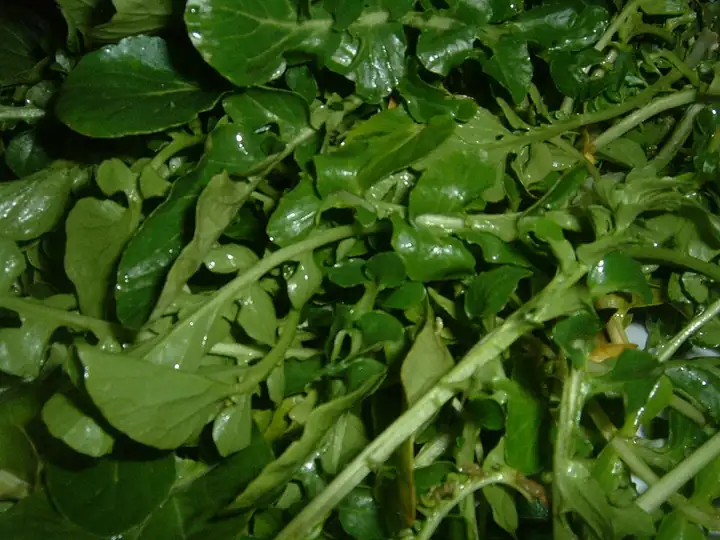
Watercress
Nasturtium officinale · Cabbage family (Brassicaceae)
| Hardiness zones | 3 to 11 |
|---|---|
| Sun | full sun |
| Water | high |
| Life cycle | perennial |
| Frost | Hardy: takes frost |
| Soil pH | 6.5–7.5 |
| Spacing | 6 to 8 inches |
| Days to harvest | 55 to 70 days |
| Soil temperature to plant | at least 50°F |
About Watercress
Watercress is a peppery, water-loving perennial green that grows in shallow, clean, slowly moving water or in a pot kept standing in water. It came from Europe and has gone wild in springs and streams across much of the U.S. It is listed as invasive in places: Connecticut bans its sale and planting, and Kentucky and Nebraska list it as an invasive pest. Don't eat wild-picked cress raw: it can carry Giardia, and raw watercress is the main way people catch liver flukes (Fasciola), with a few U.S. cases in Hawaii, California and Florida.
Grown as a cool-season crop in every zone, in pots or beds kept constantly wet. It is hardy enough to pick through winter in Utah, stays green all winter in Missouri springs and Nebraska streams, and Florida grows it as a winter crop; no source we found gives hardiness zones. Keep it out of streams and ponds where it can escape.
When to plant
Timing is counted from your average last spring frost (and first fall frost). Sow & Tell works out the actual dates for your ZIP code.
- Sow seeds outdoors: 3 weeks before the last frost
Days count from planting; plants from seed can be cut about 3 weeks after seedlings appear. Sow seed about 3 weeks before the last frost in cool, wet soil (50 to 60F), and set out transplants after the last frost. Stem cuttings root fast in wet soil.
Soil
Wet, organic-rich soil, best with roots in shallow, clean water; in a pot use a soilless mix and keep the pot standing in 2 to 3 inches of water changed once or twice a week.
Line a shallow bed or use a pot of soilless mix (or compost or peat over plastic); as a starting point, mix about 1 cup of garden fertilizer into 25 square feet of planting soil, and follow a soil test in the ground.
Feeding
- while growing in a pot or tub, especially if leaves turn pale, dark and stunted, or scorched at the edges: complete water-soluble fertilizer. Mix it into the water at the label rate; yellowing between the veins of new leaves in winter points to low iron.
Letting the roots dry out; change standing water once or twice a week.
Harvest
Cut the tender tops, about 6 inches down from the tips, any time of year; plants branch and thicken after cutting. Flavor is best before flowering and in cool weather; for a fall crop, cut plants back to 4 inches and let them regrow.
Cut the tops and the plants keep growing thicker; a cut bed takes about a month to regrow. For a fall crop, cut plants back to 4 inches and let them regrow.
Pests to watch for
Aphids, Whiteflies, Twospotted spider mite, Brown garden snail
Diseases and problems
Turnip mosaic
In the kitchen
Raw in salads and sandwiches or as a garnish; also stirred into soups, stir-fries, pasta and egg dishes.
Keeping it: Stand stems in a jar of water, cover loosely and refrigerate, or wrap stems in a damp towel in an open bag; it lasts about a week but is best in 2 to 3 days.
Safety: Don't eat wild or stream-gathered watercress raw: it can carry Giardia and the liver fluke Fasciola, so grow your own in clean water or buy cultivated cress (CDC, U.S. Forest Service). If you take the blood thinner warfarin, keep the amount of leafy greens you eat about the same from day to day, because they are rich in vitamin K (NIH Office of Dietary Supplements).
Pets: Toxic to dogs, cats and horses (ASPCA): it is a stomach irritant that can cause mild vomiting and diarrhea.
Sources
- edis.ifas.ufl.edu
- extension.usu.edu
- aggie-hort.tamu.edu
- fs.usda.gov
- mdc.mo.gov
- cms.unl.edu
- portal.ct.gov
- cipwg.media.uconn.edu
- gardenclubky.org
- cdc.gov
- extension.illinois.edu
- extension.umd.edu
- ods.od.nih.gov
- aspca.org
Photo: Photo: Masparasol / Wikimedia Commons, CC BY 3.0 (CC BY 3.0). Photo resized for the web.

Planting dates and advice are general guidance; check with your local Cooperative Extension office for your area.