
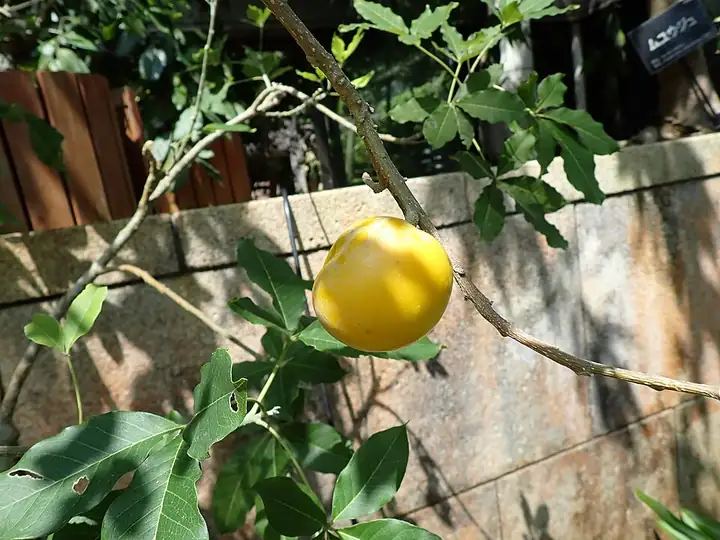
White sapote
Casimiroa edulis (also the woolly-leaf C. tetrameria and hybrids) · Citrus family (Rutaceae)
| Hardiness zones | 9 to 11 |
|---|---|
| Sun | full sun |
| Water | moderate |
| Life cycle | perennial |
| Frost | Half-hardy: takes a light frost |
| Soil pH | 5.5–7.5 |
| Spacing | 300 inches |
About White sapote
White sapote is a mostly evergreen tree from the highlands of central Mexico and Central America, grown for round, thin-skinned green to yellow fruit with sweet, smooth, custardy white flesh. It is grown in home yards in southern California and Florida and is a heavy bearer. Trees get big, and the fruit bruises so easily that it is seldom sold in stores, which makes it a true backyard fruit.
UC Cooperative Extension says it does well anywhere in California that oranges grow, north to Chico but not in the deserts; frost damage starts near 22 F and young trees can be hurt at 30 F. UF/IFAS says young trees are damaged or killed at 24 F and older trees at 26 F, and it fruits best where winters are cool or dry. The zone range is our estimate from those temperatures. The Hawaii-Pacific Weed Risk Assessment rates it low risk, and we found no U.S. invasive or noxious listing.
When to plant
Timing is counted from your average last spring frost (and first fall frost). Sow & Tell works out the actual dates for your ZIP code.
Plant a grafted tree in full sun in the warmest spot that doesn't flood, at least 25 ft from other trees, buildings and power lines (UF/IFAS). Grafted trees bear in 3-4 years; seedlings vary a lot and may take 7-8 years (UC Cooperative Extension; UF/IFAS). No source ties planting to a frost date.
Soil
Almost any well-drained soil, including sand, clay and limestone; avoid salty soil and spots that stay wet after summer rain (UF/IFAS; UC Cooperative Extension).
Don't add fertilizer, topsoil or compost to the planting hole; if you amend, mix it no more than half and half with the native soil, and plant on a 2-3 ft mound where water stands (UF/IFAS).
Feeding
- When new growth starts after planting, then every 6-8 weeks through the first year: Young-tree fertilizer such as 6-6-6-2 with minor elements. Start with about 1/4 lb per tree and work up gradually to 1/2, 3/4 and 1 lb per feeding as the tree grows; scatter it under the canopy and water in (UF/IFAS).
- April through September, each year: Micronutrient leaf spray with zinc, manganese, boron and molybdenum. Four to six sprays a year for young trees and two to three for bearing trees; follow the label (UF/IFAS).
- Bearing trees, 2-3 times a year: Fruit tree fertilizer with phosphate and potash, such as 6-6-6 or 8-3-9. About 2.5-5 lb per feeding for mature trees, spread evenly under the canopy (UF/IFAS); in California, regular nitrogen feedings work well and minor-nutrient shortages are treated as for citrus (UC Cooperative Extension).
Don't overwater with timer-run sprinklers, which can rot the roots, and avoid heavy lawn fertilizing near the tree, which may cut fruiting (UF/IFAS); shallow watering makes surface roots (UC Cooperative Extension).
Harvest
Fruit ripens about 6-9 months after bloom, mostly October-November in California and spring-summer in Florida. Clip it with a bit of stem several days before it would drop, handle it gently, and let it soften at room temperature; underripe and overripe fruit both turn bitter (UC Cooperative Extension; UF/IFAS).
A main crop each year, mostly October-November in California and spring to summer in Florida; 'Suebelle' can bear year-round in California, and some varieties tend to crop heavily only every other year.
Varieties (18)
| Variety | Type | Days | Notes |
|---|---|---|---|
| Blumenthal | California selection | Fair to good flavor; creamy white flesh. Pale yellow fruit of about 5-6 oz. | |
| Chestnut | California selection | Good flavor; the skin is bitter. Yellow-green fruit that can be picked early and ships well; tends to bear heavily every other year. | |
| Denzler | California selection | Good flavor; yellow flesh. Large yellow fruit, about 11-13 oz. | |
| Fiesta | California selection | Good flavor. Very small yellow fruit that handles well. | |
| Lemon Gold | California selection | Excellent flavor. Yellow, average-size fruit that can be picked early. | |
| May | California selection | Very good flavor. Medium green fruit that changes color very little as it ripens, so check softness. | |
| McDill | California selection | Good to excellent flavor; creamy white flesh. Very large greenish-yellow fruit, about 12-16 oz. | |
| Pike | California selection | Rich, good, non-bitter flesh; the skin is bitter. Green, medium-size fruit of about 8-9 oz; an older variety. | |
| Reineke Commercial | California selection | Good flavor; yellow flesh. Large golden to orange fruit with few seeds that keeps well, but the tree bears lightly. Also spelled 'Reinikie' or 'Reonecke Commercial' in Extension guides. | |
| Stickley | California selection | Good flavor, sweet even when picked early. Large yellow-green fruit. | |
| Suebelle | California selection | Excellent, sweet flavor. Small to medium yellow-green fruit on a small tree; UC calls it the best home variety. Also called 'Hubbell'. | |
| Vernon | California selection | Green, medium-size fruit that doesn't turn bitter when overripe; tends to bear every other year. | |
| Yellow | California selection | Good flavor; pale yellow flesh. Bright yellow fruit, about 9-10 oz. | |
| Cuccio | Florida selection | Excellent flavor. Light green, average-size fruit that holds well on the tree; bears early. Also called 'Florida'. | |
| Dade | Florida selection | Good, non-bitter flavor; creamy white flesh. Golden-yellow fruit tinged green, about 6-7 oz. | |
| Homestead | Florida selection | Good, non-bitter flavor; creamy white flesh. Yellow-green fruit, about 7 oz. | |
| Smathers | Florida selection | Fair flavor; yellow flesh. Greenish-yellow fruit, about 8-9 oz. | |
| Golden (Mac's Golden) | Woolly-leaf white sapote (C. tetrameria) | Strong, unusual flavor with some bitterness; some people dislike it. Yellow-green fruit of about 4-5 oz with few seeds. |
Pests to watch for
Scale insects, Mealybugs, Aphids, Garden ants, Brown garden snail
Diseases and problems
Scab, Root rot
In the kitchen
Eaten fresh with a spoon, or blended into milkshakes and desserts; cooking dulls its flavor (UF/IFAS; UC Cooperative Extension).
Keeping it: Let firm fruit soften at room temperature, then keep it in the refrigerator and use it within about 7-10 days; handle gently, because bruised flesh turns bitter.
Safety: The seeds are poisonous and should never be eaten (UF/IFAS); an older reference quoted in the Hawaii weed-risk assessment calls them possibly fatal if eaten raw. The seeds and leaves contain sedative compounds, so don't use them as a home remedy. We found no research-based guidance on pregnancy, drug interactions or allergies for the fruit.
Pets: Not listed by the ASPCA. Keep the poisonous seeds away from pets (UF/IFAS).
Sources
Photo: Photo: M108t, CC BY 4.0, via Wikimedia Commons (CC BY 4.0). Photo resized for the web.

Planting dates and advice are general guidance; check with your local Cooperative Extension office for your area.