
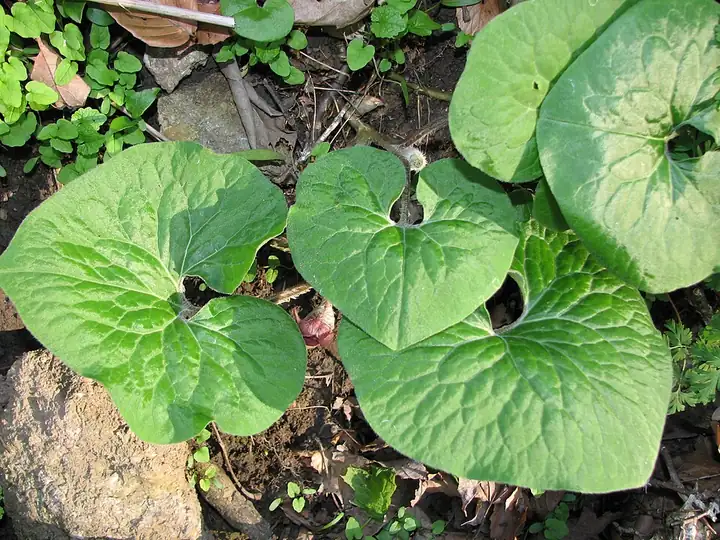
Wild ginger
Asarum canadense (Canadian wild ginger); European ginger is A. europaeum · Birthwort / pipevine family (Aristolochiaceae)
| Hardiness zones | 4 to 8 |
|---|---|
| Sun | shade |
| Water | moderate |
| Life cycle | perennial |
| Frost | Hardy: takes frost |
About Wild ginger
Wild ginger is a native woodland groundcover with velvety heart-shaped leaves and odd brownish-purple flowers hidden at ground level in spring (NC State). It spreads slowly into a dense patch, and it is a host plant for pipevine swallowtail caterpillars. It is not related to kitchen ginger and should not be eaten.
NC State lists zones 4-6 for Canadian wild ginger, but it is native from Manitoba south to Georgia and Louisiana and grows well to zone 8 in shade.
When to plant
Timing is counted from your average last spring frost (and first fall frost). Sow & Tell works out the actual dates for your ZIP code.
Plant in spring or fall in light to deep shade. It grows and spreads slowly; divide the rhizomes to make more (NC State).
Soil
Moist, humus-rich soil, acidic to neutral; it tolerates wet soil (NC State).
Humus-rich, moist soil (NC State).
Feeding
Keep the soil moist while it settles in; it grows slowly (NC State).
Pests to watch for
Slugs, Brown garden snail
In the kitchen
Safety: Do not eat it. It contains aristolochic acid, which harms the kidneys and causes cancer (NC State). Early Americans used the root as a ginger substitute, but that is not safe.
Pets: Not listed as toxic by the ASPCA. NC State rates it moderately poisonous because it contains aristolochic acid, so keep pets from chewing it.
Sources
Photo: Photo: Chris S. Packard / Wikimedia Commons, CC BY 2.5 (CC BY 2.5). Photo resized for the web.

Planting dates and advice are general guidance; check with your local Cooperative Extension office for your area.