
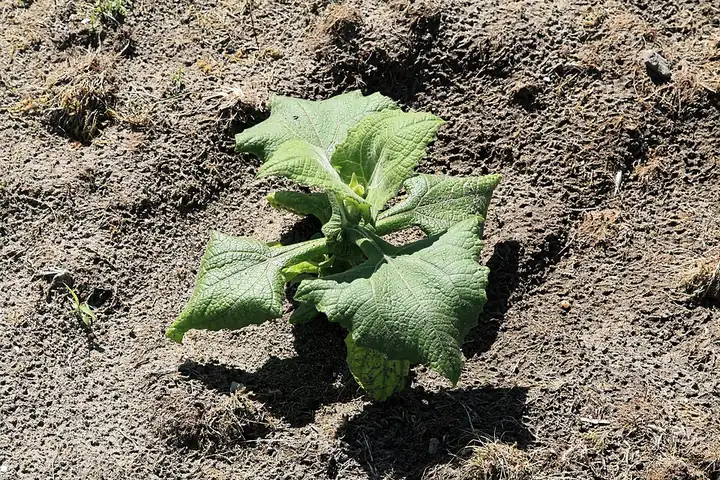
Yacon
Smallanthus sonchifolius · Aster family (Asteraceae)
| Hardiness zones | 3 to 11 |
|---|---|
| Sun | full sun to part shade |
| Water | moderate |
| Life cycle | tender perennial (grown as an annual) |
| Frost | Tender: killed by frost |
| Spacing | 24 to 40 inches |
| Days to harvest | 180 to 210 days |
About Yacon
Yacon is a tall Andean cousin of the sunflower, grown for big, crisp roots that taste sweet, a bit like apple or pear, and are usually eaten raw. Plants can reach about 8 feet. The sweetness comes from fructooligosaccharides (FOS), a kind of sugar people can't fully digest, so the roots taste sweet without much carbohydrate. UF/IFAS notes it is not listed as invasive.
Grown as a summer annual. It needs a long season (about 6 to 7 months, roughly 180 days in Florida), grows best at 64-80F and tolerates 32-105F; Alaska Master Gardeners grow it in Anchorage with indoor starts, though plants stay smaller there.
When to plant
Timing is counted from your average last spring frost (and first fall frost). Sow & Tell works out the actual dates for your ZIP code.
- Start seeds indoors: 8 weeks before the last frost
- Set out plants: up to 2 weeks after the last frost
Days count from planting out; UF/IFAS gives about 6 to 7 months to maturity. Yacon is grown from the knobby crowns (corms) at the base of last year's stems, not seed: sprout them in pots of potting soil about two months before planting, harden off for about a week, and set out once frost danger has passed. Rooted stem cuttings also work.
Soil
Loose, fertile, sandy loam kept evenly moist; it tolerates acidic to slightly alkaline soil and does better in garden soil than in pure compost.
Work in compost and fertilizer according to a soil test; UF/IFAS says no yacon-specific rate exists yet and suggests following potato fertilizer guidelines, keeping the bed evenly moist.
Feeding
- Through the season while plants grow: fertilizer as your soil test recommends, following potato guidelines (nitrogen such as ammonium sulfate). UF/IFAS notes nitrogen raises both yield and root sugar (FOS) content; feed as for potatoes and keep the soil moist, since water is crucial for root formation.
Don't let the soil dry out while roots are forming, and don't dig before frost: roots dug early are less sweet.
Harvest
Dig after the first killing frost shrivels the leaves; Alaska Master Gardeners found roots dug before frost were noticeably less sweet. Lift the whole clump with a spading fork starting at least a foot from the stems, and handle the brittle roots gently because they bruise and snap easily. Save the crowns for next year's planting.
Each plant is dug once, after the first killing frost when the roots are sweetest. UF/IFAS notes home gardeners can dig plants a few at a time over the season; save the crowns to replant next spring.
Varieties (12)
UF/IFAS lists 12 yacon variety names offered to U.S. growers but describes none of them, so these are names only; root skin can be white, yellow or pink depending on variety.
| Variety | Type | Days | Notes |
|---|---|---|---|
| Bekya | |||
| Blanco | |||
| Bogachiel | |||
| Cajamarca | |||
| Kalaloch | |||
| Late Red | |||
| Morado | |||
| New Zealand | |||
| Quinault | |||
| Rojo | |||
| Rose | |||
| Sol Duc |
Pests to watch for
Whiteflies, Mealybugs, Aphids, Slugs, Leafminers, Cucumber beetles, Cutworms, Grasshoppers, Leafhoppers
Diseases and problems
Fusarium rot, Bacterial soft rot, White mold, Alternaria leaf spot
In the kitchen
Peel or scrub and eat the roots raw in salads or as a crunchy snack, like a sweet, juicy water chestnut; they brown quickly once cut, so they are rarely cooked. In South America the roots are also boiled down into a sweet syrup.
Keeping it: Scrub the roots, pat them dry, seal them in a bag and refrigerate; Alaska Master Gardeners kept them over 60 days this way. Left out to air-dry, they shrivel.
Safety: The roots are rich in FOS, a fiber-like sugar that can cause gas if you eat a lot at once, much like Jerusalem artichoke; start with small helpings. Stems and leaves are covered in fine hairs.
Pets: Not listed by the ASPCA
Sources
Photo: Photo: Frank Vincentz, CC BY-SA 3.0, via Wikimedia Commons (CC BY-SA 3.0). Photo resized for the web.

Planting dates and advice are general guidance; check with your local Cooperative Extension office for your area.