
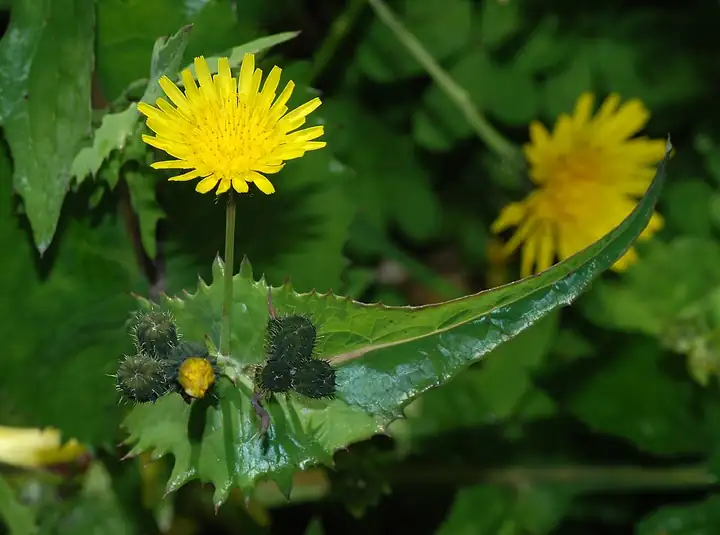
Annual sowthistle
Sonchus oleraceus
| Type | Broadleaf |
|---|---|
| Life cycle | Annual |
| Family | Aster family (Asteraceae) |
| Origin | Introduced from elsewhere |
| Most common in | Southeast, South Central, Southwest, Pacific Northwest, California |
About
Annual sowthistle is a soft, dandelion-flowered weed from the Mediterranean that sprouts in both cool and warm seasons. It can go from seedling to seed in about six weeks and spreads on the wind.
Also called common sowthistle, sow thistle, sowthistle, smooth sowthistle, hare's lettuce
How to identify it
Look for
Stems are smooth, thick and hollow, and leak milky sap when cut. Leaves are cut almost to the midrib, with soft-spined, irregular teeth, and their pointed bases clasp the stem. Yellow dandelion-like flower heads form in clusters and turn into fluffy seed heads.
Look-alikes
Spiny sowthistle has sharp, prickly leaf edges, less deeply cut leaves and large, curled "ram's-horn" leaf bases hugging the stem; prickly lettuce has a row of stiff prickles under the leaf midrib.
Where it grows
Gardens, yards, orchards, field edges, roadsides and waste areas; in mild coastal areas it grows year-round.
When
Sprouts in fall, winter or spring when days are cool to mild; it flowers 6 to 9 weeks after sprouting, and seeds are ready about a week after flowering.
How it spreads
Wind-blown seed, about 6,100 per plant in one study; seeds left on the surface mostly die within a year, but buried seeds last longer.
Most common in
| Northeast | Common here |
|---|---|
| Southeast | Very common here |
| South Central | Very common here |
| Midwest | Common here |
| Great Plains | Common here |
| Mountain West | Common here |
| Southwest | Very common here |
| Pacific Northwest | Very common here |
| California | Very common here |
| Alaska | Occasional here |
| Hawaii | Common here |
What to do, gentlest first
Start at the top. Weed killers are a last step; always read and follow the label.
Pull before the fluff Prevent
Remove plants as soon as you see buds; seeds form about a week after flowers open and drift in from neighbors, so check often.
Pull or hoe By hand
Pull young plants or hoe seedlings; the stems are soft and hollow, so pull from the base to get the root.
Don't compost plants with open flowers or seed heads.
Mulch to keep surface seeds dark Barrier
Seeds sprout best from the top 0.4 inch of soil, so mulch over bare soil stops most of them.
Burn down seedlings with a contact spray Organic spray
Horticultural vinegar (acetic acid), fatty-acid soap, pelargonic acid or clove-oil sprays burn what they touch within hours. They work best on young seedlings in warm, sunny weather, and you will need to repeat, because they don't move into roots and bigger plants regrow.
They kill any plant they touch, so shield crops. Strong vinegar can burn skin and eyes; wear goggles and gloves and follow the label.
Spot spray young plants Conventional spray
In lawns, a broadleaf herbicide such as 2,4-D; in beds, glyphosate as a spot spray on the weed only.
Read and follow the label. Many lawn weed killers also kill or damage vegetables and flowers, so keep spray and drift off garden plants.
Uses, wildlife and pets
Pets
Not listed by the ASPCA.
Sources
Photo: Photo: Alvesgaspar / Wikimedia Commons, CC BY-SA 3.0 (CC BY-SA 3.0). Photo resized for the web.

Planting dates and advice are general guidance; check with your local Cooperative Extension office for your area.