
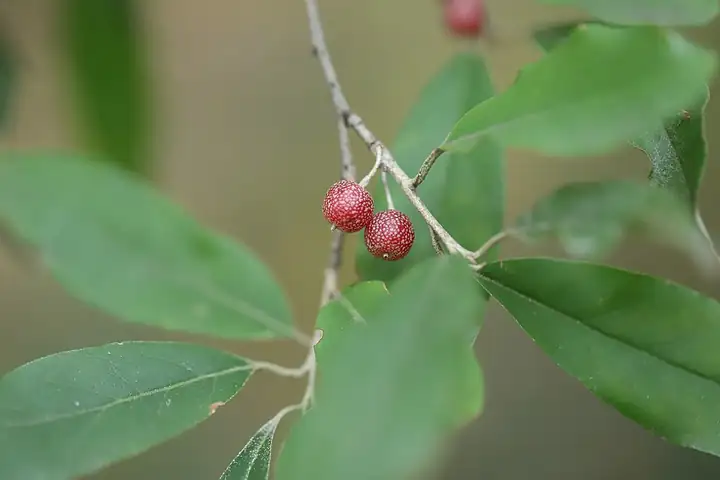
Autumn olive
Elaeagnus umbellata
| Type | Shrub or tree |
|---|---|
| Life cycle | Perennial |
| Family | Oleaster family (Elaeagnaceae) |
| Origin | Introduced from elsewhere |
| Most common in | Northeast, Southeast, Midwest |
About
An Asian shrub that fills old fields, roadsides, forest edges and yard edges across the East. It fixes its own nitrogen, fruits heavily, and resprouts hard after cutting.
Also called autumn-olive
How to identify it
Look for
A shrub 10 to 16 feet tall with alternate, oblong leaves 2 to 4 inches long that are green above and silvery-white underneath from tiny scales. Young twigs are silvery-brown and often have sharp spurs. Trumpet-shaped, pale yellow to white flowers in spring become small red berries flecked with silver dots in late summer and fall.
Look-alikes
Russian olive is a related tree with longer, narrower, drooping leaves and is more common in the western US.
Where it grows
Old fields, pastures, roadsides, forest edges and disturbed, sunny sites; it tolerates poor, salty soils.
When
Flowers in April and May, and berries ripen in August and September and hang on into winter.
How it spreads
Birds spread the seeds; a mature shrub can bear about 30 pounds of fruit (tens of thousands of seeds) a year, and plants start fruiting within 3 to 5 years.
Most common in
| Northeast | Very common here |
|---|---|
| Southeast | Very common here |
| South Central | Occasional here |
| Midwest | Very common here |
| Great Plains | Occasional here |
| Mountain West | Not found here |
| Southwest | Not found here |
| Pacific Northwest | Not found here |
| California | Not found here |
| Alaska | Not found here |
| Hawaii | Occasional here |
Where it is regulated
West Virginia lists it as a noxious weed in several counties.
What to do, gentlest first
Start at the top. Weed killers are a last step; always read and follow the label.
Pull seedlings early Prevent
Young plants fruit within a few years, so remove seedlings before they start making berries.
Pull or dig small plants By hand
Hand-pull or dig seedlings and small shrubs, ideally when the soil is moist. Mowing or cutting alone brings back more stems.
Watch for the sharp twig spurs.
Triclopyr: foliar, basal bark or cut-stump Conventional spray
Spray leaves with triclopyr (or glyphosate plus triclopyr) from June until fall color, spray triclopyr in oil on the lower 12 to 18 inches of bark any time of year, or treat stumps right after cutting.
Read and follow the label. Many lawn and brush killers also harm garden plants, so keep spray and drift off anything you want to keep.
Uses, wildlife and pets
Edible?
Penn State Extension notes people sometimes eat the berries, usually as jam or jelly, but warns that plants on polluted sites can carry heavy metals into the fruit. Only pick from clean, unsprayed sites and be sure of your ID.
Not 100% sure? Don't eat it. Never pick from ground that may have been sprayed, or along roads and railways.
For wildlife
Robins, cedar waxwings, finches and other birds eat the fruit, and thickets give cover.
Pets
Not listed as toxic by the ASPCA
Sources
Photo: Photo: Steven Bodzin / Wikimedia Commons, CC BY 4.0 (CC BY 4.0). Photo resized for the web.

Planting dates and advice are general guidance; check with your local Cooperative Extension office for your area.