
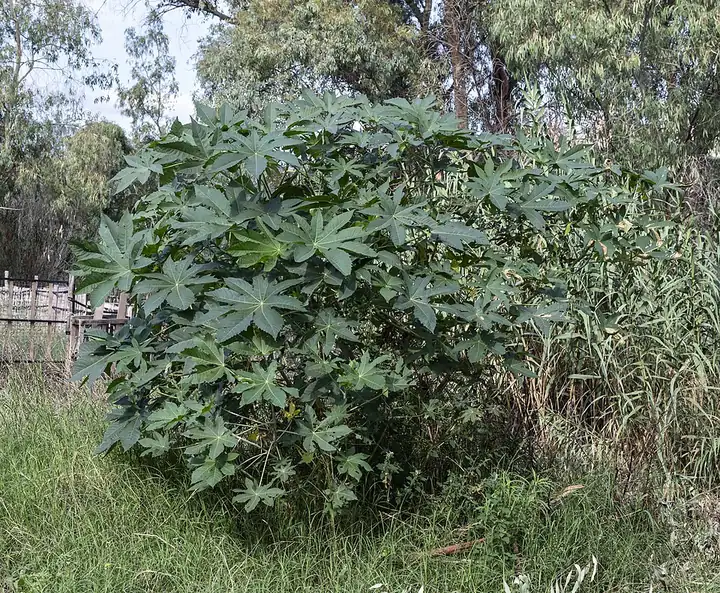
Castor bean
Ricinus communis
| Type | Broadleaf |
|---|---|
| Life cycle | Annual |
| Family | Spurge family (Euphorbiaceae) |
| Origin | Introduced from elsewhere |
About
A fast-growing tropical plant grown for its bold leaves that has escaped in warm states. Its seeds contain ricin, one of the most dangerous plant poisons, so it doesn't belong where children or pets play.
Also called castorbean, castor oil plant, mole bean plant, African wonder tree
How to identify it
Look for
Huge, star-shaped leaves with 5 to 11 pointed lobes can be 1 to 2½ feet across, on red, green or purple stems. It grows 6 to 15 feet in a single season, and more in frost-free areas where it lives for years. Spiny red or green seed pods hold shiny, mottled seeds that look like swollen ticks.
Where it grows
Disturbed ground, roadsides, old fields, rocky slopes and gardens in full sun, mainly in warm, frost-free areas.
When
Grows through the warm season, flowers from summer into fall, and ripens seed pods from late summer on; it dies with frost in cold areas.
How it spreads
Spreads by seed that sprouts readily near parent plants.
Most common in
| Northeast | Occasional here |
|---|---|
| Southeast | Common here |
| South Central | Occasional here |
| Midwest | Occasional here |
| Great Plains | Occasional here |
| Mountain West | Occasional here |
| Southwest | Occasional here |
| Pacific Northwest | Occasional here |
| California | Common here |
| Alaska | Not found here |
| Hawaii | Common here |
Where it is regulated
The California Invasive Plant Council lists it as invasive (limited), and Florida's invasive species council ranks it Category II invasive.
What to do, gentlest first
Protect yourself first. Weed killers are a last step; always read and follow the label.
Don't plant it Prevent
Choose a safer bold-leaved plant, especially where children, pets or livestock roam.
Never keep or share the seeds.
Pull seedlings and cut off seed spikes By hand
Pull young plants while small. On larger plants, cut off the flower spikes before pods form, then cut or dig out the plant.
Wear gloves and bag pods and seeds for the trash; don't compost them.
Uses, wildlife and pets
Pets
Toxic to dogs, cats and horses (ASPCA); the seeds are the biggest risk, and as little as an ounce can kill.
Sources
Photo: Photo: Cayambe / Wikimedia Commons, CC BY 4.0 (CC BY 4.0). Photo resized for the web.

Planting dates and advice are general guidance; check with your local Cooperative Extension office for your area.