
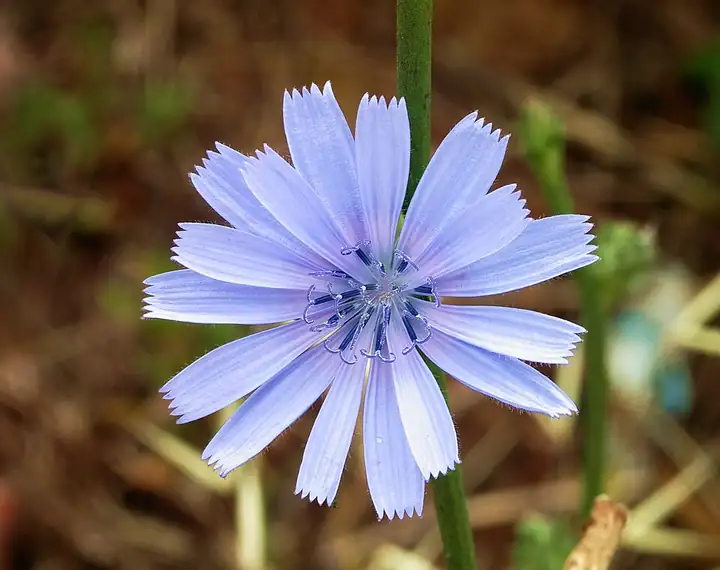
Chicory
Cichorium intybus
| Type | Broadleaf |
|---|---|
| Life cycle | Perennial |
| Family | Aster family (Asteraceae) |
| Origin | Introduced from elsewhere |
| Most common in | Northeast, Midwest |
About
Chicory is a European roadside plant with sky-blue flowers and a deep, milky taproot. It is more of a nuisance in fields, pastures and neglected ground than a serious garden weed, and it seldom invades natural areas.
Also called common chicory, blue sailors, succory, coffeeweed
How to identify it
Look for
The basal leaves look like dandelion leaves (up to about 8 inches long), rough and hairy. Stems 2 to 4 feet tall carry bright blue flower heads 1 to 1.5 inches across that usually close by midday. The deep, fleshy taproot oozes milky sap when cut.
Look-alikes
Before it flowers, the rosette looks like a dandelion; chicory leaves are rougher and hairier, and the plant later sends up tall flowering stems.
Where it grows
Roadsides, fields, pastures and other disturbed ground.
When
Rosettes grow in spring; it flowers from midsummer until frost.
How it spreads
By seed; established plants hold on with a deep, fleshy taproot.
Most common in
| Northeast | Very common here |
|---|---|
| Southeast | Common here |
| South Central | Common here |
| Midwest | Very common here |
| Great Plains | Common here |
| Mountain West | Common here |
| Southwest | Occasional here |
| Pacific Northwest | Common here |
| California | Common here |
| Alaska | Not found here |
| Hawaii | Not found here |
Where it is regulated
Listed as a noxious weed in Colorado (List C).
What to do, gentlest first
Start at the top. Weed killers are a last step; always read and follow the label.
Keep ground covered Prevent
Chicory moves into open, disturbed spots, so keep lawns thick and beds planted or mulched.
Dig out the taproot By hand
Dig out young plants with as much of the deep taproot as you can, before they flower and seed.
Uses, wildlife and pets
Edible?
The leaves are edible but bitter, raw or cooked, and the roots are dried, roasted and ground as a coffee substitute; the flowers are edible too. Young rosettes resemble dandelion, so be sure of the ID, and never pick from sprayed lawns or roadsides.
Not 100% sure? Don't eat it. Never pick from ground that may have been sprayed, or along roads and railways.
For wildlife
Bees and butterflies visit the flowers for nectar.
Pets
Not listed by the ASPCA.
Sources
Photo: Photo: Alvesgaspar / Wikimedia Commons, CC BY 2.5 (CC BY 2.5). Photo resized for the web.

Planting dates and advice are general guidance; check with your local Cooperative Extension office for your area.