
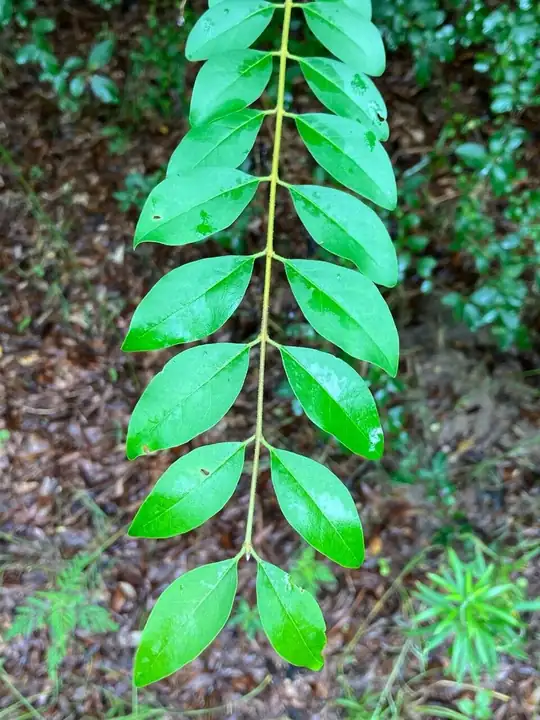
Chinese privet
Ligustrum sinense
| Type | Shrub or tree |
|---|---|
| Life cycle | Perennial |
| Family | Olive family (Oleaceae) |
| Origin | Introduced from elsewhere |
| Most common in | Southeast, South Central |
About
A hedge shrub from China that escapes into woods, stream bottoms and yard edges, forming dense thickets up to about 30 feet tall. Birds spread the berries far and wide, and it's very hard to get rid of once it's established.
Also called privet
How to identify it
Look for
Leaves are opposite, small (about 1 to 2 inches), oval and glossy, and they stay green most or all of the winter. Young twigs are hairy with obvious lenticels, and the thin bark is light gray to brown. Clusters of small white flowers with a strong, often unpleasant smell bloom in spring, followed by dark purple to black berries about a fifth of an inch across in fall.
Look-alikes
Japanese privet and glossy privet are close relatives with bigger (1.5 to 4 inch), thicker, more leathery leaves.
Where it grows
Woodland edges, stream banks and bottomlands, fence rows, old hedges and neglected yards.
When
Flowers from about March to June, and fruit ripens from September through late fall.
How it spreads
Birds and other animals spread the seeds, and the shallow, wide root system sends up suckers.
Most common in
| Northeast | Occasional here |
|---|---|
| Southeast | Very common here |
| South Central | Very common here |
| Midwest | Occasional here |
| Great Plains | Not found here |
| Mountain West | Not found here |
| Southwest | Not found here |
| Pacific Northwest | Occasional here |
| California | Not found here |
| Alaska | Not found here |
| Hawaii | Not found here |
What to do, gentlest first
Protect yourself first. Weed killers are a last step; always read and follow the label.
Replace privet hedges Prevent
Swap old privet hedges for noninvasive shrubs so they stop feeding birds a seed supply, and pull seedlings every year. No single treatment gets rid of privet, so plan on follow-up.
Pull seedlings or use a weed wrench By hand
Pull seedlings and small saplings when the soil is moist, getting the whole root. A weed wrench lever tool pulls saplings up to about 2 inches thick.
Cutting alone just makes it resprout.
Goats Natural enemies
Goats browse privet within their reach and can help keep regrowth down.
Cut-stump, basal bark or winter foliar treatment Conventional spray
Paint a 25% glyphosate or triclopyr solution on stumps within minutes of cutting, or spray triclopyr in oil on the lower 12 to 18 inches of bark any time of year. A 3 to 5% glyphosate leaf spray works well from late fall to early winter, when most native plants are dormant but privet is still green.
Read and follow the label. Many lawn and brush killers also harm garden plants, so keep spray and drift off anything you want to keep. Don't spray on windy days.
Uses, wildlife and pets
For wildlife
Birds eat the fruit and deer browse the leaves.
Pets
Chinese privet isn't listed separately, but the ASPCA lists common privet (Ligustrum vulgare) as toxic to dogs, cats and horses.
Sources
Photo: Photo: Cedar Wood / Wikimedia Commons, CC BY 4.0 (CC BY 4.0). Photo resized for the web.

Planting dates and advice are general guidance; check with your local Cooperative Extension office for your area.