
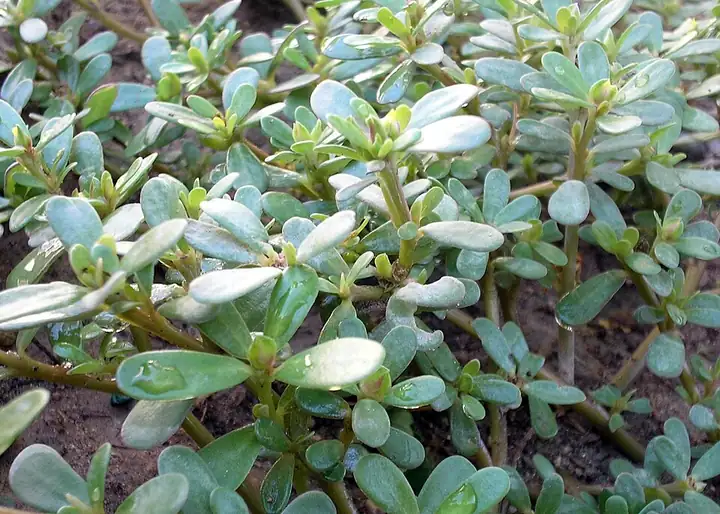
Common purslane
Portulaca oleracea
| Type | Broadleaf |
|---|---|
| Life cycle | Summer annual |
| Family | Purslane family (Portulacaceae) |
| Origin | Native and introduced forms |
| Most common in | Northeast, Southeast, South Central, Midwest, Great Plains, Mountain West, Southwest, California |
About
Purslane is a low, fleshy summer annual that forms mats in hot, sunny beds and cracks. It can flower within weeks of sprouting, and pulled pieces left on moist soil can root again.
Also called purslane, little hogweed, verdolaga, pusley, pigweed
How to identify it
Look for
Smooth, reddish, succulent stems spread flat from a central root. Leaves are thick, shiny, paddle shaped and 1/2 to 2 inches long. Small yellow five-petaled flowers open only on sunny mornings.
Look-alikes
Prostrate and spotted spurge also form flat mats in the same places, but a broken stem bleeds milky white sap and the flowers are whitish pink; purslane has thick, fleshy stems, clear sap and yellow flowers. Spurges are poisonous, so check the sap before eating anything.
Where it grows
Vegetable gardens, flower beds, new lawns, sidewalk cracks and other warm, bare, often sandy soil.
When
Sprouts in late spring once the soil is warm and keeps coming through summer; it can flower 4 to 8 weeks after sprouting and finish two or more generations a year.
How it spreads
Seeds (about 7,000 on a foot-wide plant and over 100,000 on a big one) that can live 30 to 40 years in soil, plus stem pieces that re-root after hoeing.
Most common in
| Northeast | Very common here |
|---|---|
| Southeast | Very common here |
| South Central | Very common here |
| Midwest | Very common here |
| Great Plains | Very common here |
| Mountain West | Very common here |
| Southwest | Very common here |
| Pacific Northwest | Common here |
| California | Very common here |
| Alaska | Not found here |
| Hawaii | Common here |
What to do, gentlest first
Start at the top. Weed killers are a last step; always read and follow the label.
Catch it before it flowers Prevent
Check beds often in summer and remove plants while they are small; it can flower within weeks.
Hoe small plants, then take them away By hand
Hoe or pull seedlings right after watering or rain. Rake up and remove the pieces, or let them dry out completely before you water again.
Pulled plants can keep ripening seed for about a week and stems can re-root, so don't leave them on the bed or put flowering plants in compost.
Mulch or solarize Barrier
Use at least 3 inches of organic mulch or landscape fabric. In a sunny summer, covering moist soil with clear plastic for 4 to 6 weeks can kill plants and seeds.
Let the purslane sawfly help Natural enemies
A purslane sawfly and a white rust disease feed on purslane, but they usually show up too late to stop seeding, so don't rely on them alone.
Corn gluten meal pre-emergent Organic spray
Iowa State lists purslane among the weeds corn gluten meal can stop as they sprout. Spread it before the weed seeds germinate (about 20 pounds per 1,000 square feet) and water it in lightly; it does nothing to plants that are already up.
It also stops seeds you sow, so don't use it where you plan to plant seeds soon. Heavy rain right after spreading weakens it.
Garden-labeled pre-emergent or spot spray Conventional spray
UC IPM lists oryzalin, pendimethalin and trifluralin as pre-emergents in ornamental beds and glyphosate as a spot spray; in lawns, dithiopyr or pendimethalin before it sprouts, or 2,4-D, dicamba or MCPP after.
Read and follow the label. Many lawn weed killers also kill or damage vegetables and flowers, so keep spray and drift off garden plants.
Uses, wildlife and pets
Edible?
Mississippi State and NC State Extension say the leaves, stems and flowers are edible raw or cooked, with a tangy, slightly salty taste; it does hold oxalates, so eat it in moderation. Before eating, break a stem: milky sap means it is a poisonous spurge, not purslane. Only pick from ground that hasn't been sprayed.
Not 100% sure? Don't eat it. Never pick from ground that may have been sprayed, or along roads and railways.
For wildlife
Sparrows and deer mice eat the seeds (NC State).
Pets
Toxic to dogs, cats and horses (ASPCA); it contains soluble calcium oxalates.
Sources
- ipm.ucanr.edu
- ipm.ucanr.edu
- sare.org
- extension.msstate.edu
- plants.ces.ncsu.edu
- crops.extension.iastate.edu
- aspca.org
- plantsservices.sc.egov.usda.gov
- yardandgarden.extension.iastate.edu
Photo: Photo: ZooFari / Wikimedia Commons, CC BY-SA 3.0 (CC BY-SA 3.0). Photo resized for the web.

Planting dates and advice are general guidance; check with your local Cooperative Extension office for your area.