
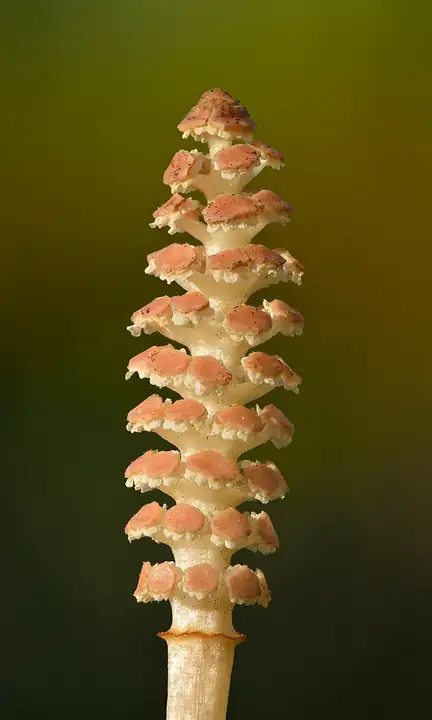
Field horsetail
Equisetum arvense
| Type | Horsetail |
|---|---|
| Life cycle | Perennial |
| Family | Horsetail family (Equisetaceae) |
| Origin | Native to the US |
| Most common in | Pacific Northwest |
About
Field horsetail is an ancient, flowerless native plant that spreads by spores and very deep rhizomes. It is hard to eradicate from wet garden soil and is poisonous to horses and other livestock.
Also called common horsetail, horsetail, western horsetail
How to identify it
Look for
In early spring, pale tan, unbranched fertile stems 4 to 12 inches tall appear, each topped with a cone that sheds spores. Soon after, green sterile stems up to about 2 feet grow, with rings of thin needle-like branches at each joint, making them look like little bottle brushes. Stems are hollow, jointed and gritty with silica, with small dark teeth at each joint.
Look-alikes
Scouring rush (Equisetum hyemale) has taller, stiff green stems with no whorled branches.
Where it grows
Wet, poorly drained or sandy and gravelly soils in gardens, landscapes, ditches, roadsides and pastures; common in the Pacific Northwest.
When
Fertile stems come up in mid-spring and die after shedding spores; green stems follow in late spring and last until frost.
How it spreads
By spores and by creeping rhizomes and small tubers that can run 6 feet deep or more and regrow from fragments.
Most common in
| Northeast | Common here |
|---|---|
| Southeast | Occasional here |
| South Central | Occasional here |
| Midwest | Common here |
| Great Plains | Common here |
| Mountain West | Common here |
| Southwest | Occasional here |
| Pacific Northwest | Very common here |
| California | Common here |
| Alaska | Common here |
| Hawaii | Not found here |
What to do, gentlest first
Start at the top. Weed killers are a last step; always read and follow the label.
Improve drainage Prevent
Fix leaks, cut back on watering and improve drainage; horsetail dislikes well-drained, shady spots, and raising acidic soil pH also discourages it.
Pull tops again and again By hand
Pull or cut off all stems about 2 weeks after each flush comes up and dig out rhizomes and tubers where you can. It can take several years of steady pulling.
Plastic or fabric, not bark Barrier
Use black plastic, landscape fabric or roofing paper covered with soil or mulch; organic mulch alone does not stop it.
Shoots may push up again when the cover comes off.
Fatty-acid (soap) burndown Organic spray
Ammonium salts of fatty acids can burn back top growth, but the waxy stems shed sprays and the rhizomes survive, so repeat often.
Read and follow the label.
Selective or pre-emergent herbicide Conventional spray
Lawn products with 2,4-D, dicamba, MCPP, triclopyr or sulfentrazone give partial control; dichlobenil granules applied in winter or early spring are used in landscape beds.
Read and follow the label; many lawn and brush herbicides also kill garden plants. Never spray near water unless the product is labeled for it.
Uses, wildlife and pets
For wildlife
It gives cover and some food to small mammals.
Pets
Toxic to horses (ASPCA lists field horsetail as toxic to horses); it breaks down vitamin B1 and can cause weakness, staggering and even death in livestock. Not listed by the ASPCA for dogs or cats.
Sources
- plants.ces.ncsu.edu
- weedguide.cfaes.osu.edu
- solvepestproblems.oregonstate.edu
- hortsense.cahnrs.wsu.edu
- pnwhandbooks.org
- plantsservices.sc.egov.usda.gov
- aspca.org
Photo: Photo: Ivar Leidus / Wikimedia Commons, CC BY-SA 4.0 (CC BY-SA 4.0). Photo resized for the web.

Planting dates and advice are general guidance; check with your local Cooperative Extension office for your area.