
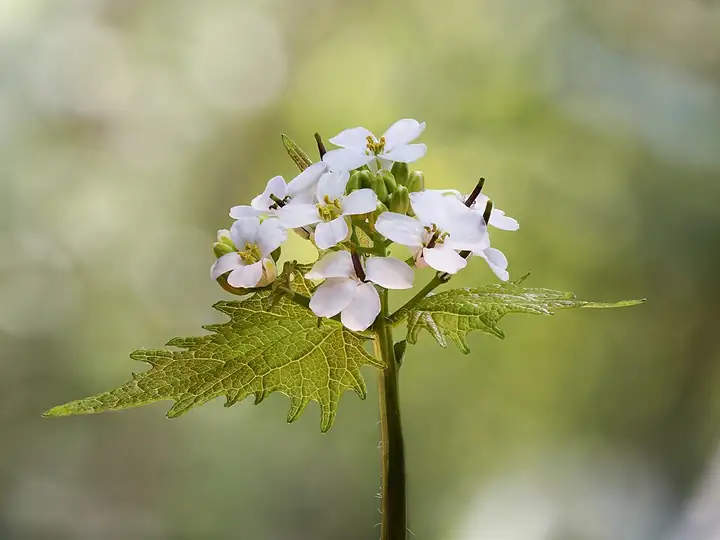
Garlic mustard
Alliaria petiolata
| Type | Broadleaf |
|---|---|
| Life cycle | Biennial |
| Family | Mustard family (Brassicaceae) |
| Origin | Introduced from elsewhere |
| Most common in | Northeast, Midwest |
About
A European biennial that carpets shady woods, hedges and garden edges, crowding out spring wildflowers. It may also harm the soil fungi that native plants rely on, though studies disagree on how much.
How to identify it
Look for
First-year plants are low rosettes of kidney-shaped, scalloped leaves. Second-year plants grow 2 to 4 feet tall with heart- or triangle-shaped, toothed leaves and small white four-petaled flowers in spring. Crushed leaves smell like garlic, and slender seed pods 1 to 3 inches long turn brown and brittle when ripe.
Look-alikes
Rosettes can be mistaken for violets, wild ginger, ground ivy (creeping Charlie) or golden alexanders; crush a leaf and sniff for garlic. Native toothworts also have white four-petaled flowers but divided leaves.
Where it grows
Shady yards, woodland edges, hedges, trails and flower beds, especially rich, moist soil.
When
Seeds sprout in late winter and early spring; second-year plants flower in spring to early summer, set seed and then die.
How it spreads
By seed only: each plant makes hundreds of seeds, which can live about 5 years in the soil and move with soil, water and wind.
Most common in
| Northeast | Very common here |
|---|---|
| Southeast | Common here |
| South Central | Occasional here |
| Midwest | Very common here |
| Great Plains | Occasional here |
| Mountain West | Occasional here |
| Southwest | Not found here |
| Pacific Northwest | Occasional here |
| California | Not found here |
| Alaska | Occasional here |
| Hawaii | Not found here |
Where it is regulated
Minnesota lists it as a restricted noxious weed.
What to do, gentlest first
Start at the top. Weed killers are a last step; always read and follow the label.
Keep seed from moving Prevent
Seeds travel in soil, water and on shoes, so check shady beds and trails each spring and pull new plants the first year you see them.
Pull before seed pods form By hand
Pull second-year plants in early spring while in bud or flower, before seed pods form, or pull rosettes in late fall. Repeat for several years, since seeds last about 5 years in the soil.
Bag or burn pulled plants that have flowers so seeds don't spread. Don't compost them.
Spot-spray rosettes Conventional spray
Spray rosettes in early spring or late fall with glyphosate, or in lawns with triclopyr, 2,4-D, or 2,4-D plus dicamba. A pendimethalin pre-emergent can stop seedlings.
Read and follow the label. Many lawn and brush killers also harm garden plants, so keep spray and drift off anything you want to keep.
Uses, wildlife and pets
Edible?
Foragers eat it (University of Minnesota Extension). Only pick plants you're sure of, since rosettes look like other plants, and never from sprayed areas.
Not 100% sure? Don't eat it. Never pick from ground that may have been sprayed, or along roads and railways.
Pets
Not listed as toxic by the ASPCA
Sources
Photo: Photo: Ermell / Wikimedia Commons, CC BY-SA 4.0 (CC BY-SA 4.0). Photo resized for the web.

Planting dates and advice are general guidance; check with your local Cooperative Extension office for your area.