
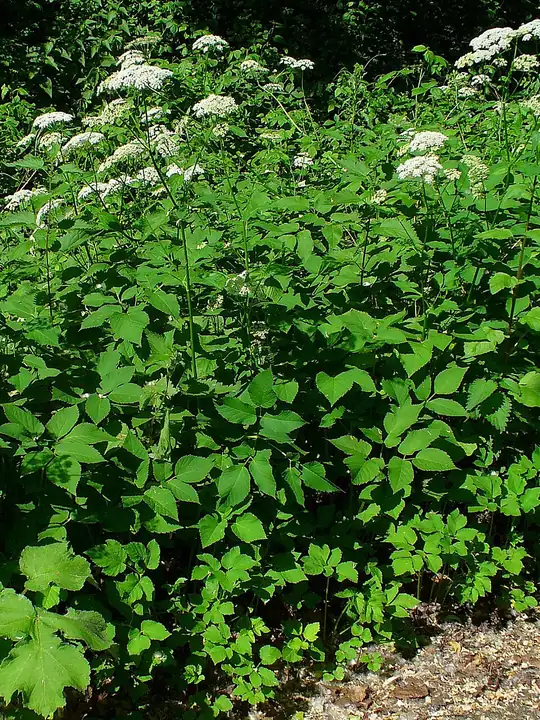
Goutweed
Aegopodium podagraria
| Type | Broadleaf |
|---|---|
| Life cycle | Perennial |
| Family | Carrot family (Apiaceae) |
| Origin | Introduced from elsewhere |
| Most common in | Northeast, Midwest |
About
Goutweed is a shade-tolerant groundcover from Europe and Asia, often planted in its white-edged form, that spreads by rhizomes into thick carpets. It crowds out other plants and tree seedlings and is considered invasive in several northern states.
Also called bishop's goutweed, bishop's weed, ground elder, snow-on-the-mountain, herb Gerard
How to identify it
Look for
Leaves are divided into three groups of three toothed leaflets with a carrot-like smell; the planted form has white-edged leaves. It forms low mats, and flat white flower clusters on stalks up to about 3 feet appear in late spring. White rhizomes spread under the soil.
Look-alikes
Its flat white flower clusters look like other carrot-family plants, including deadly poison hemlock and water hemlock; goutweed is shorter and its leaves are split into three sets of three leaflets rather than fern-like or lacy.
Where it grows
Shady and sunny beds, plantings, forests and forest edges, fields, pastures and other disturbed ground.
When
Leafs out in spring and flowers in May and June.
How it spreads
Mostly by rhizomes that resprout from small fragments; also by seed.
Most common in
| Northeast | Very common here |
|---|---|
| Southeast | Occasional here |
| South Central | Occasional here |
| Midwest | Very common here |
| Great Plains | Occasional here |
| Mountain West | Occasional here |
| Southwest | Not found here |
| Pacific Northwest | Common here |
| California | Occasional here |
| Alaska | Not found here |
| Hawaii | Not found here |
What to do, gentlest first
Start at the top. Weed killers are a last step; always read and follow the label.
Don't plant it Prevent
Choose a non-invasive groundcover instead, and check divisions and soil from other gardens for white rhizomes.
Dig out rhizomes; mow to slow it By hand
Dig or pull plants, removing all rhizomes, and bag the debris. Mowing slows its spread into lawns.
Fragments readily resprout; don't compost them.
Black landscape fabric Barrier
Lay black landscape fabric over the patch in early spring and leave it at least one full growing season.
Systemic spot treatment Conventional spray
A systemic herbicide such as glyphosate can be spot-applied to the leaves.
Read and follow the label; many lawn and brush herbicides also kill garden plants. Keep spray off nearby plants.
Uses, wildlife and pets
Edible?
The young leaves are eaten raw or cooked, best picked before flowering. Be absolutely sure of the ID, since the carrot family includes deadly poison hemlock and water hemlock, and don't pick from sprayed areas.
Not 100% sure? Don't eat it. Never pick from ground that may have been sprayed, or along roads and railways.
For wildlife
Bees, beetles and flies visit the flowers.
Pets
Not listed by the ASPCA.
Sources
- plants.ces.ncsu.edu
- dnr.wisconsin.gov
- poison.org
- extension.psu.edu
- plantsservices.sc.egov.usda.gov
- aspca.org
- aspca.org
- aspca.org
Photo: Photo: H. Zell / Wikimedia Commons, CC BY-SA 3.0 (CC BY-SA 3.0). Photo resized for the web.

Planting dates and advice are general guidance; check with your local Cooperative Extension office for your area.