
Johnsongrass
Sorghum halepense
| Type | Grass |
|---|---|
| Life cycle | Perennial |
| Family | Grass family (Poaceae) |
| Origin | Introduced from elsewhere |
| Most common in | Southeast, South Central, Southwest |
About
A tall, aggressive perennial grass from the Mediterranean, brought in as forage in the early 1800s. Thick rhizomes let it take over gardens and field edges, and stressed leaves can poison grazing animals.
Also called Johnson grass
How to identify it
Look for
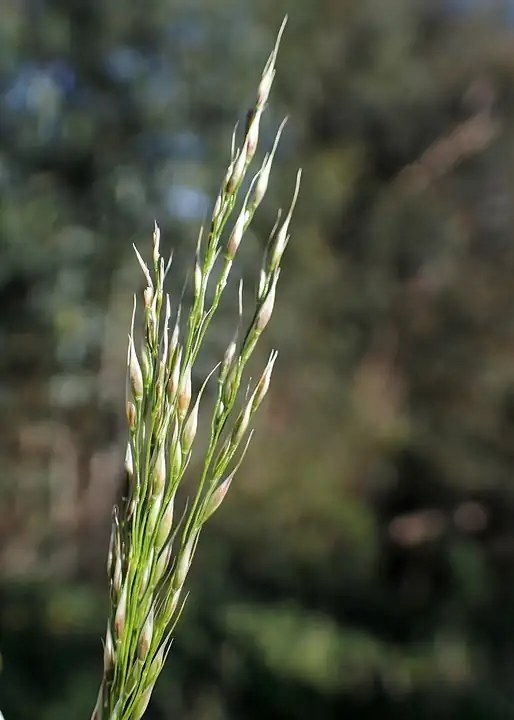
Stands 2 1/2 to 7 feet tall with smooth leaves up to 2 feet long and a bold white midrib. The ligule is a membrane with a hairy fringe. Large, open, purplish seedheads appear in summer, and the rhizomes are thick, fleshy, cream-colored and often spotted with purple.
Look-alikes
Young plants look like corn or sudangrass. Fall panicum is another look-alike; the white midrib and thick rhizomes point to johnsongrass.
Where it grows
Field edges, ditches, roadsides, fence lines, vegetable gardens and neglected lots in full sun.
When
Shoots rise from rhizomes in mid-spring and from seed soon after, flowers from early summer into fall, and ripens seed in September and October.
How it spreads
Spreads by hundreds of seeds per plant and by thick rhizomes whose pieces sprout new plants; equipment moves both.
Most common in
| Northeast | Occasional here |
|---|---|
| Southeast | Very common here |
| South Central | Very common here |
| Midwest | Common here |
| Great Plains | Common here |
| Mountain West | Occasional here |
| Southwest | Very common here |
| Pacific Northwest | Occasional here |
| California | Common here |
| Alaska | Not found here |
| Hawaii | Occasional here |
Where it is regulated
Listed as a noxious weed in about 19 states, including Illinois and North Carolina.
What to do, gentlest first
Start at the top. Weed killers are a last step; always read and follow the label.
Mow before it flowers Prevent
Repeated mowing keeps it from setting seed, but it won't kill the rhizomes. Clean tools and equipment after working in patches.
Dig young plants and rhizomes By hand
Dig young plants with their rhizomes. Repeated digging or hoeing of new shoots drains the food stored in the roots.
Chopped rhizomes regrow, so remove all the pieces you can.
Glyphosate or a grass-selective spray Conventional spray
From June to August, spot-spray glyphosate on plants at least 18 inches tall, up to early flowering. Grass-selective clethodim or sethoxydim can be used around many broadleaf plants.
Read and follow the label. Many lawn herbicides kill garden plants, so keep spray and drift off beds and vegetables.
Uses, wildlife and pets
Pets
Not listed by the ASPCA, which does list its relative Sudan grass as toxic to horses. After frost or drought, johnsongrass can build up prussic acid (cyanide) and nitrates that poison livestock, and Oklahoma State Extension advises never putting horses on it.
Sources
- ipm.ucanr.edu
- plants.ces.ncsu.edu
- extension.psu.edu
- extension.illinois.edu
- extension.okstate.edu
- plantsservices.sc.egov.usda.gov
- aspca.org
- aspca.org
- aspca.org
Photo: Photo: Krzysztof Ziarnek, Kenraiz / Wikimedia Commons, CC BY-SA 4.0 (CC BY-SA 4.0). Photo resized for the web.

Planting dates and advice are general guidance; check with your local Cooperative Extension office for your area.