
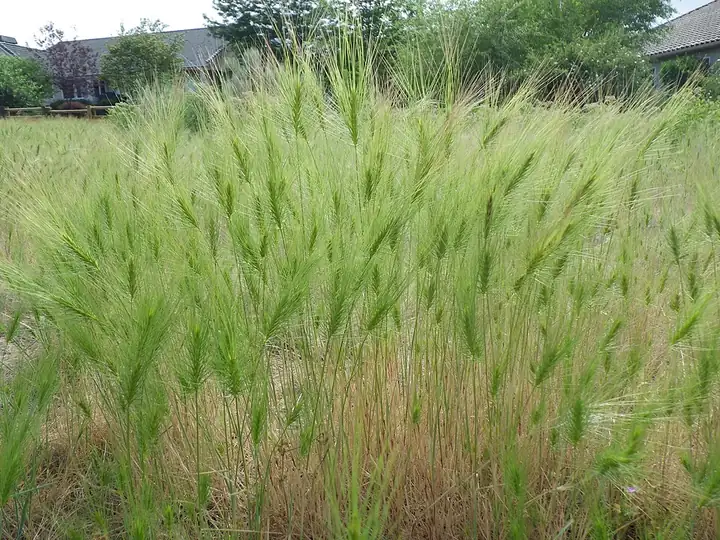
Medusahead
Taeniatherum caput-medusae
| Type | Grass |
|---|---|
| Life cycle | Winter annual |
| Family | Grass family (Poaceae) |
| Origin | Introduced from elsewhere |
| Most common in | Pacific Northwest, California |
About
Medusahead is a Mediterranean annual grass that has taken over millions of acres of western rangeland. Its dead, silica-rich thatch rots slowly and burns readily, feeding more frequent wildfires, and its long barbed awns injure animals.
Also called medusahead wildrye, medusahead rye
How to identify it
Look for
Plants are 6 to 24 inches tall with few, rolled leaves. The bristly seedhead carries very long awns (about 1 to 4 inches) with tiny upward-pointing barbs that splay out like Medusa's snakes. It stays bright green into spring, then dries to brown or straw color, later than cheatgrass.
Look-alikes
Bottlebrush squirreltail and foxtail barley have similar bristly heads. SDSU notes medusahead's awns stay attached to the seed as it falls, while theirs break away.
Where it grows
Rangeland, grasslands, roadsides and disturbed ground, especially on clay-rich soils in areas with wet winters and dry summers.
When
Seeds sprout from fall into spring; plants flower in early summer and seed matures in late June to July, a few weeks after other annual grasses.
How it spreads
By seed carried by animals, wind, water and vehicles; stands can drop up to 6,000 seeds per square foot, and the seeds stay alive about 1 to 3 years.
Most common in
| Northeast | Not found here |
|---|---|
| Southeast | Not found here |
| South Central | Not found here |
| Midwest | Not found here |
| Great Plains | Not found here |
| Mountain West | Common here |
| Southwest | Not found here |
| Pacific Northwest | Very common here |
| California | Very common here |
| Alaska | Not found here |
| Hawaii | Not found here |
Where it is regulated
Listed as noxious in California, Colorado, Nevada, Oregon and Utah (USDA Forest Service), and in Montana and Wyoming (SDSU Extension).
What to do, gentlest first
Start at the top. Weed killers are a last step; always read and follow the label.
Stop the seeds from moving Prevent
Use certified weed-free hay, clean vehicles and equipment after driving through infested land, and keep healthy perennial grass cover, the best barrier against it. Report new patches to your county weed board.
Early grazing and reseeding on larger land Natural enemies
Repeated, early, heavy grazing before it matures can reduce it. Follow any treatment by seeding competitive perennial grasses.
Pre-emergent and burndown on rangeland Conventional spray
SDSU lists indaziflam, imazapic and glyphosate as effective, often after a spring burn by trained crews that removes the thatch.
Read and follow the label. Many lawn weed killers also kill garden plants, so keep spray and drift off beds and vegetables. Prescribed burning is a job for professionals with permits; its dry thatch is a serious fire hazard.
Uses, wildlife and pets
For wildlife
Very low value: livestock avoid it and upland game birds can't digest the seeds (USDA Forest Service).
Pets
Not listed by the ASPCA. Its barbed awns can injure the eyes, noses and mouths of grazing animals. Check dogs and cats after walks: UC Davis vet school says foxtail-type seeds work into ears, eyes, noses, paws and skin. Watch for head shaking, sneezing, pawing, limping or eye swelling, and see a vet if a seed is embedded.
Sources
- fs.usda.gov
- extension.sdstate.edu
- cal-ipc.org
- plantsservices.sc.egov.usda.gov
- healthtopics.vetmed.ucdavis.edu
- aspca.org
Photo: Photo: Matt Lavin / Wikimedia Commons, CC BY-SA 2.0 (CC BY-SA 2.0). Photo resized for the web.

Planting dates and advice are general guidance; check with your local Cooperative Extension office for your area.