
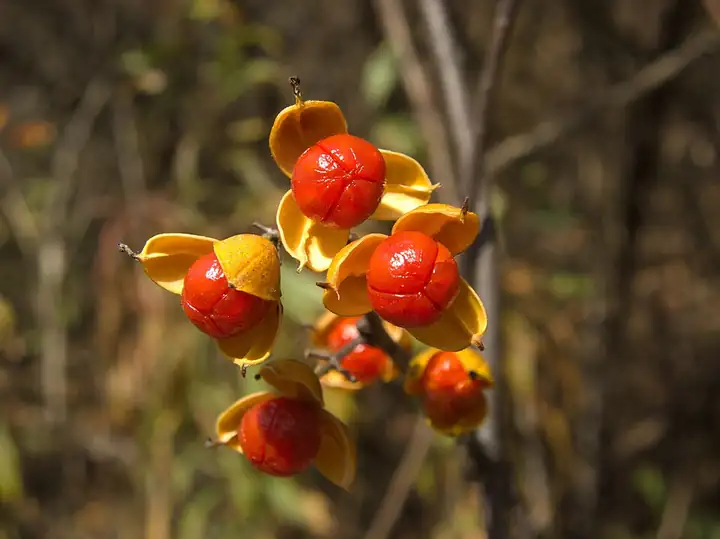
Oriental bittersweet
Celastrus orbiculatus
| Type | Vine |
|---|---|
| Life cycle | Perennial |
| Family | Bittersweet family (Celastraceae) |
| Origin | Introduced from elsewhere |
| Most common in | Northeast |
About
A woody, twining vine from East Asia, often used in fall wreaths for its orange-and-red berries, that climbs high over trees and shrubs. Birds spread the seeds widely, and cut vines resprout hard from the roots.
Also called Asian bittersweet, Asiatic bittersweet, round-leaved bittersweet, round leaf bittersweet, climbing spindleberry
How to identify it
Look for
Leaves are alternate, 2 to 5 inches long with finely toothed edges; lower leaves are nearly round and upper ones more football-shaped, and they turn bright yellow early in fall. Female plants carry small clusters of yellow-orange capsules at nearly every leaf joint along the stem; in fall the capsules split to show bright red seeds.
Look-alikes
Native American bittersweet, Celastrus scandens, has flowers and fruit only in clusters at the tips of the stems, not at each leaf joint, and more football-shaped leaves. The two can cross, so if you're unsure, have it checked before you remove it.
Where it grows
Forest edges, hedgerows, fence lines, roadsides and yard edges, especially moist, disturbed ground.
When
Flowers in May and June; fruit ripens from about July to October and hangs on through winter.
How it spreads
Birds eat the fruit and drop the seeds, and a typical plant bears hundreds of fruits a year; it also sprouts from roots, root pieces and the root crown, especially after cutting.
Most common in
| Northeast | Very common here |
|---|---|
| Southeast | Common here |
| South Central | Occasional here |
| Midwest | Common here |
| Great Plains | Occasional here |
| Mountain West | Not found here |
| Southwest | Not found here |
| Pacific Northwest | Not found here |
| California | Not found here |
| Alaska | Not found here |
| Hawaii | Not found here |
Where it is regulated
Minnesota lists it as a prohibited noxious weed.
What to do, gentlest first
Start at the top. Weed killers are a last step; always read and follow the label.
Don't use the berries in wreaths Prevent
The seeds stay alive even after the branches dry, so decorations can start new infestations. Pull seedlings as soon as you spot them.
Pull young vines and cut big ones at the base By hand
Pull small plants, roots and all. Cut large vines at ground level to save the trees they climb, then keep cutting the resprouts to wear down the roots.
Remove fruit before discarding vines; don't compost berries or roots.
Cut-stump, basal bark or foliar triclopyr or glyphosate Conventional spray
Paint oil-based triclopyr on fresh cuts, spray triclopyr in oil on the lower bark of stems under 6 inches thick, or spray regrowth with triclopyr or glyphosate from July on, at least 8 weeks after cutting.
Read and follow the label. Many lawn and brush killers also harm garden plants, so keep spray and drift off anything you want to keep. Avoid treating big tangles of vines in the root zone of trees you want to keep, since the herbicide can injure them.
Uses, wildlife and pets
For wildlife
Many birds, like robins, thrushes, mockingbirds and starlings, eat the fruit, which is how it spreads.
Pets
Oriental bittersweet itself isn't listed by the ASPCA, but its close relative American bittersweet (Celastrus scandens) is listed as toxic to dogs, cats and horses.
Sources
- extension.psu.edu
- fs.usda.gov
- extension.umn.edu
- plantsservices.sc.egov.usda.gov
- extension.psu.edu
- aspca.org
- aspca.org
Photo: Photo: Cbaile19 / Wikimedia Commons, CC0 (CC0). Photo resized for the web.

Planting dates and advice are general guidance; check with your local Cooperative Extension office for your area.