
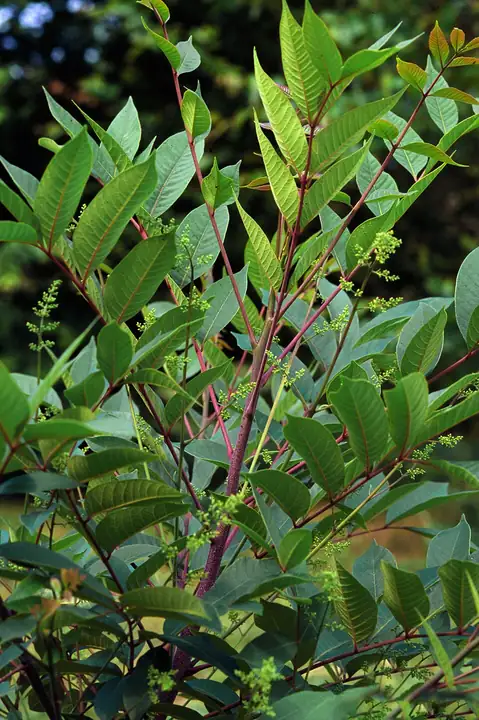
Poison sumac
Toxicodendron vernix
| Type | Shrub or tree |
|---|---|
| Life cycle | Perennial |
| Family | Sumac family (Anacardiaceae) |
| Origin | Native to the US |
About
A native shrub or small tree of eastern swamps and bogs that can cause a severe rash. It breaks the 'leaves of three' rule, so people often don't recognize it.
Also called swamp sumac, thunderwood
How to identify it
Look for
Each leaf has 7 to 13 smooth-edged leaflets set in pairs along a bright red stalk. It grows up to about 20 feet tall with smooth gray-brown bark. Loose, drooping clusters of pale, whitish berries hang on through winter.
Look-alikes
Harmless smooth sumac has 11 to 31 toothed leaflets, and winged sumac has leafy wings along the leaf stalk; poison sumac has 7 to 13 smooth-edged leaflets on a red stalk and drooping whitish fruit. Young ash trees and poison ivy are also confused with it.
Where it grows
Wet, acidic ground: swamps, bogs, marshes and thickets along rivers.
When
Leaves appear in spring, greenish flowers hang in early to mid summer, and the whitish berries ripen in late summer and stay into winter.
How it spreads
Birds eat the berries and carry the seeds.
Most common in
| Northeast | Common here |
|---|---|
| Southeast | Common here |
| South Central | Occasional here |
| Midwest | Common here |
| Great Plains | Not found here |
| Mountain West | Not found here |
| Southwest | Not found here |
| Pacific Northwest | Not found here |
| California | Not found here |
| Alaska | Not found here |
| Hawaii | Not found here |
What to do, gentlest first
Protect yourself first. Weed killers are a last step; always read and follow the label.
Learn it and give it room Prevent
Learn the red-stalked leaf with 7 to 13 leaflets before working in wet ground. Wear gloves, long sleeves, long pants and eye protection.
Wash tools and clothes after contact; the oil lasts on surfaces.
Cut or dig small plants with care By hand
Small plants can be cut or dug out, best in winter when there is less sap.
Bag the pieces for the trash and never burn them. Call a professional for shrubs and small trees.
Spot-treat with glyphosate or triclopyr Conventional spray
Spot-spray or treat freshly cut stumps while the plant is growing; repeat as needed.
Read and follow the label. Many lawn and brush herbicides also kill garden plants, so keep spray and drift off anything you want to keep. In wetlands, use only products labeled for use near water.
Uses, wildlife and pets
For wildlife
Bees visit the flowers, and birds such as grouse, pheasants and bobwhites eat the fruit.
Pets
The ASPCA lists poison sumac as non-toxic to dogs, cats and horses, but pets can carry the oil on their fur to people. Bathe a pet that brushed through it while wearing gloves.
Sources
Photo: Photo: James H. Miller & Ted Bodner, Southern Weed Science Society, Bugwood.org / Wikimedia Commons, CC BY 3.0 (CC BY 3.0). Photo resized for the web.

Planting dates and advice are general guidance; check with your local Cooperative Extension office for your area.