
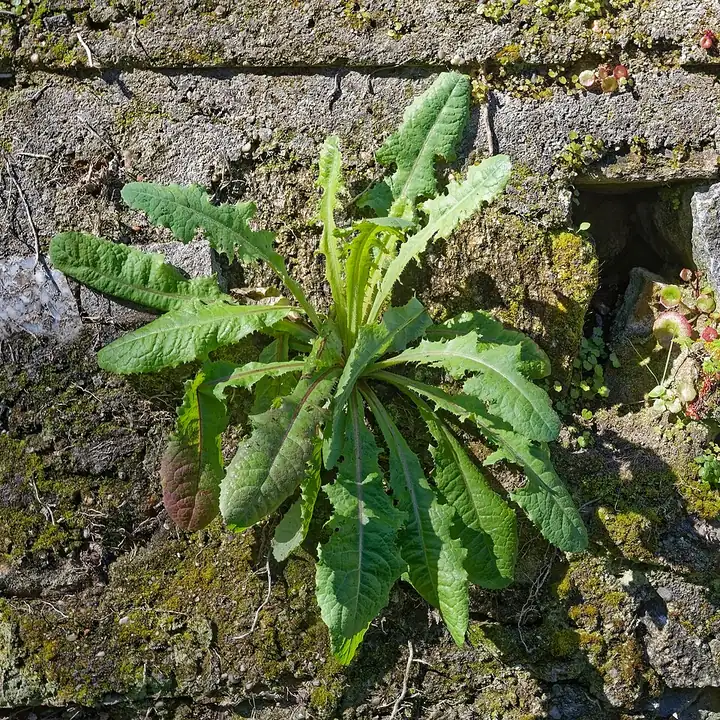
Prickly lettuce
Lactuca serriola
| Type | Broadleaf |
|---|---|
| Life cycle | Winter annual |
| Family | Aster family (Asteraceae) |
| Origin | Introduced from elsewhere |
| Most common in | Midwest, Great Plains, Mountain West, Pacific Northwest, California |
About
Prickly lettuce is a wild relative of garden lettuce from the Mediterranean and western Asia. It grows into a stiff stalk up to 6 feet tall and scatters fluffy, wind-blown seeds across gardens, roadsides and vacant lots.
Also called wild lettuce, compass plant, China lettuce, common wild lettuce, horse thistle
How to identify it
Look for
The key clue is a row of stiff prickles along the underside of the leaf midrib; leaf edges are prickly too, and leaves may be deeply lobed or not. Broken stems and leaves ooze milky sap. Small pale-yellow flower heads open on a branched top and turn into seeds with a tuft of white hairs.
Look-alikes
Sowthistles also have milky sap and prickly leaves, but their leaves wrap around the stem at the base and lack the row of stiff prickles under the midrib; bitter lettuce and willowleaf lettuce are close relatives.
Where it grows
Gardens, orchards, vineyards, landscaped areas, crop fields, roadsides and other urban and disturbed spots.
When
Most plants sprout in fall and overwinter as rosettes, with a few sprouting in spring; they bolt and flower from about July to September.
How it spreads
Wind-blown seed: a few hundred on a small plant and around 55,000 on a 5-foot plant, but few seeds survive more than three years in the soil.
Most common in
| Northeast | Common here |
|---|---|
| Southeast | Common here |
| South Central | Common here |
| Midwest | Very common here |
| Great Plains | Very common here |
| Mountain West | Very common here |
| Southwest | Common here |
| Pacific Northwest | Very common here |
| California | Very common here |
| Alaska | Not found here |
| Hawaii | Occasional here |
What to do, gentlest first
Start at the top. Weed killers are a last step; always read and follow the label.
Get it before it flowers Prevent
Remove rosettes in fall or spring. Seeds can be viable about three weeks after flowering starts, and they blow far on the wind.
Hoe or dig young rosettes By hand
Hoe or dig rosettes while they are small; spring cultivation kills plants that sprouted in fall.
Wear gloves; the leaves are prickly.
Mulch bare soil Barrier
Seeds sprout from the very surface, so a layer of mulch over bare soil keeps most from coming up.
Burn down seedlings with a contact spray Organic spray
Horticultural vinegar (acetic acid), fatty-acid soap, pelargonic acid or clove-oil sprays burn what they touch within hours. They work best on seedlings at the two- to four-leaf stage in warm, sunny weather, and you will need to repeat, because they don't move into roots and bigger plants regrow.
They kill any plant they touch, so shield crops. Strong vinegar can burn skin and eyes; wear goggles and gloves and follow the label.
Treat young rosettes Conventional spray
In lawns, a broadleaf herbicide such as 2,4-D on young rosettes; in beds, a glyphosate spot spray on the weed only.
Read and follow the label. Many lawn weed killers also kill or damage vegetables and flowers, so keep spray and drift off garden plants.
Uses, wildlife and pets
Pets
Not listed by the ASPCA. Cattle that eat a lot of fresh young plants can be harmed (SARE).
Sources
Photo: Photo: Luis Miguel Bugallo Sánchez / Wikimedia Commons, CC BY-SA 4.0 (CC BY-SA 4.0). Photo resized for the web.

Planting dates and advice are general guidance; check with your local Cooperative Extension office for your area.