
Puncturevine
Tribulus terrestris
| Type | Broadleaf |
|---|---|
| Life cycle | Summer annual |
| Family | Caltrop family (Zygophyllaceae) |
| Origin | Introduced from elsewhere |
| Most common in | South Central, Mountain West, Southwest, California |
About
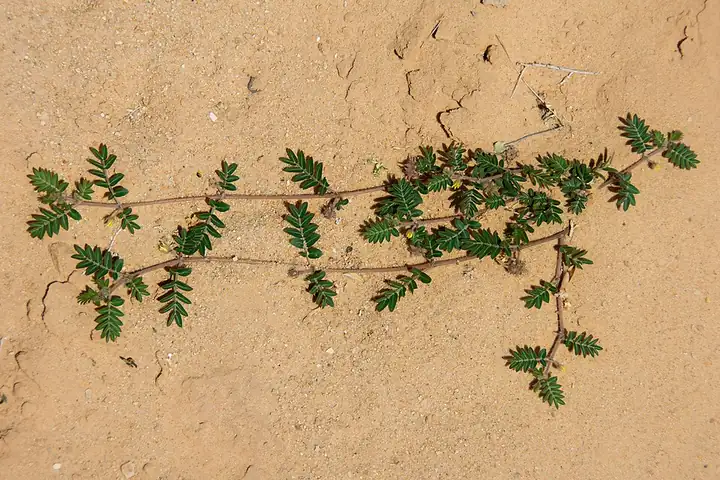
A flat, mat-forming summer annual with small yellow flowers and woody, spiny burs known as goatheads. The burs puncture bike tires and shoes and injure pets' paws and bare feet, and the plant can poison sheep and other livestock.
Also called goathead, goat's head, caltrop, tackweed, devil's thorn
How to identify it
Look for
Hairy stems trail flat from a deep central taproot, forming mats 2-5 feet across. Leaves are opposite and split into 4-8 pairs of small oval leaflets. Yellow five-petal flowers about 1/2 inch wide are followed by a hard bur that breaks into five wedge-shaped pieces, each with two stout spines.
Where it grows
Hot, dry, compacted or sandy spots such as roadsides, rail lines, sidewalk cracks, driveways, parks, yards and field edges.
When
Sprouts from spring through summer when soil is warm and moist; it can bloom within 3 weeks and keeps making burs until frost kills it.
How it spreads
By seed in burs that stick to tires, shoes and animals; a plant makes about 200-5,000 seeds, which can stay alive in the soil up to five years.
Most common in
| Northeast | Occasional here |
|---|---|
| Southeast | Occasional here |
| South Central | Very common here |
| Midwest | Common here |
| Great Plains | Common here |
| Mountain West | Very common here |
| Southwest | Very common here |
| Pacific Northwest | Common here |
| California | Very common here |
| Alaska | Not found here |
| Hawaii | Occasional here |
Where it is regulated
Washington and Oregon list puncturevine as a Class B noxious weed, and it is a noxious weed seed under seed laws in states including Arizona and Idaho (prohibited) and Colorado and Iowa (restricted).
What to do, gentlest first
Start at the top. Weed killers are a last step; always read and follow the label.
Keep ground covered with healthy plants Prevent
Puncturevine takes over bare, compacted ground. Healthy lawns and plantings leave it little room.
Pull or hoe before it flowers By hand
Pull or hoe plants before they bloom and keep checking from late spring through summer. It doesn't root from its stems, so pulling out the taproot removes the whole plant; on small spring plants, shallow hoeing (1 inch or less) works.
Wear gloves and shoes. Bag any burs; digging can bring buried seeds up.
Mulch at least 3 inches deep Barrier
Organic mulch at least 3 inches thick, or a synthetic mulch, blocks the light seedlings need.
Puncturevine weevils Natural enemies
A seed weevil (Microlarinus lareynii) and a stem weevil (M. lypriformis) were released in the US in 1961 and work best together. They are established in Oregon, but they don't give effective control in Washington; ask your county agricultural commissioner or weed board.
Pre-emergent in late winter, or treat young plants Conventional spray
Oryzalin, benefin or trifluralin applied before seeds sprout (late winter to mid-spring) prevent seedlings. 2,4-D, dicamba or glyphosate work on young plants before burs form. UC IPM notes chemicals usually aren't needed in home landscapes.
Read and follow the label. Many lawn weed killers also kill vegetables and flowers, and glyphosate harms any plant it touches.
Uses, wildlife and pets
Pets
Not listed by the ASPCA. The spiny burs lodge in paws and fur, and the leaves are toxic to livestock, especially sheep, which can develop sun-sensitive skin sores.
Sources
- ipm.ucanr.edu
- ipm.ucanr.edu
- nwcb.wa.gov
- oregon.gov
- hortsense.cahnrs.wsu.edu
- plants.ces.ncsu.edu
- plantsservices.sc.egov.usda.gov
- aspca.org
- ams.usda.gov
Photo: Photo: Bill.pix / Wikimedia Commons, CC BY-SA 4.0 (CC BY-SA 4.0). Photo resized for the web.

Planting dates and advice are general guidance; check with your local Cooperative Extension office for your area.