
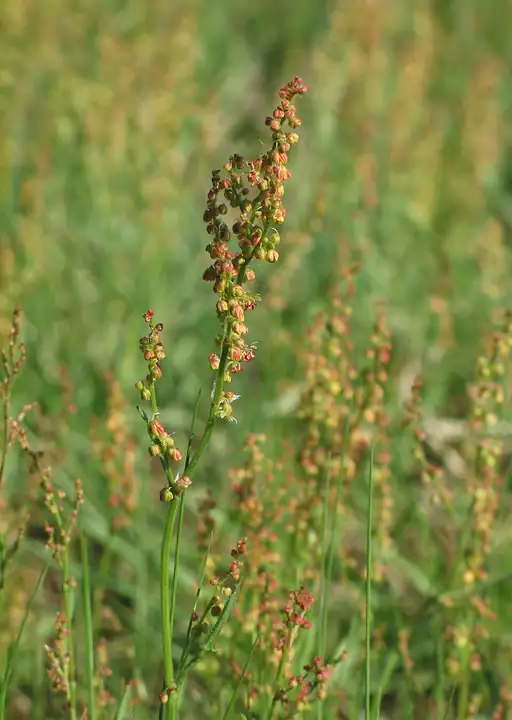
Red sorrel
Rumex acetosella
| Type | Broadleaf |
|---|---|
| Life cycle | Perennial |
| Family | Buckwheat family (Polygonaceae) |
| Origin | Introduced from elsewhere |
| Most common in | Northeast, Southeast, Pacific Northwest |
About
Red sorrel is a low perennial with sour, arrowhead-shaped leaves that spreads by shallow creeping roots. It thrives in sandy, acidic, low-fertility soil, so it is a sign your lawn or bed needs lime and feeding.
Also called sheep sorrel, field sorrel, sour weed
How to identify it
Look for
Leaves are 1 to 3 inches long and shaped like an arrowhead, with two lobes flaring out at the base, and they taste sour. Slender, often reddish stems reach about 18 inches with tiny flowers on spikes: reddish on female plants and yellow-green on male plants. A papery sheath wraps the stem where each leaf joins it.
Look-alikes
Curly and broadleaf docks are much larger, with long leaves and no flared lobes.
Where it grows
Thin lawns, pastures, gardens, nursery beds, roadsides and poor, sandy or acidic soils.
When
Grows from early spring, flowering from about March into fall.
How it spreads
Mostly by creeping roots and rhizomes in the top 8 inches of soil; a plant can also make up to 1,600 seeds a year that may last decades.
Most common in
| Northeast | Very common here |
|---|---|
| Southeast | Very common here |
| South Central | Common here |
| Midwest | Common here |
| Great Plains | Occasional here |
| Mountain West | Occasional here |
| Southwest | Occasional here |
| Pacific Northwest | Very common here |
| California | Common here |
| Alaska | Occasional here |
| Hawaii | Occasional here |
What to do, gentlest first
Start at the top. Weed killers are a last step; always read and follow the label.
Lime and feed the soil Prevent
Test your soil; if the pH is below 6, add lime to raise it toward 6.5 to 7, and fertilize so grass or garden plants can outcompete it.
Pull or fork out early By hand
Pull or fork out plants while the patch is small, ideally when the soil is moist, getting as much of the running root as you can. Repeat as it resprouts.
Root pieces left behind regrow.
Broadleaf lawn herbicide Conventional spray
In lawns, a liquid broadleaf herbicide with 2,4-D, mecoprop (MCPP), dicamba or triclopyr can be spot-applied.
Read and follow the label; many lawn and brush herbicides also kill garden plants. Don't spray dicamba over the roots of trees and shrubs.
Uses, wildlife and pets
Edible?
Foragers use the tart, lemony leaves in salads and cooked dishes. The leaves contain oxalates, so eat only small amounts, be sure of the ID, and never pick from sprayed lawns or roadsides.
Not 100% sure? Don't eat it. Never pick from ground that may have been sprayed, or along roads and railways.
For wildlife
It is a host plant for American copper butterfly caterpillars.
Pets
Toxic to dogs, cats and horses (ASPCA lists dock and sorrel, Rumex, as toxic); livestock can be poisoned if they eat a lot of it.
Sources
- ipm.ucanr.edu
- extension.psu.edu
- extension.umd.edu
- turffiles.ncsu.edu
- plantsservices.sc.egov.usda.gov
- aspca.org
- aspca.org
- aspca.org
Photo: Photo: Robert Flogaus-Faust / Wikimedia Commons, CC BY 4.0 (CC BY 4.0). Photo resized for the web.

Planting dates and advice are general guidance; check with your local Cooperative Extension office for your area.